Last updated on
The Northern Lights and I have been in love for more than 8 years now. We’re getting to know each other quite well, and I go to see them several times a year. Not just to take photos, but because to see this spectacle is to endlessly marvel at it with the eyes of a child.
You can’t get enough of it, because every light is different, every place is different, every night is different, and it’s not that easy to find yourself in the best conditions. So you have to earn it, and that makes it all the more satisfying 🙂
I mainly go to the north of Norway, to Tromso, Senja, the Vesteralen and Lofoten, and a couple of times to the Alta region. I also went to see them in Iceland, but it was much more difficult because of the weather.
Because organizing a trip to see the Northern Lights requires a bit of organization and, above all, raises a lot of questions (the best places, what time of year…), I’ve put together here all the questions I’ve asked myself over the past few years, which I still ask myself before going back, as well as the most frequently asked questions I’ve seen on forums or social media. There may be some missing, in which case, don’t hesitate to send me a quick message, I’ll get back to you and add the missing elements here.
I’ve also listed all the articles related to the Northern Lights, they’re displayed under the questions/answers 🙂 But be warned, I’m going to say this pretty much all the time, but the Northern Lights are a natural phenomenon, and therefore pretty damn unpredictable. There will never be a guarantee of seeing them, even if the probabilities (based on my little experience) are high. That’s the beauty of it. I know they may not be there, so I’m not disappointed if I don’t see them. On the other hand, I’ll always be as excited as a flea when I see them. Even for 5 minutes.
So arm yourself with your utmost patience, because if they come, they could come at any time

5 questions to ask if you want to see the northern lights
To help you plan your trip (because there really are a lot of questions to ask when you don’t know), there are these 5 questions to ask yourself. Obviously, there will be lots of sub-sections, I’ve really packed in a lot of information. But first the “when””, and then you can choose the “where”. That’s the most important thing
- Which season to go to see the northern lights
- Autumn or winter: snow or not, cold or not too cold, hikes or dog sledding
- Where to go: which country and which region
- Mountainous landscapes or lakes and forests, choose between Norway, Iceland and Finnish Lapland.
- How to see the Northern Lights onceyou’re there
- Studying the weather to know where to go when renting a car
- How to choose the right agency to see the aurora
- Finding the right spot with an unobstructed view, away from the lights
- How to dress
- Cover up well in winter, as the cold can be terrible
- Pay attention to footwear
- How to photograph them
- What equipment do I need?
- What are the settings
- Photographing with a camera

When can you see the Northern Lights?
Basically, as soon as it’s almost dark. Activity is probably highest in winter, but in northern Europe (Tromso, Iceland…), the Northern Lights are visible from late August to early April. After that, there’s no real night, so the eye can no longer see the aurora. But they’re there all year round! In some parts of Canada, high enough to see them but low enough not to have the midnight sun, they are seen timidly in August (in the north of Scotland too, for example).
So all in all, north of Norway, Sweden, Finland and Iceland we have 7 full months to see the aurora, which is pretty good!

The northern lights month per month
Here’s my opinion, month by month, for a well-located destination (i.e. Finnish Lapland, Sweden, Tromso, Iceland…). There’s no month with more auroras than another, it’s all a question of weather and what you want to do on the side:
- September: I love this month, the days are long enough, there’s the equinox effect, and the weather is normally good.
- October: also a very good month, it cools down a bit, there may be a little snow, but it’s still pleasant. More rain
- November: the days are short, the weather becomes more difficult, but as long as you’re mobile, there are possibilities.
- December: very short days, little light. Snow, cold, lots of people for the festive season.
- January: still very cold, a little more light, pretty colors, less difficult weather than “normal” November/December.
- February: a popular month, the weather is improving, it’s cold with lots of snow, true winter.
- March: I love it. Beautiful colors, a little less cold, still plenty of snow, rather long days, and the equinox effect in mid-March.
- April: mid-April there’s no real night, so it’s very difficult to see the aurora. Not impossible, but definitely not easy.
To make it more understandable, i’ve created this small infographic about places in Norway, it gives you information about best times
- in the following blog post, I give you much more information about when is the best time to enjoy the northern lights

See the aurora borealis in France and at low latitudes
As you’ve seen, with the sun becoming increasingly active (we’re close to solar maximum), the northern lights are now visible from time to time in France.
- When to see the aurora borealis in France and Europe: all year round! But it all depends on the sun. I was able to see the northern lights in France in November, during the famous storm of May 2024. There’s more to come.
- You need a real solar storm to be visible in France.
- To find out if a solar storm is coming, you have several options:
- follow me on Instagram or Facebook, I say when it’s stirring and you’re likely to see some
- check out sites like Spaceweatherlive and follow them on Twitter (I know, it’s not its real name anymore, but I’m nostalgic)
- use an aurora borealis app. But be careful! there are some things to take and not to take:
- for France, you have to trust the KP. It’s not a very reliable value, but it indicates that a big storm is forecast, so there’s a chance. You need a very negative BZ, like -20/-30, and a high BT.
- watch webcams, they’re super useful
- activate alerts and geolocation, it’s handy to know when there’s trouble and possibilities at your latitude.
Roughly speaking, I’d say that until mid-to-late 2026, there will be 2/3 opportunities per year. After that, we’ll be approaching solar minimum for 5 years, so it should be close to impossible.

When is the best time to see the Northern Lights?
As I mentioned above, the Northern Lights are potentially visible as soon as it gets dark. So the best time will depend first on you, then on the weather. Do you want to see the Northern Lights in the magic of winter, with its snow and activities (dog sledding, snowshoeing…) or in autumn, with lots of hiking and greenery?
- For winter, I recommend February and March. November and (especially) December are difficult in terms of weather and light. January is mostly light, but it gets better at the end of the month.
- For autumn, I recommend September (especially) to mid-October. There’s usually no snow yet, and the days are still long. There’s enough to go around and not get too cold.
- Late October to late November is also not bad. But the days are short
- Here’s an article describing ALL the advantages of seeing the Northern Lights in autumn!
!! WARNING: There is NO wrong period!There are periods with better weather, longer or shorter days, but this remains conditional because the weather is very changeable!!!So even if you hesitate to go in December January, it’s better than not going at all and by being mobile you’ll get there 🙂

How long will it take to see the Northern Lights?
I always advise against going for 3 days or less. Because of the weather. Only once did I not see the aurora for more than 3 nights. It was 5 nights one winter when the weather was bloody rotten. I managed to get a small window, an aurora all the same. But you have to be mobile to optimize your chances of seeing them, or go through an agency. It’s rare not to get a single opportunity in 4 days or more, so in my opinion, if you leave for more than 3 days, you’ll increase your chances a hell of a lot.
Ideally, I recommend a week to really take advantage of them. If you can’t, 5 days is great because you don’t have to spend your time in transport, and that leaves time for a few activities, a bit of good weather and a few slots for the auroras. Just to show that you can’t get bored, I did an article on a week’s itinerary in Tromso. But it’s the same in all places where there are Northern Lights, there’s so much to see, it would be a shame not to take advantage of it!
What time can you see the Northern Lights?
As soon as it gets dark, and sometimes even a little before. I take photos a little after sunset, but it’s rare. In general during solar storms we can see the northern lights before it gets totally dark
Before 7pm, it happens, I try to be in place at that time but I would say that at 7h30pm you have to be ready, on the spot and on your toes for the aurora borealis observation. That’s why the agencies pick up their clients at 6pm. I have very rarely the aurora started after 1am. But it did happen. On the other hand, I’ve seen them go on until 2 a.m., even until sunrise, having started much earlier. After that, it obviously depends on the season. If it’s dark at 10pm like it is at the end of September, there’s no point in being ready at 8pm. If it’s dark at 2pm, like in December, you still have time. I’ve had them at 6pm, 4pm, 11pm… a few times it’s lasted until dawn, or more commonly until 2am. There really are no rules. It helps, doesn’t it? 😀
If nothing has happened before midnight, then don’t wait too long. To get some visibility, take a photo in the distance with high exposure time and iso, to see if there’s a bit of green on the horizon. If there’s nothing to be seen in the late evening, then unfortunately it’s going to be complicated.
So if I were to give you a time slot for observation, reserve your 7pm-midnight and be ready! and above all… patience. Because, as mentioned, it could happen at any time
How long does it last?
Very easy! It’s impossible to answer 😀 It can last 15 minutes or 7 hours. Both have already arrived. I’ve already waited until 11.45pm and a little show lasted 15 minutes. Just as I’ve already had auroras at 5pm and that lasted until 1am (and a little longer it seems, but I couldn’t take the cold any more, I went home).
I’ve had beautiful things at 3 a.m. too, but in general, we’ll have 2/3 sets of auroras, spaced at half-hour intervals. And it’s totally random, that’s the beauty of it.
That’s why you MUST be patient.
Small update: on one evening last September, it started at around 9pm and continued until first light, at around 4am. Exhausting but fantastic

Where to see the Northern Lights and where is the best place?
The northern lights bypass the magnetic field to enter the atmosphere where it is weakest, around the poles. This is because auroras can be found both to the north and to the south. In fact, this is a misnomer. To the north, they’re called aurora borealis, and to the south, aurora australis.
To the south (i.e. aurora australis), it’s more complicated, as the land to the south descends less “south”. So you can see them, in the distance, from the southern part of New Zealand, Tekapo, Queenstow, Invercarghill. Also in South America, in Ushuaia and the Falkland Islands.
So what interests us most is the northern hemisphere. Auroras bypassing the magnetic field to the north enter what’s known as the auroral oval, i.e. a zone between 65° and 75° north. So the zone between these two latitudes is the perfect place to observe the aurora. And we’re going to find the following places:
- Tromso ( 69°, just perfect) and all the far north of Norway. My favorite place because of a correct weather and superb landscapes. We can escape the clouds by driving.
- Lofoten Islands: it’s getting more and more complicated because of the weather. The climate is increasingly oceanic, cloudy and there are fewer clear skies than before. I wouldn’t go for the Lofoten Islands with a view to seeing the Northern Lights, but rather as a bonus.
- Vesteralen islands: much the same, they say it’s the worst weather in the country. But it’s easier to get out of the Vesteralen than the Lofoten and find milder weather by driving for a few hours. However, it’s not easy!
- Senja: ah well, that’s much better! Easier than Lofoten, even though it’s just as beautiful, full of micro-climates and not very crowded. I’d recommend it!
- Northern Lapland
- Finnish Lapland to Ivalo, Inari, Kilpisjarvi (up to Rovaniemi max)
- Swedish Lapland to Kiruna, Abisko
- Norwegian Lapland: the whole northern part of the country, from Tromso to Kirkenes, via Alta (the best weather, the driest and therefore best for dawns, is said to be in Alta).
- Iceland: but Icelandic weather is a real treat.
- Murmansk and surrounding area, Russia
- In Canada, the two aurora capitals are Yellowknife and Whitehorse. Inuvik, much further north, is very well located. Churchill has a very good reputation.
- Fairbanks, Alaska
In this area, you have the best chance of seeing the aurora, however faint, as this is where it “comes in”. Further south, they’ll have to be stronger, and you’ll have to have good visibility to the north.
So, all this is to say which is the best place. It depends on a lot of parameters, but also on individual tastes: latitude (but that’s taken care of), weather, facilities. I really like Tromso and the surrounding area because:
- it’s very easy to get to and not too expensive (well, relatively speaking, especially compared to Canadian and Icelandic destinations)
- the landscapes are magnificent and varied
- it’s not “too” cold compared with central Canada or Lapland
- the weather is fairly mild
In Iceland, a little further south, the weather is much more changeable. In Canada, it’s very, very cold.
Lapland is flatter, less varied, but still magnificent. The huge advantage of Lapland for aurora viewing is that, because it’s flatter, it’s easier to observe. In fact, you have a very clear view, which is a luxury in Norway. And in Lapland, the weather is drier. A drier sky means a sky with fewer clouds, so that’s great!
Iceland has, I think, the greatest variety of landscapes, no light pollution and the possibility of seeing far into the distance.
Generally speaking, you shouldn’t think that being above the Arctic Circle guarantees the Northern Lights. Rovaniemi, right on the Arctic Circle, is less active than Tromso, some 500km further north. You have to look at the northern oval. Iceland, further south than Rovaniemi, is normally better situated. But with this weather… 😀
You’ll find in the following article a huge review about the best places to see the northern lights
I’ve also put together a detailed face-off of the two aurora capitals if you can’t decide: Tromsø or Rovaniemi for the northern lights.

See the Northern Lights in Norway
As I mentioned above, northern Norway is a great place for the aurora. North of Bodo, to maximize your chances of seeing them.
- Tromso: the perfect place in my opinion. Super photogenic landscapes, very easy to find places with unobstructed views and no light pollution. Plenty of agencies to see the aurora, and it’s a pretty little town. Great for all seasons, from autumn colors to winter snow and activities!
- Senja: a magnificent island (where I’m writing from!), few tourists, superb scenery, lots of great photogenic spots and virtually no light pollution.
- Lofoten Islands: Norway’s most beautiful landscapes, but funky weather. Which doesn’t make for an easy experience! Also a fair amount of light pollution. But it’s worth a try! It’s not as easy as elsewhere


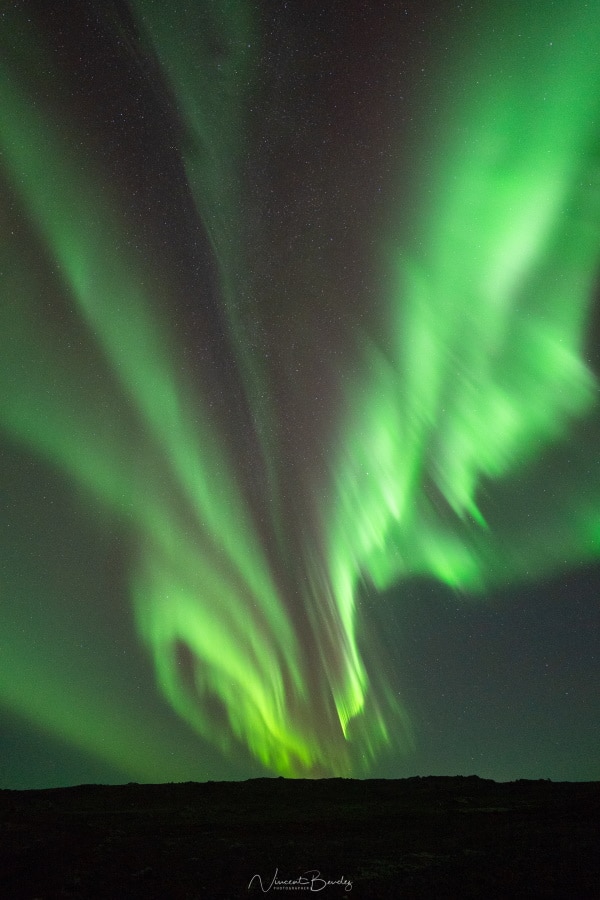
See the Northern Lights in Iceland
Paradoxically, Iceland is both one of the best places to see the aurora and also one of the worst. Let me explain:
- it’s one of the best places because there’s almost no light pollution. It’s a sparsely populated island, very much concentrated on Reykjavik, so apart from a few villages and 2-3 small towns, it’s all dark. What’s more, with these vast landscapes, you very often have clear views, which are ideal for aurora observation. Finally, with magnificent landscapes and waterfalls, you have plenty of superb settings to enhance your photos and see the aurora in beautiful conditions.
- However, it’s also one of the worst places to be because of the weather. The weather in Iceland is probably the worst you can find. To have a cloudless day is quite rare. To have a night without clouds or with holes in the clouds is even rarer. The weather changes all the time, and very quickly. And conditions are worse than in Norway, for example. Stronger, more icy winds, more clouds, total unpredictability. Especially as the weather doesn’t vary to within 10km like in Norway, but rather to within 100km, it can be necessary to drive a long way to escape the clouds (I had to cross half the country to witness a solar storm).
So going to Iceland specifically to see the aurora isn’t the best idea I think. Some photographers offer special aurora workshops in Iceland, but I find that rather presumptuous. On the other hand, when conditions allow, it’s great.
So my advice would be to take the aurora as a bonus, but go first for the unique landscapes. Here are some resources for Iceland (only in French for the moment, sorry!):

See the Northern Lights in Finnish Lapland
Finnish Lapland is the northern part of Finland (as the name suggests). And frankly, it’s an excellent place to see the Northern Lights. As it’s huge, I recommend being above the Arctic Circle, so at least as far as Rovaniemi. But Levi, Ivalo, Yllasjärvi are better located as more in the north.
The weather in Finnish Lapland is often better than in Norway. It’s common to spend evenings on the Finnish side of the border when you’re in Tromso, as the mountain range acts as a barrier to clouds. For example, we often go to Kilpisjärvi (3h drive from Tromso) when it’s overcast in Tromso, thanks to the rather special climate, cold and dry (in winter).
Except that, precisely, a colder, drier climate means it’s freezing! It’s not uncommon to have -30 and even colder. Finnish Lapland is mostly lakes and forests. And lakes. And forests. On and on and on. It’s beautiful, especially in autumn, but it’s not the most varied of landscapes. On the other hand, since these are landscapes that aren’t in Norway, it’s convenient, it gives you variety. But if you’re looking for wahoo scenery, fjords, beautiful mountains, you’re likely to be disappointed.
So I’d say that Finnish Lapland ticks pretty much all the boxes for Northern Lights viewing. Its lack of landscape variety (especially in winter, with its frozen lakes) is compensated for by its unobstructed views and numerous activities!


How do I find a place to watch the Northern Lights?
Some basic tips for finding a good place to watch the Northern Lights:
- the most important: avoid clouds. We’ll talk about this below.
- stay away from light pollution. This is characterized by: city lights, village lights and road lights. Otherwise, firstly, you won’t be able to see them properly, and secondly, the light will ruin your photos. It’s not just a few dozen meters away, but several dozen km from towns and villages. Depending on humidity levels, light pollution can be visible from very far away.
- have an unobstructed view to the north-west and ideally to the east. Classic auroras arrive from the north and most often north-west (the arcs). The clearer your view, the better. Who cares about the south? Orientation is very, very important. When the sun blows, it blows from east to west, so it’s a good idea to have an unobstructed view of the sides. And in the event of a solar storm or strong activity, the aurora arrives from the south.
- Avoid power poles, busy roads and all the other junk that could be in your photo. Don’t hesitate to stand by the side of the road and walk a little to get away from them (just watch out for hidden “not-that-frozen” lakes!).
- Find a nice setting: a view of the sea (watch out for the wind!), a well-oriented fjord, on a hill above a forest in Lapland… you’ll know as you walk along, you’ll say to yourself “ah! here it is!”
- You can take inspiration on Google Maps, check remote places, far from civilisation, it gives a lot of ideas!
As I’m getting to know northern Norway, I’ve put together a few guides to the best spots to see the northern lights in Tromso, Senja and the Lofoten Islands.

Can you see the Northern Lights in town?
Absolutely! But it won’t be the same to see them in the middle of the city, because of the light pollution. So we’ll always have a sort of luminous veil that will prevent us from seeing the aurora properly.
If you stay in the city center, you’ll have trouble seeing the small auroras. You’ll be able to see the big ones, but try not to get your nose in the streetlights 🙂

Northern lights and weather
How to study the weather to avoid clouds
In practical terms, to see the Northern Lights, there’s one ESSENTIAL condition: clear skies. Clouds are every aurora enthusiast’s nightmare, so the most important thing when you want to see the Northern Lights is:
where can you find clear sky?
⭐️That’s why you absolutely must look at the weather, the cloud coverage⭐️
But the weather changes very often in the Nordic countries. So looking several days in advance gives a small indication, but it’s not enough. You need to look in the morning and especially in the late afternoon.
- First of all, check the weather on cloud cover sites like Ventusky or Windy (you can find out more in this article on aurora apps).
- Watch the evolution of cloud cover throughout the evening, as it can be different at 7pm and at 11pm.
- This gives you a big clue as to where to go, as you’ll often have to drive for an hour or more (e.g. 3 hours from Tromso to Finland, but it’s worth it!).
- The wind is a factor to be taken into account, as it moves the clouds around, and can cause holes in the cloud cover.
- Finally, an overcast sky can still hold some pleasant surprises.
In the image below, you can see the cloud cover changing radically at a particular location. That’s why you need to study it, because a few kilometers away, it changes completely (and in a few minutes too)

Is it cold when you watch the Northern Lights?
Of course, seeing the Northern Lights in winter can be scary. The question everyone asks me is what to wear. And understandably so, because it can be cold. But the cold won’t be your worst enemy. You’ll have two: the wind and immobility. You’re going to dress well (see below), but you have to remember that while you’re watching and waiting for the Northern Lights, you’re not going to move.
So, during the day, the -15° (or less) is fine because you’re active, but at night, when you’re not moving, it’s complicated. Especially when your feet are in the snow. So stay active, take small steps, wiggle your toes all the time.
As for the wind, it’s clearly what makes the climate so complicated. You get used to the cold. But the wind is harder. In Lapland and inland generally, it’s even worse. Along the coast, in Norway (Tromso, Senja, Lofoten) it’s relatively temperate with the end of the gulf stream (emphasis on the “relatively” 😀 ).
But as soon as you head inland to the south, you can easily lose 10 degrees. The cold takes even more of a toll on the body.
But you’ll be well equipped, won’t you?
If you’re chilly,autumn is a really good time to see the Northern Lights. Because between mid-September and mid-October, there’s no snow yet, and the weather will be nice and warm. Frankly, it’s a good time.

If the weather is ugly, does that mean I can’t see the Northern Lights?
Well… you can! but under certain conditions.
Most importantly, my #1 tip: find a star. Ideally the Big Dipper, but we won’t be picky if the weather’s bad.
Be mobile : If it’s bad in one place, it doesn’t mean it’s bad everywhere. It changes within a few kilometers, so don’t hesitate to move around a bit!
Two examples. First, in Senja, it was very bad in the Mefjordvaer fjord. I took the tunnel to Ersfjord and there it was clear and no snow. Why? because the low clouds were stuck in the fjord and blocked by the mountains. The second example, in Tromso. I’d gambled on going to Kvaloya, but the weather was rotten. On the Yr.no app (top for weather) I see that it’s clear 30 km to the south. And indeed, I went to a fjord further south and had a fantastic sky full of stars. Okay, not a single aurora that evening, but very clear skies. So moving is important if you don’t feel it. But it’s going to depend on the wind, as we’ll see below.
Thanks to the wind, If the sky is overcast but the wind is blowing, that means you can have clear skies, because the wind will move the clouds.
So it’s far from being lost. Look up to see if the clouds are moving, and check out the Yr.no application, which gives you wind direction and a forecast of where the wind is coming from (so you can anticipate).
Very high clouds: If the clouds are low, it’s hard to see through them. If the clouds are high, on the other hand, it means they’re thinner and you can see something – the two are not incompatible, as you can see in the photo below. Inevitably it’s less clear, but it’s still a lot more fun than when the sky is playing hide-and-seek with the clouds

Can you see the northern lights when there’s a moon?
Absolutely! Okay, the moon acts like a streetlight in the sky, which is clearly not very practical. But the cool thing is that the Moon’s direction is more east/south/west, so it’s never really due north in the aurora. On the other hand, it can be in the aurora when it’s due east or due west.
Without the Moon, you have a sky full of stars, the possibility of seeing the Milky Way, and the aurora in full force. With the Moon, on the other hand, its light is reflected in the snow, so the ground is very bright, and so are the photos. So whether I prefer one or the other, I honestly can’t say. Both have their advantages. But for a first-timer, I’d advise going during the new moon, i.e. when it’s not there yet.

Photographing the Northern Lights
How to photograph the northern lights?
Well, I’ve given you a very complete article here, (still in French), but below you’ll find the most important points.
First of all, the difficulty with the aurora is to be able to photograph something bright in the dark, and which moves. So you’re going to have to juggle the various factors that influence the amount of light to bring in (exposure time, ISO, aperture). But since we’re not going to touch the aperture, which we’ll leave as large as possible, it’s a matter of juggling between ISO and exposure time.
Important: it’s better to have an under-exposed photo (with less light) than an over-exposed one (with too much light). It’s easier to make up for it later. If the photo is “burnt out”, i.e. the auroras are too bright, it’s difficult to take again. You need to be stabilized and have a tripod, as these are long exposures (several seconds) and if you do it by hand, it’s bound to move. Unless you’re a great Buddhist master.
- The exposure time defines the “shape” the aurora will take. But obviously, the longer the exposure time, the more light comes in. So you need to be able to open the shutter long enough for it to take on a nice shape (but not too much) and let in enough light. An aurora moves, but slowly (in general). So you can do a long exposure of 6/8 seconds if it’s a slow arc that you can see coming in the distance. When the aurora is moving a lot, you’re looking at 2 seconds or less.
- Aperture: in the case of auroras, this is roughly the amount of light your lens will let in. A wide aperture of 1.4 to 2.8 is very good for auroras. The larger the aperture (1.4 is larger than 2.8), the better, and the clearer the light will be captured. So open as wide as you can. An aperture of 4 isn’t wow. Less light coming in means you have to crank up the ISO, and as we’ll see, that’s not great.
- ISO: used to amplify incoming light. The higher the ISO, the more light is amplified. In low-light situations, you “turn up the ISO” to get more light, otherwise you won’t see anything. The problem with ISO is “noise”. It’s that grain you see, that makes the picture look crappy. The higher the ISO, the more noise you’ll get. ISO quality depends very much on your camera and lens. This means that you can’t go too high in ISO, otherwise you’ll get too much grain. For auroras, ISO 3200 is fine if it’s not too high.
- Manual focus: ultra-important, to avoid blurred photos. You tell your camera “where to look”, more or less far away. It will then focus where you tell it to, i.e. at infinity (because auroras are so far away). But you have to adjust it yourself by looking at a star. So, you need to focus on infinity on your lens, but be careful! on the lens, infinity is indicated and it’s not good. It will be a little earlier, but you have to find it manually. So, you find a star, you focus on it and, very very important, you do a test, you take a photo, you look at the result if it’s sharp or blurred. Then do it again to see if you can get it any better.
A setting that can be used as a basis for an arched aurora that doesn’t move but that we can see moving towards us:
- exposure time of 8 seconds
- largest possible aperture, ideally between 1.4 (the best) and 2.8
- ISO 3200
You can then increase the exposure time if the aurora is stable, which lowers the ISO to get less grain (noise). If the aurora is moving, this means it’s emitting more light. But it’s moving. So we’ll have to lower the exposure time. And don’t forget the wide-angle lens! Because the northern lights take up a lot of space in the sky
What equipment, camera and lenses for the Northern Lights?
I talk about it quite a bit in this article, which describes precisely my equipment and why I chose the Sony A7SIII, but it’s important to know that any camera can take aurora photos. The quality may vary, but as long as you can make manual adjustments, you’ll come up with something. For me, the few essential points when choosing photographic equipment for the aurora borealis are :
- good low-light management (to avoid a lot of noise)
- a range of lenses combining wide angles (16mm, 20mm) and large apertures (between 1.4 and 2.8).
Then, of course, there are the classic points:
- a relatively sturdy and handy tripod to withstand the wind
- several batteries, remembering to charge them before setting out on the hunt
- several memory cards, because under the aurora we tend to click a lot
- a remote control to keep your hands warm
But in the article I quoted, I explain my choices much more precisely, with examples for each lens. I’m pro-Sony because it suits my needs superbly, but there’s no such thing as miracle equipment, there’s a camera to suit every need, every person.

Is it possible to photograph the Northern Lights with a cell phone?
Well… yes! But the good thing about cell phone cameras is that they have a wide aperture, usually 2. So it’s cool for low light. And that’s where they’re making great progress, on night shots. If the Northern Lights are bright, then you can take them by hand, provided you have a very recent phone. And honestly, the results are quite good!
Iphone, since the 12, is very good in low light. Results with 15 pro max is crazy, whereas what I have with my Pixel 9 pro is… well, no.
Now there is, almost every time, a night mode that allows you to take pictures during a few seconds without tripod.
You can obviously take more conventional photos with a tripod and a long exposure mode, that works very well. You need :
- a tripod for your phone(something like this, very good and inexpensive), essential for long exposures, which you can’t do by hand
- access to the camera’s settings to modify exposure time, ISO, ideally shoot in RAW, play with white balance and select the widest possible aperture. This is essential, because auto mode can’t do much in the middle of the night.
There are applications for taking photos of the northern lights with your phone. In general, they offer easy access to settings and predefined parameters. It’s not crazy, but clearly, it’s better than nothing
Gear up to see the Northern Lights
What should I take to see the Northern Lights?
We’ve already talked about clothes and camera equipment, but there are other items that I think are essential or very practical:
- the most important or almost: a flashlight, ideally a headlamp which is much more practical. A phone battery is all very well, but it runs out very quickly in the cold and is much less practical.
- a thermos flask with coffee, tea, herbal tea, chocolate – in short, anything that will keep you warm. Try to keep it light but warm for a long time, and 1L is fine.
- a book, music, something to keep you busy until the sun comes up 🙂
- hand warmers – there are also foot warmers!
- something to eat and drink. The wait can be long, and it helps to keep up your strength in this cold.
- have more than a quarter full of fuel in the car. I try never to carry less than half a tank in case of an emergency.
- an extra layer of clothing
- your patience and your childlike eyes 🙂

How to dress to see the Northern Lights?
As I said just above, it’s going to be cold but that’s not the most important thing. The most important thing is the wind, then the stillness. When you’re watching or waiting for the Northern Lights, you’re outside in the snow (or if there’s no snow, it’s never very warm, given the region). So you’ll need to equip yourself, especially for the extremities.
After all, it’s not your body that’s going to be cold, but your feet, hands and head (nose and ears). As for my body, I work like an onion. I have lots of little layers. Thermal merino tee shirts, dedicated to cross-country skiing. They’re formidable, and they pile up easily. Then a chunky sweater, either wool or alpaca (I stocked up in Peru, a real killer!).
For coats, I recommend big goose-feather coats. Yes, it’s not necessarily the best for geese, but it’s damn efficient, a hell of a lot better than synthetics. And with a hood, super important. For the legs, there’s the classic ski pant, but I recommend adding a pair of thermal tights dedicated to cross-country skiing, it’s very effective. With that and a pair of jeans, I’m fine down there until -15. But my wife says i’m not normal.
If you’re a bit chilly, ski pants will be fine. Feet: for me, this is the most important part, because your feet are going to be constantly in the snow, but without moving. And that’s very hard.
Top of the line, socks with a very high % of wool. I’d bought some with us at Décathlon, but they weren’t crazy, I’d wear two pairs, and sometimes that wasn’t enough. I bought some locally, at the supermarket in Tromso, 80% wool (it costs almost nothing), a real killer.
In terms of footwear, if you already have what it takes to go skiing, that’s fine, but if not, you need cold-weather boots that can withstand the cold for several days. Gloves are complicated. Well, it’s not complicated to find gloves that keep you warm, especially since you’ve got pockets too, and that you can use with your camera. What I like are mittens, i.e. very warm gloves with fingertips that can be removed to handle the camera without having to take off the glove. I also highly recommend using hand warmers (and why not foot warmers!).
For the head, a cap is classic, but especially one that protects the ears, because it’s going to be difficult for them 🙂 A chapka is perfect!
And something to cover the nose and cheeks. A wool scarf, a winter sports nose warmer. It’s super practical in windy conditions, really.


Is it necessary to rent a car?
Well, not really, but it does make life a lot easier. So I’m going to give 3 good reasons for renting a car:
- the price. Renting a car for a week costs less than a Northern Lights evening with an agency. Car rental costs an average of €40 per day, while an Aurora tour costs €150 per person.
- Get away from the city lights. Unless you’ve got a cabin deep in the boreal forest, you’ll be staying somewhere with lights all around. And to really enjoy it, you’ll need to get away from those lights. So the car is a great way to get away from it all.
- find your own spot. The pleasure of the Northern Lights lies not only in observing them, but also in finding the best spots. Driving along back roads and thinking “ah! tonight it’s here!”, and then being able to enjoy it afterwards, that’s really great 🙂
So, if you have a driver’s license, don’t hesitate to rent a car. As for me, as for plane tickets, I compare a lot. Like with Rental Cars, or Discover Cars. I do compare comparators 😀
Is driving on snow easy?
Let’s be honest, it’s… super simple 🙂 Because when you go up there to rent a car, they’re not going to give you the 20-year-old Lada. Even if you book an “economy” car, you’ll end up with a super car with all the options. And, most importantly, the tires are top-notch. They hold up very well to the road, whether on snow, ice or even uphill. At first, you’ll skate a bit, but you’ll have to respect 2-3 common-sense rules to avoid any scares 🙂
- respect safety distances, and even more. All right, there’s usually not many people on the road, but braking on snow is much longer, so if the person in front of you brakes, you need to have some margin without having to ram.
- avoid sudden movements. Abrupt braking, sudden acceleration or turning too quickly can send you into a skid and cause fright.
- respect speed limits. There are a lot of radars, and speeds are not high, but it’s really for the good of the drivers. And yes, this is not a legend, it does cost a lot! 1200€ for 20km/h above speed limit.
- be very, very careful when it’s very windy, because the wind brings snow to the roadside. And this little snow is much more dangerous than the “real” snow that falls, because it’s not uniform on the road, and it throws the car off balance. Really, if you see snow on only one side, anticipate it and drive gently into it.
CAR RENTAL IN NORWAY
Discover the Norwegian roads with Discover Cars

- Rent a car from many airports or in the city
- Small model, SUV or electric for adventure
- Prices from 25€
Which apps to use for aurora borealis and weather?
- You can take a look at the following articleto see in detail the best apps and data sites for the northern lights
There are a whole host of aurora borealis apps out there. They’re all based on the same data, they’re all going to come up with the same thing. What will change is the design and readability. I also use other applications, and even more often, for weather and wind.
- for aurora activities: Northern Eye Pro, Aurora Alerts or especially My Aurora Forecast. Provides KP, short- and medium-term forecasts and a map.
- for aurora alerts: My Aurora Forecast sends an alert when the aurora is potentially at its strongest. Handy when you don’t want to spend your time outside. And handy for building excitement, like “ah! it’s coming!”. But even if there’s no alert, there may be aurora! It sounds when the activity is supposed to be higher.
- for the weather: Yr.no. but especially Ventusky. The app is good, the site is very good, especially for its hour-by-hour, village-by-village forecasts. Ultra practical. Windy is also very good!


How reliable are aurora forecasting apps?
The aurora borealis is the result of solar winds whose particles enter the atmosphere bypassing the magnetic field, which is weaker at the poles. That’s why they arrive so far north and south. The stronger these winds, the “logically” stronger the auroras. That’s logic. The stronger the winds, the more the magnetic field will be disturbed (in layman’s terms, sorry for the purists 😀 ). The level of disturbance is defined by the KP-index. The higher the KP, the more the magnetic field is disturbed, so logically, the more powerful the auroras will be
So… to answer the original question, yes, the apps are all reliable, because they are based on data. It’s the auroras that are not. Because data are only… data. And northern lights are a natural phenomenon that can’t never be 100% predicted.
A high KP doesn’t mean the sky is going to be all green and it’s going to go every which way. Just as a KP=0 doesn’t mean you’re not going to see anything. KP is an estimate, but not for northern lights. There are lots of other factors that will influence whether or not auroras appear. It’s nature, it will always be a surprise. Check BZ indicator, much more relevant. Negative BZ and you should have something great.
Important : At Tromso or equivalent latitude, ALWAYS assume that there will be auroras. Whatever the KP.
Quite honestly, the number of nights I’ve had no aurora when the sky was clear… very few. But you have to be patient. In particular, I remember when the KP was announced at 4, which was a bit of a party because it had been really quiet for several days. Well positioned in a fjord, I waited. Beautiful sky, lots of stars, but nothing. Just goes to show that KP is an indicator, but never an exact science. In the same way, I’ve had some very nice evenings at KP=0.
Look especially at the BZ index, the more negative the better!
Are the northern lights really green?
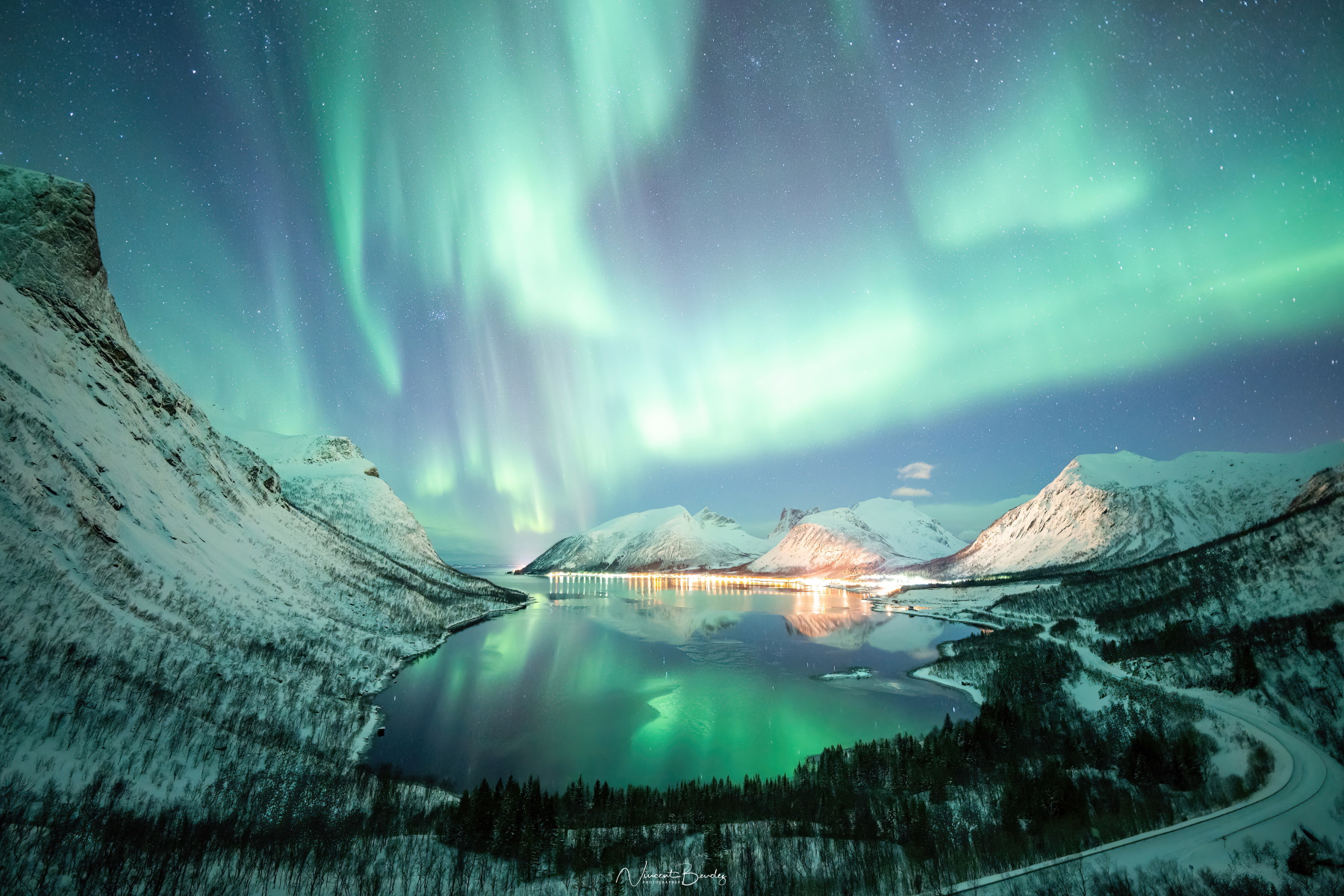
First and foremost, what you see in photos is not, or only slightly, what you see in the sky, especially in terms of color. The shapes do, and they’re even more beautiful in real life than in photos, but the color will be amplified by the photo. This is due to the high exposure time, so the light will hit the camera’s “retina” longer than our eye. Basically, auroras are pale. It’s green (in general), but pale. The brighter and faster it is, the more visible the color.
Weak auroras are not very visible to the naked eye. You see a pale veil in the distance. Medium and strong auroras, on the other hand, are clearly visible, and not only green. You can see the “bottom” of the aurora in white, you can see some orange, some pink when it’s dancing. In small doses, of course, and not all the time. When it fizzes out in all directions, it’s very visible, and here’s a video showing what you can see with the naked eye when it’s very active.
Here, unlike the photos, this is what you can see.
How do I organize my trip under the Northern Lights?
Quite honestly, organizing a trip under the Northern Lights, whatever the country, isn’t the most complicated thing. The most important thing is to get started early. The essential steps to follow are :
- When to go: autumn or winter? snow or no snow?
- How long do you want to stay?
- Which country and destination: Norway (Tromso, Senja, Lofoten…), Sweden, Finnish Lapland, Iceland… there are many possible destinations! It depends on what kind of landscapes/weather/activities you want
- Book the plane, compare dates, make changes, be flexible to benefit from good prices. Always compare. I use Booking and Momondo.
- Find accommodation: look between Booking and Airbnb
- Car rental: compare brokers (like Discover Cars and Rental Cars) and direct companies (Avis, Hertz…).
Once you’ve got that, you can look at the different activities. There’s a little less pressure.
In general, I look at activities on Viator (Tripadvisor group) and Getyourguide. Take a good look at the ratings and reviews and compare. But in terms of activities in these countries, you’re going to find dog sledding, reindeer watching, whale-watching or landscape boating, photo outings… you’re spoilt for choice! You can see an example here for Tromso.

What is the budget to see the Northern Lights?
Well… the Northern Lights themselves are free, but getting there and staying there is expensive. For example, a budget for two people for 5 days in Tromso would be:
- 600€ airfare (300€ per person)
- 600 hotel (decent double room at 120€, can be x3 during very touristic season)
- 250 car (+ gas)
So a total of 1400€, or 700€ per person. But it’s largely possible to cut back by going Airbnb and being smart and flexible on flights, especially out of peak tourist season. My last flight was 200€ and there can be Airbnb at 60€ a night during low season, outside city center.
You have to be resourceful and that brings the bill down to €450 a head. I’m not counting food because it’s really up to each person. If you go to the supermarket, you can easily get food for very little, even if it’s more expensive than back home.
Restaurants range from €20 to €60 per head (€80 for the very good ones)
Are the Northern Lights too touristy?
Seeing the Northern Lights is one of the most popular activities at the moment. I can see the difference from 5 years ago, when I was just starting out.
However, the places where you can see them most easily are the very natural places where accommodation is limited. So even in Tromso at rush hour, it’ll never look like Galeries Lafayette before Christmas. What’s more, it’s very easy to find quiet spots for the early hours.
It’s only when it comes to booking accommodation that you need to get a head start, as in Norway, Iceland and Lapland, this is (fortunately) limited. If you want to see people, you’ll see them; if you don’t want to see people, you won’t see them.
So yes, it can be touristy, but that’s never a problem, because whether in the city or in the wilderness, you can easily find yourself on your own. And this is especially true in Lapland!
Well, little update: this is touristy, you still can have space for yourself, but there are two main problems :
- now, if you want to book activities and aurora tour, you NEED to book it in advance! months. Really.
- and there is more and more peuple, but not more accommodation. So there is a small issue 😀 You also need to book your accommodation in advance
Do I need an agency to see the Northern Lights?
It depends! The first time, I went through an agency, not really knowing how to do it. I didn’t think it was that simple. But it gives you confidence, the guides are nice, give explanations, animate. And if you don’t have a car, it’s better than looking from the city center. So I’d say it’s a good way to gain confidence, for the first time, if you don’t know what to do (even with all the guides and advice I’ve given you 😀 )
In Tromso, there are some that I particularly recommend (because I know how serious they are and how hard they work):
But if you’d like to find out more, in the following article I explain the advantages and disadvantages of using an agency to see the Northern lights. I also list the best agencies.