Last updated on
This is probably the question I get asked the most: when is the best time to see the northern lights? hehe, it’s not that simple. Well, actually it is, in itself it’s super simple, but there are loads of factors to take into account. Otherwise it wouldn’t be any fun.
Quick answer: there is no “best time” to see the northern lights.
But there are moments when it’s easier — you have to watch out for the night, the weather, the location… anyway, if you want to know more, follow the guide!
When can you see the northern lights?
Know that there are northern lights all year round!
There, that’s out of the way. Simply put, in the northern regions, you can see them as soon as there’s night, that is to say from late August until mid-April. Otherwise, there’s too much light and it’s impossible to see them.
Exceptionally, still in the Far North, you can catch them in mid-August and late April.
So we’re busting a myth here: the northern lights are not only visible in winter, contrary to what many people think — nope! Winter is the most touristy season, but not the only one.
So, it’s the night that makes it all happen! Of course. For example, in summer, in the northern hemisphere, while it’s impossible to see them in northern Europe, you can see them in Canada.
To sum up:
- there are northern lights all the time
- you need night to see the northern lights
- so in northern Europe, they’re visible from late August to mid-April, except during a solar storm


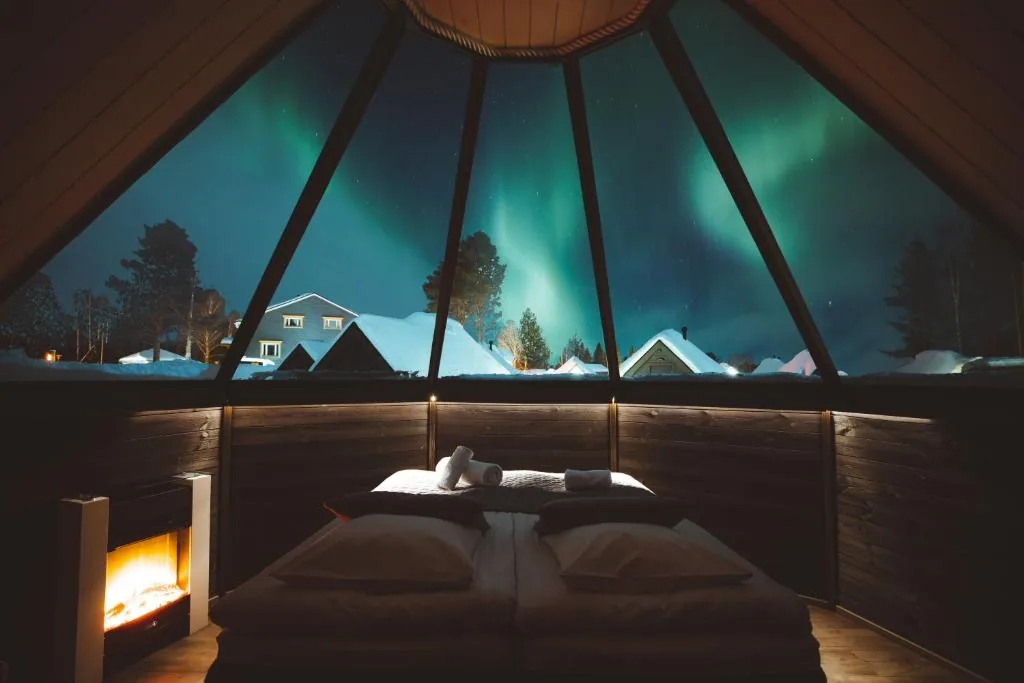
But why can you sometimes see the northern lights in summer?
Indeed, it happens, but not in the Nordic countries! To see the northern lights in summer you need:
- to be in a zone far enough north, but not too far, so that you still get night in summer
- and for that zone to be relatively close to the auroral oval
- There you have Canada, Scotland, and Denmark in particular
- or else to wait for a solar storm that will push the northern lights much further south, making them visible as far as France, like we had in May 2024
So it’s rarer, but it’s doable. You can see that we’ve mostly spotted them in recent years thanks to the solar maximum. That’s something that should decrease over the coming years.


Seeing the northern lights in the southern hemisphere
In this article I’m talking about the auroras accessible to 99.9% of my readers, namely the auroras in the Scandinavian countries.
But in the southern hemisphere, it’s absolutely possible to see the auroras, mainly in New Zealand, on the South Island (which is incredible, by the way). And on the same principle, it has to be winter down there, so summer here. So roughly the months from May to September.
Note that the auroras have to be stronger, because New Zealand is “less far south”, less close to the auroral oval, than northern Europe. But it’s absolutely possible and it’s really pretty — you can recognise them, they’re a little different 🙂 Unfortunately I haven’t had the chance to see them, for now!
What is the best month to see the northern lights?
As I told you in the introduction, there is no best time to see the northern lights. But why?
Because the auroras depend SOLELY on the sun’s good will! On its activity. And there’s no rule for that — it’s a star, not a power plant you switch on on demand. So when the sun doesn’t feel like it, the auroras are weak.
As we’ve just seen: there are auroras all the time! And all you need is a dark enough night to enjoy them.
However, even though the activity depends on the sun, you need good conditions to see them. The first condition is the weather. So when people say some months are more favourable than others, I’d say it all depends on the weather. December is generally cloudier so it’s less easy — you’ll need to be more patient or drive more kilometres to escape the clouds.
So, the “best month”, I’d say it’s going to depend on:
- the general weather conditions
- and on what you want to do besides the auroras
- do you want to go hiking
- do you want snow to do dog sledding and get that winter magic
The auroras, if you give yourself the means (a guide, a car, being mobile and knowing the weather), you will see them whatever the time of year (as long as it’s dark, of course)
From the Arctic Circle, in Europe (Norway, Sweden, Finland, Iceland), it goes something like this:
- August: the auroras are visible from the end of the month, the nights are very short and not completely dark — doable but not ideal
- September: the nights are getting longer, the weather is generally decent, no snow — it’s a good time for the auroras and the landscapes. Plus accommodation is cheap!
- October: it’s not really going to snow yet, rainy weather, some wind, but it’s still good for the auroras and the weather
- November: the days are very short, the weather is a bit trickier, you often have to move around quite a bit to see the auroras. There’s usually snow
- December: the shortest days, even non-existent with the beautiful polar night. Snow and the activities that come with it. Good for the auroras if you’re mobile
- January: the gradual return of daylight, plenty of snow and activities, a good month to see the auroras, especially as it’s the coldest month, so the driest sky, so fewer clouds!
- February: the most popular month, but somewhat iffy weather. Snow, cold, and auroras
- March: maybe my favourite month! snowy but stable weather, and beautiful auroras
- April: the days are long and the night disappears. You can see the auroras until roughly mid-April, there’s still snow
Below I’ve put two very interesting infographics (well, I hope) that let you know the good periods and also the other activities, to figure out when you might go depending on what you want to do.


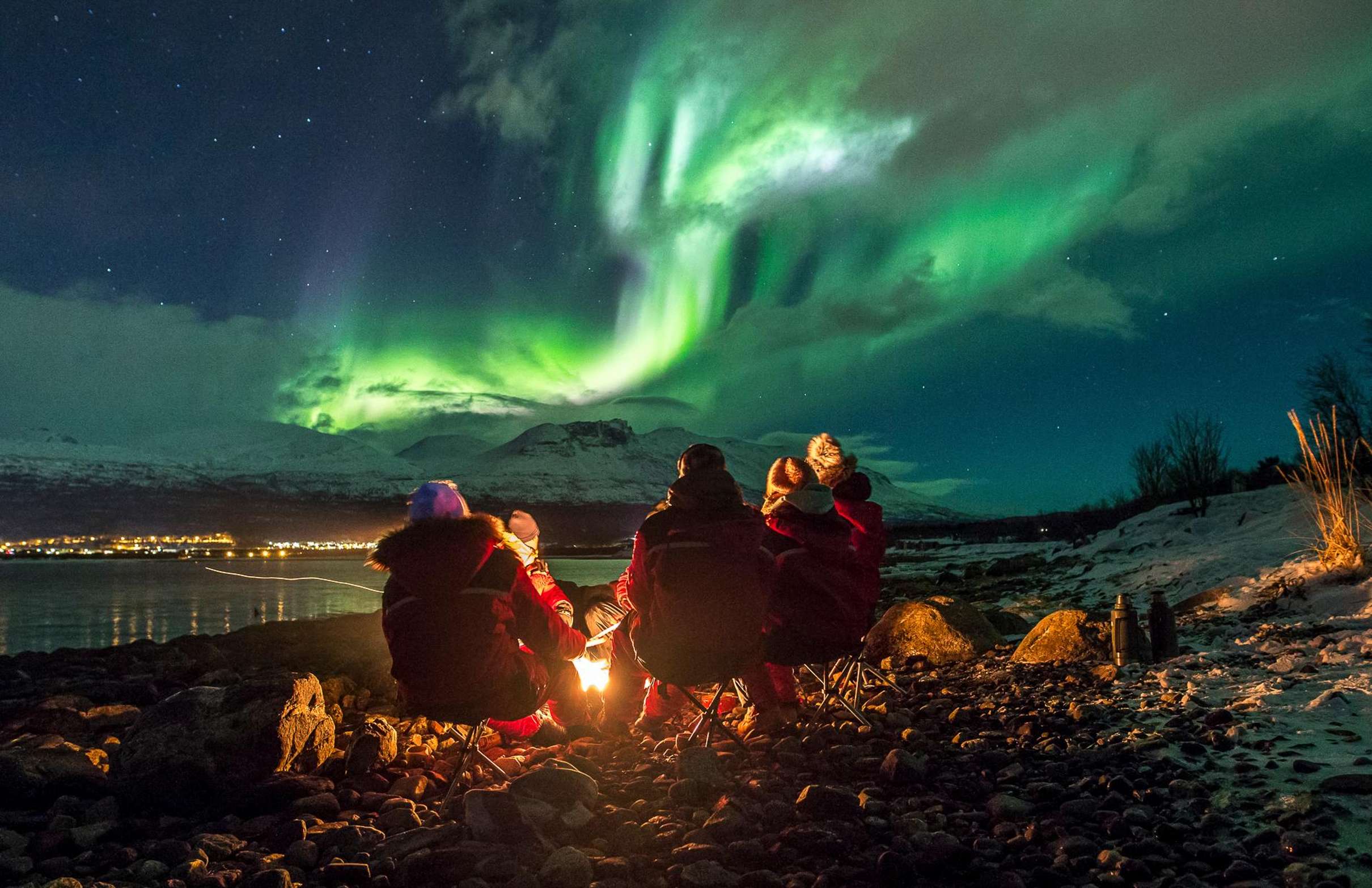
📍 Tromsø · Northern Horizon (6-7 h)
Small-group hunt (15 max) with a documented 98% success rate, multilingual guides including French.
- Small group of 15 max, guides FR/EN/ES/DE/IT
- Documented success rate of 98%
- Reindeer sausages + hot drinks by the fire
Free cancellation
From €93 / person

📍 Tromsø · Wandering Owl (5-8 h)
One of the most experienced teams in Tromsø: small-group hunt, campfire, meal and souvenir photos.
- 2,400+ reviews, very experienced team
- Thermal suits + boots provided
- Souvenir photos sent by email
Free cancellation
From €213 / person

📍 Tromsø · Creative Vacations (7-9 h)
Ultra-personalised hunt in a group of 7 max with Kevin, one of the best French-speaking guides in Tromsø.
- Small group of 7 max with French-speaking guide
- Tripods + suits + boots provided
- 5.0/5 over 406 reviews · pro photographer on board
Free cancellation
From €249 / person

📍 Tromsø · Enjoy the Arctic (6 h 30)
Aurora hunt with campfire, knekkebrød and gulrotcake (carrot cake) beside a fjord.
- 90% of French speakers rate it 5/5
- Campfire + knekkebrød + gulrotcake
- Tripods + photo tutorial + Wi-Fi on board
Free cancellation
From €136 / person
My favourite times to see the northern lights
I keep drilling into you that no, there’s no best time to see the auroras, and yet I have my favourite periods. It makes no sense. And yet it does!
I love these two periods:
- mid-September to late October: nature’s colours are gorgeous, a good mix to enjoy both day and night. In terms of auroras it corresponds to the equinox, and there seems to be more activity — generally speaking it’s an excellent time for the northern lights!
It’s not cold, you can hike, enjoy the landscapes, and you have access to other spots for the auroras, notably the lakes that let you take photos with reflections (less easy when it’s frozen over!) - mid-February to late March: I especially love the month of March, the weather seems better there, there’s tons of snow. March, for now, has fewer thaws than February, it’s ideal for the auroras and the activities. Especially since there’s the equinox too!
I also find the colours of the sky are more beautiful, with sunrise and sunset, but that might be because there are fewer clouds
I’m (finally) talking to you about the equinox.
It’s said that during the equinox there are bigger auroras and stronger solar activity. The equinox effect. Is it true? There’s nothing really scientific that proves it. On the other hand, off the cuff (so from the feeling), there really does seem to be something to it — beautiful auroras around the equinoxes.
So I’d say “it’s not wrong!”. There are some studies that prove it but whose reliability remains to be proven. I’d just say that if you can travel during these periods, go for it! I’ve never been disappointed 🙂
Below, two photos taken during my favourite periods


Seeing the northern lights during the sun’s maximum and minimum activity
Unless you live in a cave, you hear a lot about the northern lights, that 2024/2025/2026 are the best years to see them. You see totally crazy headlines like “the strongest auroras in 10 years are coming!”
This is completely false. Yes, we’re in the middle of the solar maximum. No, that doesn’t mean we’ll have the biggest auroras in a century or whatever clickbait headline.
Solar maximum and northern lights
The sun works in an 11-year cycle. For 5.5 years, the sun ramps up in power and in 2025 it reached its “maximum”. Then its activity will gently decline for 5.5 years.
When the sun ramps up in intensity, that means STRONGER auroras, not “more auroras”. The auroras will have other colours, more red in particular. At solar minimum, in 2020, there were plenty of auroras, but green ones.
The solar maximum will bring:
- stronger auroras
- more solar storms, so auroras visible further south, which is why they were seen in France several times
- more colour like red
But at high latitudes, we have northern lights all the time!
During the solar minimum, or when the marketing campaigns aren’t as active, you also see very beautiful northern lights, but beyond the Arctic Circle.
Why? Because Tromsø, in particular, sits right under the auroral oval! Meaning that when the auroras enter the atmosphere, it’s at roughly Tromsø’s latitude. That’s why we have northern lights all the time.
We noted differences in the auroras between the solar minimum and the solar maximum
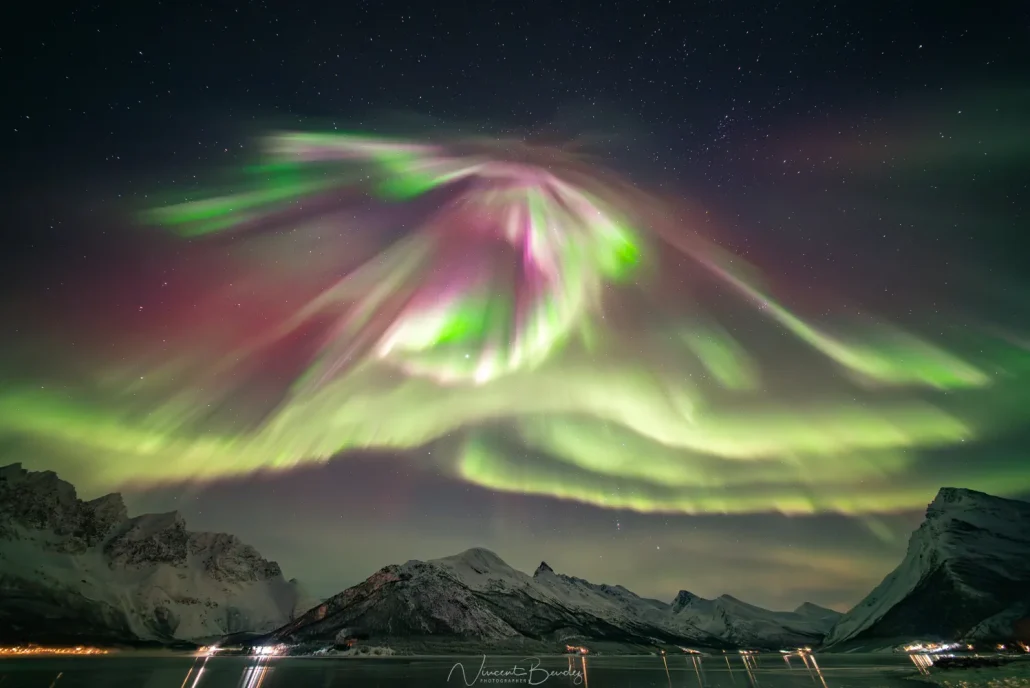
2.5 years before the solar maximum, we saw the first red northern lights appear to the naked eye. It was an event! And the closer we got to the solar maximum, the more red and solar storms we saw.
However, at the solar maximum we saw fewer of the loooong green and pink dances that last a long time. It was more brief.
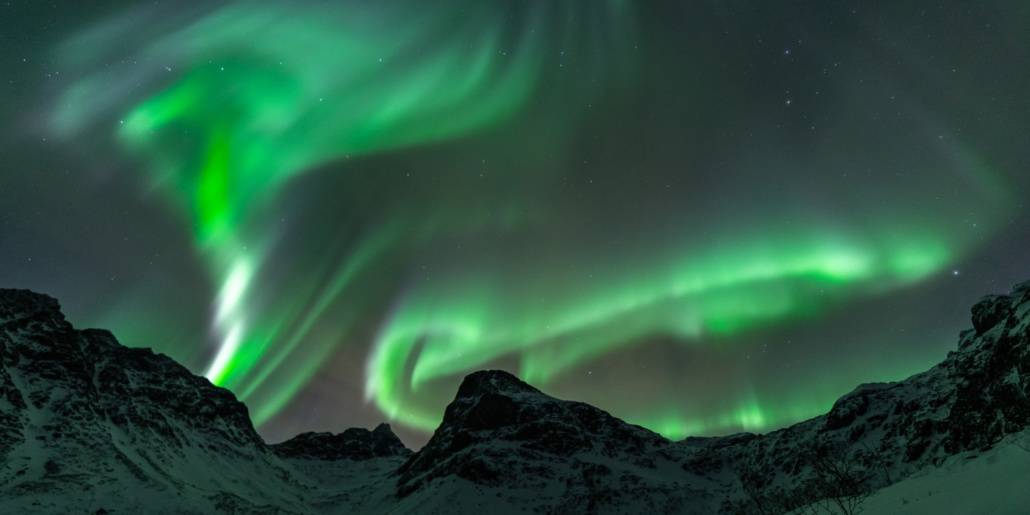
At the solar minimum, we get auroras every evening too, but green ones that dance overhead with some pink. We don’t get these red walls that come from the south.
Below I’ve put 2 photos. The first taken in the middle of a solar storm near the solar maximum. The second taken during the solar minimum, in 2020.


Seeing the northern lights during the full moon, a bad idea?
People say the best time to see the northern lights is at the new moon, when there isn’t a scrap of moon. Well, it’s both true and false.
Yes, you can absolutely see the northern lights with the moon!
The moon has one advantage: it highlights the surroundings. So if you’re in a lovely spot, a fjord, pretty fir trees you want to appear in your photos, then yes it’s really nice.
The moon doesn’t stop you from seeing the northern lights. On the other hand, you don’t see them the same way. They’re paler, and when they’re not strong, then it’s less impressive. You can see the colours with the moon, that’s not a problem. You can watch them dance no problem.
But they appear lighter, the green is paler.
So, can you see the northern lights with the moon? yes!
Should you CHANGE your dates to get the new moon and not be bothered by its brightness? honestly, that’s entirely up to you. You can see them, you enjoy the landscapes. But I’ll never tell you to specifically change your trip dates because of the moon.
Should you anticipate this and prefer a date without moon? if your goal is to see the auroras, I’d say “yes but”. If you also want to do photography, the moon will be your friend. If you’re afraid of the dark, then go for the moon.
Once again, the moon lights things up yes, but doesn’t stop you from seeing the auroras. If the auroras are beautiful, then you’ll see them beautiful. You’ll see them dance with or without the moon.
Below I’ve put two photos taken with a beautiful moon.



Practical info about the northern lights
- How to see the northern lights in the evening
You first need to know where the clouds are, via the weather apps. Identify the clear areas and drive there. Find a spot with no light pollution and a very open view. And then you have to wait! In the following article I tell you a lot more about hunting the northern lights.
- What are the best places to see the northern lights
Tromsø is a great spot because it offers lots of possibilities. Swedish and Finnish Lapland are very cold but have better weather, while the Lofoten Islands have the most beautiful landscapes. I point you to the 9 most beautiful places to see the northern lights.
- What time do the northern lights come out
That’s hard to say. Just because it’s dark at 3pm doesn’t mean there are auroras at 3pm. It’s more tied to the Earth’s rotation, when it gets closer to the “deep night”. So I recommend being in place from 7pm, but it does happen that you get them earlier. It’s possible to see nothing until midnight and then poof! And rarely, it’s possible to get nothing despite a superb sky.
- Do you need a car to see the northern lights
You have to find a spot without clouds, so there’s no guarantee that where you’re staying the sky will be clear. It happens but it’s far from a given. So a zone without clouds, without light, an open spot. I recommend having a car to put all the odds on your side.
- Do you need to go through a guide to see the northern lights
If you don’t have a car, then yes, clearly. A guide takes care of driving on the snow, in the storm, of finding the good cloud-free spots — you can relax. So it’s very handy! In the following article I point you to the best aurora guides in Tromsø.