Last updated on
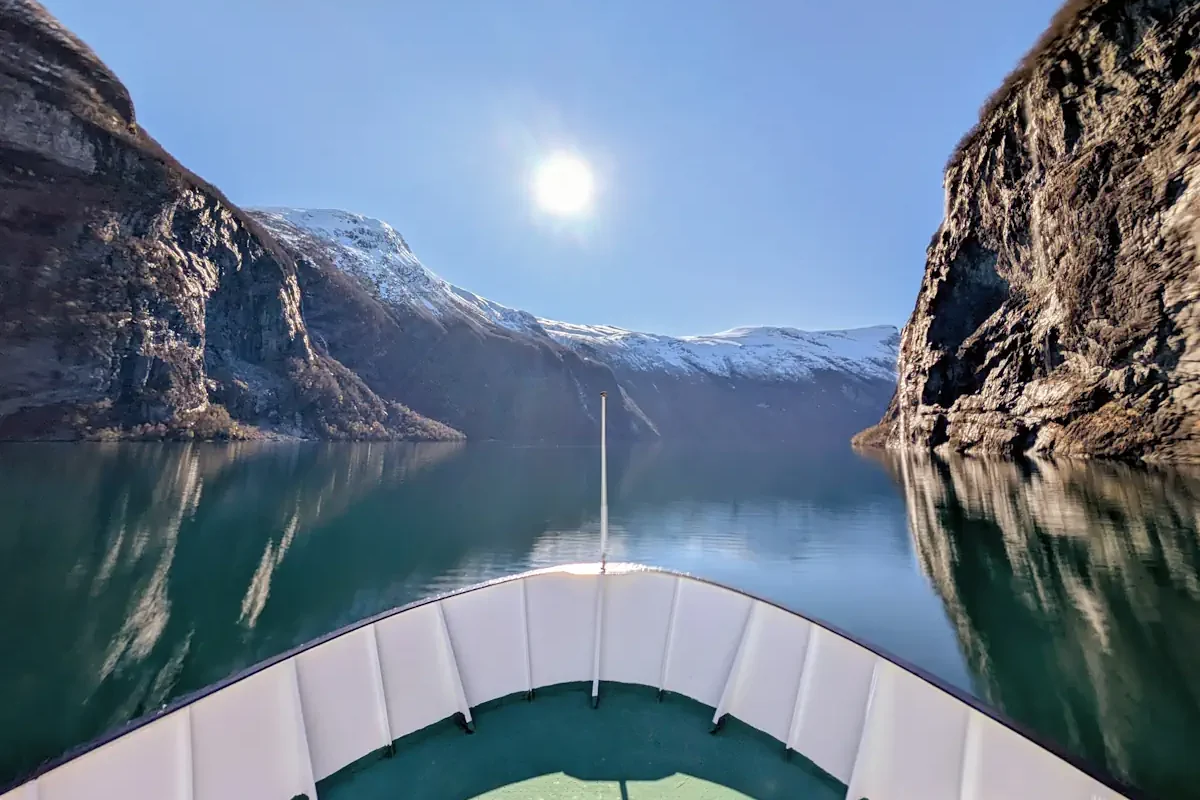
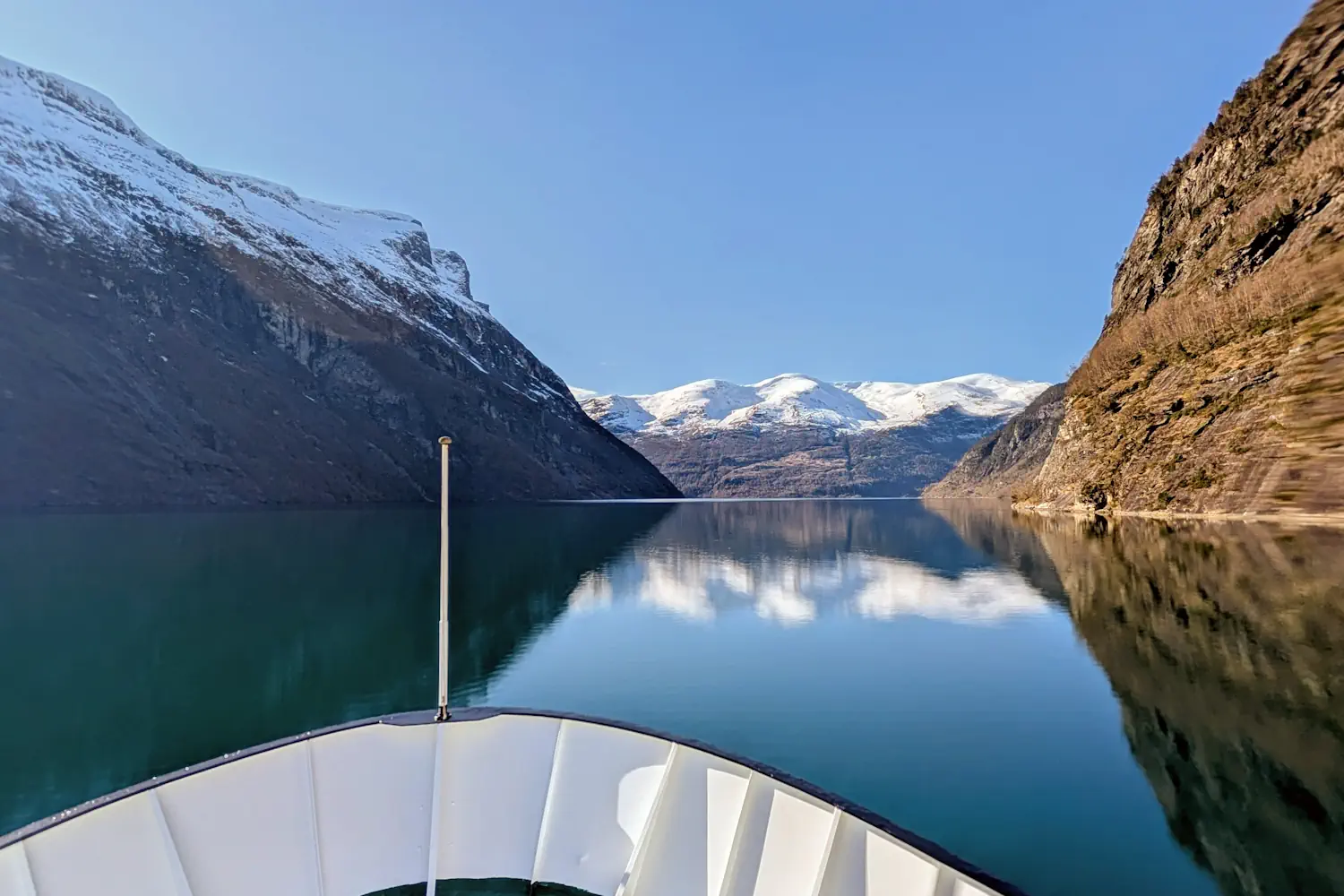
If you are visiting Geiranger, there is one thing I really recommend doing, even if you don’t have to take the boat just for fun: a cruise on the Geirangerfjord. And if you are driving, then the ferry between Geiranger and Hellesylt could be just right for you. It is both one of the most beautiful trips in Norway and the smartest way to get out of (or into) the head of the fjord.
Why? Because Geiranger sits deep at the end of the Geirangerfjord, and Hellesylt at the other end. By road, you have to go all the way around the massif: count on nearly 2 hours and 125 km. By ferry, it’s barely over an hour, sitting on deck facing the Seven Sisters, without turning a single steering wheel. Whether you’re in a car, a motorhome, on a bike or even on foot, this ferry is a little gem of convenience.
In this article, I explain everything: the live timetable (with a handy little widget just below), the two companies that share the route, the 2026 prices, how to book, and above all in which cases this ferry will save you precious time.
⛴️ The Geiranger–Hellesylt ferry at a glance
- Duration: about 1 hour (1h05 to 1h10 depending on the company)
- Season: from March to mid-December depending on the company; only January and February have no ferry
- Frequency: in high season, very regular departures (often every 30 min to 1h when combining both companies); down to just 2 a day in winter
- Two companies: Fjord1 and Fjordtours (The Fjords / Norway’s Best)
- Price: from 390 NOK (~€34) per foot passenger; for a car, count on ~1,530–1,650 NOK (~€133–143) one way (Fjordtours Car Package = 1,650 NOK, up to 4 passengers)
- On foot: no need to book, just show up at the quay shortly before departure
- By car: booking recommended in summer (limited spaces)
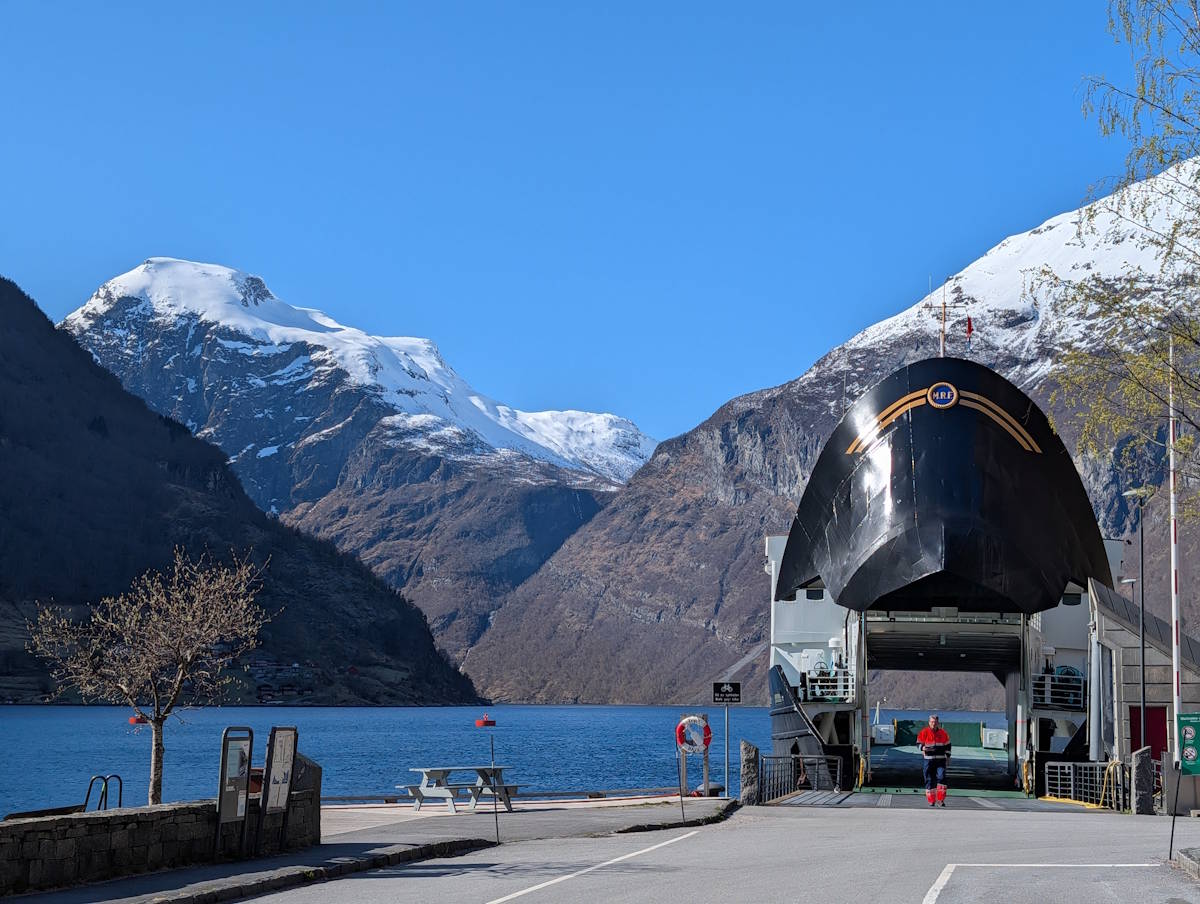
Next ferry departures between Geiranger and Hellesylt
Here are the next departures in real time, in both directions. The times are pulled directly from Entur (the official Norwegian transport service), so they are always up to date. The coloured dot tells you which company operates the departure.
A small note: the line does not run in the depths of winter. If the widget shows no departures, you are probably viewing it in January–February, outside the ferry season.
Why take the ferry rather than the road?
That’s THE question, and the answer is doubly simple: first because the cruise is stunning, and because the road is very long. Look at a map: Geiranger is wedged deep at the end of its fjord, surrounded by mountains. To reach Hellesylt by road, there is no shortcut along the water — you have to climb over the passes, drop down towards Grotli and Stryn, skirt Lake Hornindal, then climb back up towards Hellesylt. In total, about 125 km and nearly 2 hours of driving (mountain roads, with hairpins).
The ferry, on the other hand, links the two villages in a straight line over the water, in just over an hour. You not only save time, you turn a connecting trip into one of the most beautiful moments of your journey. Honestly, it’s a no-brainer.
1. You are travelling by car or motorhome
The ferry takes vehicles. Rather than tackling 2 hours of mountain passes, you cut across the fjord, step out of the car, and enjoy the scenery. Arriving in Hellesylt, you set off again fresh and rested. It’s also very handy for closing a loop itinerary without driving the same roads twice (see my 2-week itinerary in the fjords).
2. You are on foot or without a car
It’s perfect. The ferry takes foot passengers, you don’t need to book, and the crossing is a reasonably priced mini-cruise. Many travellers without a car use this ferry as an excursion in its own right: a return trip Geiranger–Hellesylt, and you’ve seen the heart of the Geirangerfjord.
3. To reach Stryn, Hornindal… or the other fjord right next door
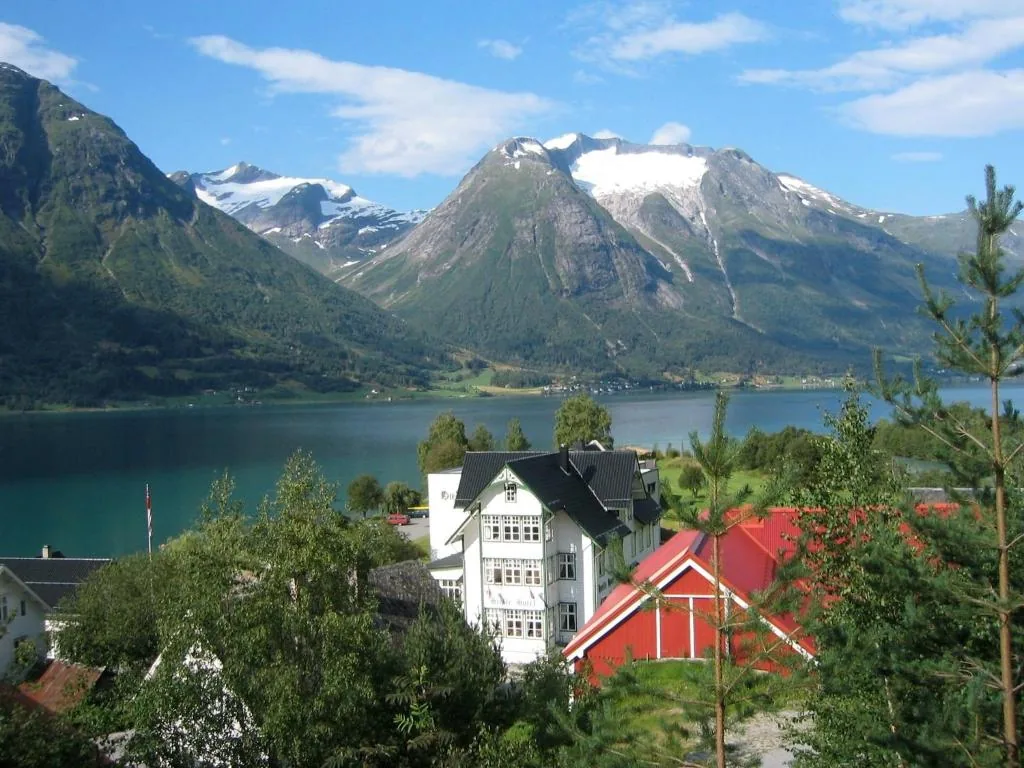
From Hellesylt, you are ideally placed to continue towards Stryn, Lake Hornindal, or — my favourite — the Hjørundfjord, the “hidden” fjord right next door. You reach it via the Norangsdalen, one of the narrowest and most spectacular valleys in the country, which leads to the villages of Øye (and its famous Hotel Union Øye), Urke and Sæbø.
Chaining the Geirangerfjord ferry + the Norangsdalen road + the Hjørundfjord is one of the most beautiful days you can treat yourself to in the region.
4. When the mountain roads are closed
Around Geiranger, several magnificent roads close in winter because of snow: the Dalsnibba road (Nibbevegen), the old Strynefjellet road, or Trollstigen a little further away. When these passes are closed (often until May, or even mid-June for the old Strynefjellet road), the options for getting out of the fjord shrink dramatically.
This is where the Geiranger–Hellesylt ferry becomes a precious way out. Since it runs from March to mid-December, it keeps going for many weeks when the passes towards the south are still (or already) closed by snow.
I was there myself in April: the road towards the south was closed… and the ferry was running the crossing without any problem. That’s exactly when it saves the day.
Only January and February are truly without service: at that time, you get in and out of Geiranger via the Ørnevegen (the “Eagle Road”, open all year) and then the public Eidsdal–Linge ferry.
CAR RENTAL IN NORWAY
Roam around Norway by renting with Discover Cars

- Rent a car from many airports or in town
- Small model, SUV or electric for the adventure
- Car supplied with the Autopass tag
- Prices from €30
The two companies that operate the line
A particularity of this line: it is operated by two different companies, whose boats pass each other on the fjord. Good news for you: it means lots of departures in high season. In the widget above, you can see both, identified by colour.
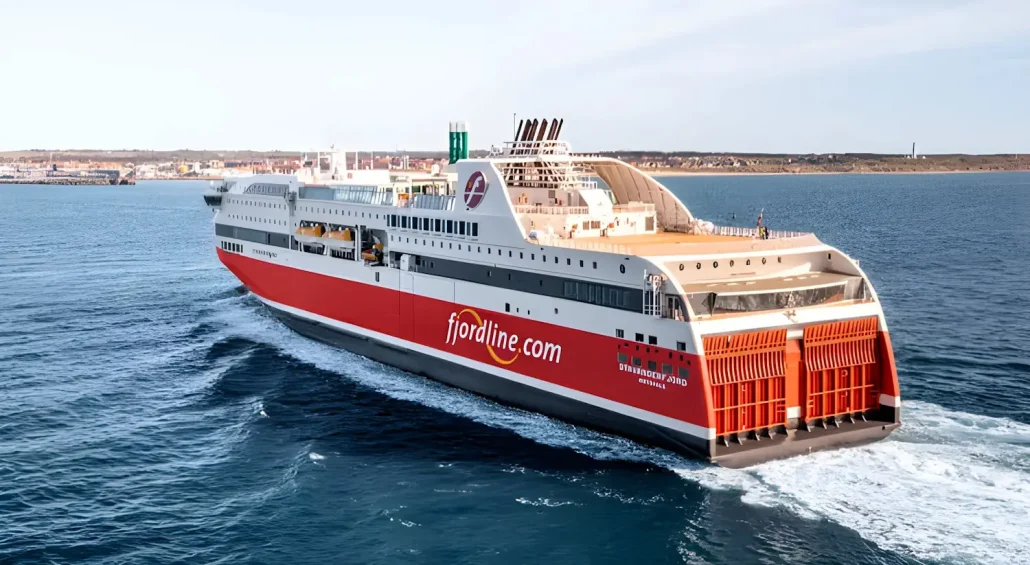
Fjord1 — the “classic” car ferry
It’s the historic operator, with its classic car ferries (the MF Veøy and Bolsøy in 2026). It takes cars, motorhomes, bikes and foot passengers, with a small kiosk and toilets on board. In practice:
- Season: from 1 April to 31 October
- Frequency: 3 to 7 crossings a day depending on the season
- Fares: 420 NOK (~€37) per foot passenger; car + 3 adults ≈ 1,534 NOK (including the “berth fee” quay charge)
- Duration: 1h10
- Booking: fjord1.no
Fjordtours (The Fjords / Norway’s Best) — the “new generation” ferry
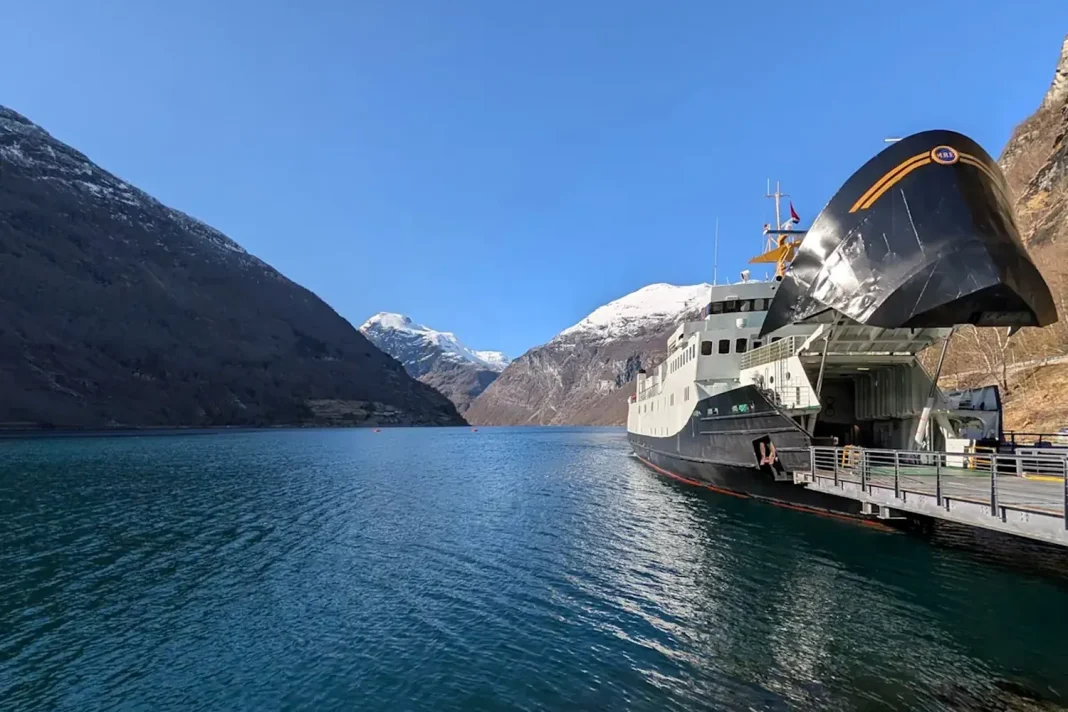
The second company is booked under the Fjordtours brand (the The Fjords / Norway’s Best service; on the official Norwegian timetables it also appears under the name “Vestlandske”). Its ambition: to operate the line with 100% electric car ferries. For now the electric boats are still being built, so two older vessels run the crossing (including the MF Skånevik, a listed 1967 ferry), with an on-board audio guide via the RoadSpot app. In practice:
- Season: from 1 May to 15 December, and again in the month of March
- Frequency: up to 14 crossings a day in summer, but only 2 a day in winter
- Fares: on foot from 390 NOK (~€34); Car Package (car + driver + up to 4 passengers) at 1,650 NOK (~€143) in summer, ~1,680 NOK in winter
- Duration: 1h05
- Booking: fjordtours.com / norwaysbest.com
It’s this company that runs the service in March and in late autumn, when Fjord1 no longer operates — in other words exactly when the mountain roads towards the south are still closed.
Fjord1 or The Fjords: which to choose?
Quite frankly, for the Geiranger–Hellesylt crossing, the view is the same and the duration almost identical. The simplest is to take the first one leaving at a time that suits you — that’s the whole benefit of having two companies. Here’s the comparison:
| Fjord1 | Fjordtours (The Fjords) | |
|---|---|---|
| Type | Classic car ferry | Car ferry (electric coming) |
| 2026 season | 1 April → 31 October | 1 May → 15 Dec + March |
| Crossings / day | 3 to 7 | 2 to 14 |
| Fares | 420 NOK/pers · car + 3 adults ≈ 1,534 NOK | 390 NOK/pers · Car Package 1,650 NOK (up to 4 passengers) |
| Duration | 1h10 | 1h05 |
| Audio guide | No | Yes (RoadSpot app) |
| Booking | fjord1.no | fjordtours.com / norwaysbest.com |
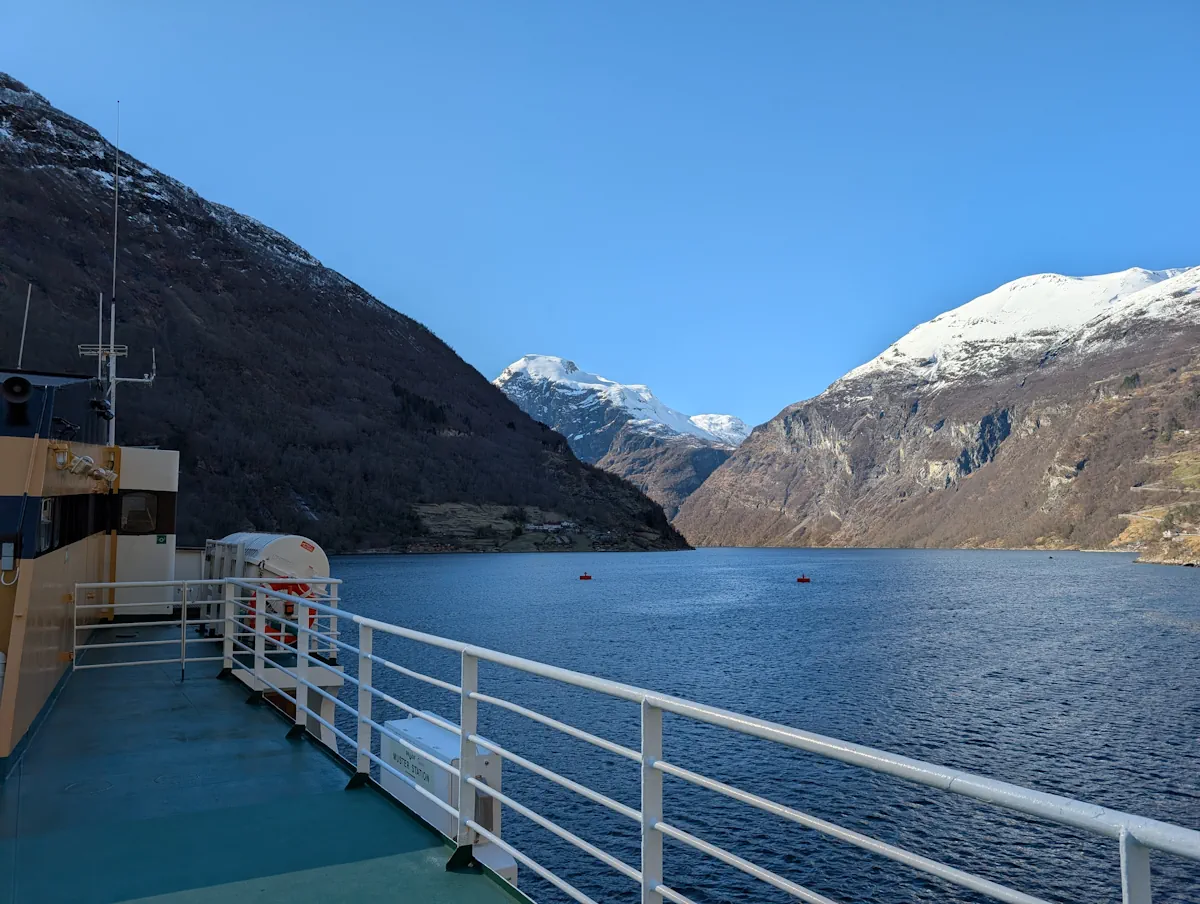
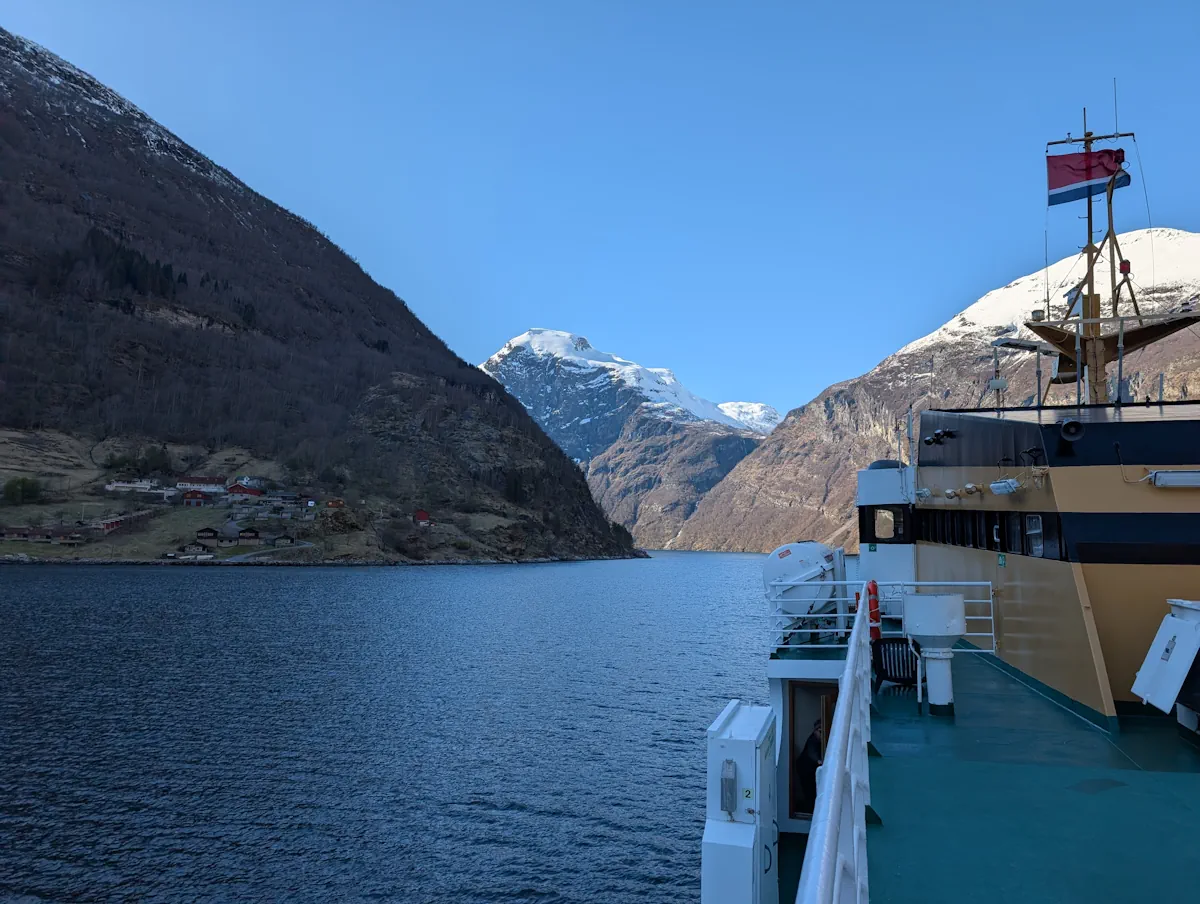
Ferry timetable and season
The line is seasonal. Combining both companies, the ferry runs from March to mid-December: Fjord1 from April to October, Fjordtours from May to mid-December plus the month of March. Only January and February have no ferry at all.
In high season (May to September), it’s plentiful: the two companies combined offer many departures a day, often every 30 minutes to 1 hour in the middle of the day. You almost never have to wait long. Conversely, at the start and end of the season (March, November–December), the service drops sharply, sometimes to just 2 crossings a day — be sure to check the schedule in advance.
To plan as precisely as possible, the best is to look at the live widget at the top of this article, or to check Entur directly (the official Norwegian planner, perfect for all the country’s ferries). The detailed 2026 schedules are also on both companies’ websites.
How much does the Geiranger–Hellesylt ferry cost?
First thing to know: unlike many Norwegian ferries, this one is a private, non-subsidised tourist ferry. As a result, it is more expensive than a classic public ferry, and — important point — the AutoPASS ferje system (the automatic billing of public ferries) does not apply here: you buy a normal tourist ticket.
On foot, it’s simple: from 390 NOK (~€34) with Fjordtours, 420 NOK (~€37) with Fjord1. No need to book.
By car, the two companies don’t charge the same way:
- Fjord1 charges for the car and each passenger, plus a small “berth fee” (quay charge). Real example taken from fjord1.no for June 2026: 1 car (≤ 6 m) + 3 adults = 1,534 NOK (~€133) one way, including 174 NOK of berth fee.
- Fjordtours keeps it simple with a fixed-price Car Package: car + driver + up to 4 passengers for 1,650 NOK (~€143) in summer (around 1,680 NOK in winter), whatever the number of people on board.
Bottom line: for a car, you’re around 1,534 NOK with Fjord1 (with 3 adults) and 1,650 NOK with Fjordtours (package up to 4 passengers). Fjord1 is often a bit cheaper with 2–3 people; but as soon as the car is full (4–5 people), Fjordtours’ fixed-price Car Package becomes the best value. Children up to 15 also get a reduced fare.
Euro conversions are indicative (~11.5 NOK/€); check the fare of the day when booking.
Taking the ferry on foot as a tourist
This ferry can be an option for a relaxed cruise on the Geirangerfjord. In that case you have to book the outbound then the return on the boat. And not take the dedicated cruises like this one. Except that the tourist cruises doing the round trip to Hellesylt cover the same route and cost less. €60 instead of €80, and are a little faster (2h30 instead of 3h).
So, in short, if as a tourist:
- you want to do the Geiranger – Hellesylt crossing: then take FjordTours or Fjord1
- you want to do the round trip: then take the classic cruise. Plus you’ll have fewer people on deck.

📍 Geiranger · 1h · Fjord Guiding · RIB 12 people
The thrill option: 1 hour on an open RIB to get as close as possible to the Seven Sisters and the Friaren. The boat goes into the waterfalls, the Skagefla mountain farm seen from the water, small group of 12 — and 90% of travellers gave it the top rating.
- Open RIB · small group max 12 people
- Approach the Seven Sisters, Friaren & Skagefla farm
- Thrills guaranteed · 90% gave it the top rating
Free cancellation
From 80 € / pers.

📍 Geiranger · 2h30 · Cruise Service · large boat
The contemplative option: a 2h30 round trip to explore the whole Geirangerfjord (UNESCO) on a large boat. Approaching the waterfalls, tasting the water from the Friaren waterfall and a 1h stop in Hellesylt to explore the village — wheelchair accessible.
- 2h30 round trip in the UNESCO Geirangerfjord
- 1h stop in Hellesylt + waterfall water tasting
- Spacious boat · wheelchair accessible
Free cancellation
From 61 € / pers.
How to book the ferry?
If you are on foot: no need to book. Show up at the quay about fifteen minutes before departure and buy your ticket on the spot.
If you are in a car: I recommend booking in high season. Vehicle spaces are limited (and large vehicles board first). Booking is done:
- For Fjord1: on fjord1.no
- For The Fjords / Norway’s Best: on norwaysbest.com or fjordtours.com
Remember to arrive at the quay 20 to 30 minutes before departure with a vehicle (15 min on foot). In case of a no-show, the ticket is generally not refunded, but cancelling in advance (often up to 48 h before with Fjord1) is possible.
What do you see during the crossing?
This is where the ferry goes from “practical” to “unforgettable”. In one hour, you sail past the most beautiful scenery of the Geirangerfjord, a UNESCO World Heritage site:
- The Seven Sisters (“De syv søstrene”): the fjord’s most famous waterfall, seven streams of water side by side
- The Suitor (“Friaren”): the waterfall facing them, the “suitor” of the legend
- The Bridal Veil (“Brudesløret”): a fine, elegant veil of water
- The abandoned farms clinging to the cliff, like Skageflå and Knivsflå, perched hundreds of metres above the water
Settle on the outer deck, camera ready: the light on the cliffs and waterfalls is striking.
Quays and practical info
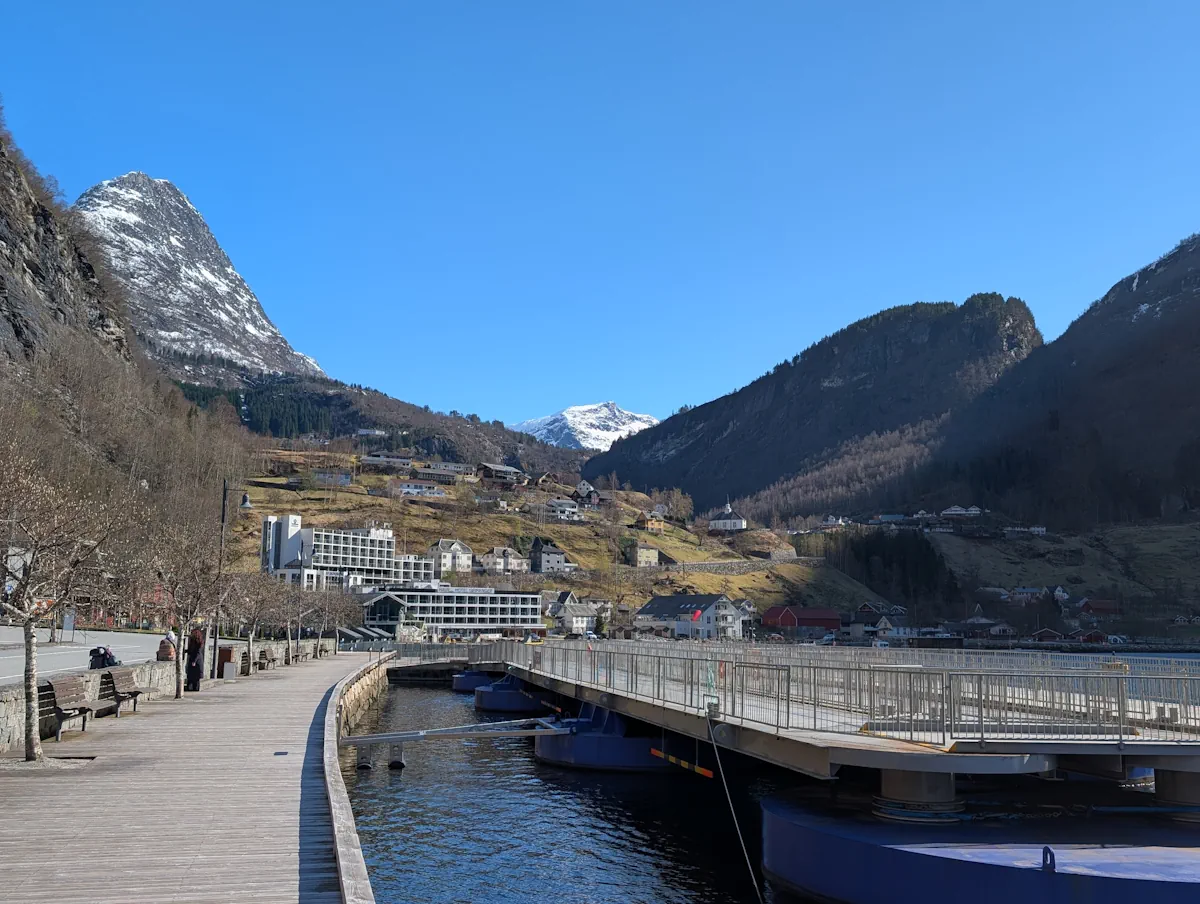
- In Geiranger: the car ferry leaves from the quay in the centre of the village (the “ferjekai”). Be careful not to confuse it with the tourist-cruise quay (“Hurtigbåtkai”), just behind the tourist office.
- In Hellesylt: boarding at the “Hellesylt ferjekai”, in the heart of the small village.
- Parking: Geiranger has paid car parks if you leave the car to do the round trip on foot.
- On board: outer deck, indoor lounge, toilets and a small kiosk. The MF Skånevik (a listed vessel) has no lift; the MF Røsund has a stairlift.
And after Hellesylt? Itinerary ideas
Once you’ve landed in Hellesylt, the hardest part is choosing where to go, the region is so beautiful:
- Towards the Hjørundfjord via the Norangsdalen (Øye, Urke, Sæbø) — the most beautiful option in my eyes
- Towards Stryn and Lake Hornindal, to loop down towards the southern fjords
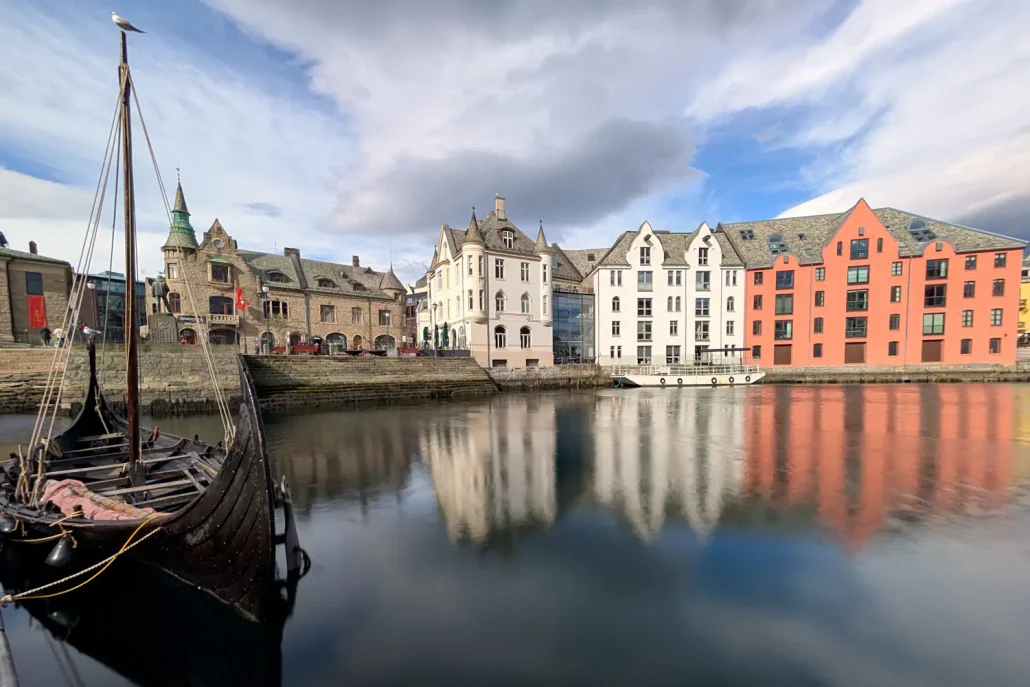
- Towards Ålesund, the pretty Art Nouveau town, in about 2 hours
To build your route, take a look at my 2-week itinerary in the fjords and my complete guide on what to do in the fjord region.
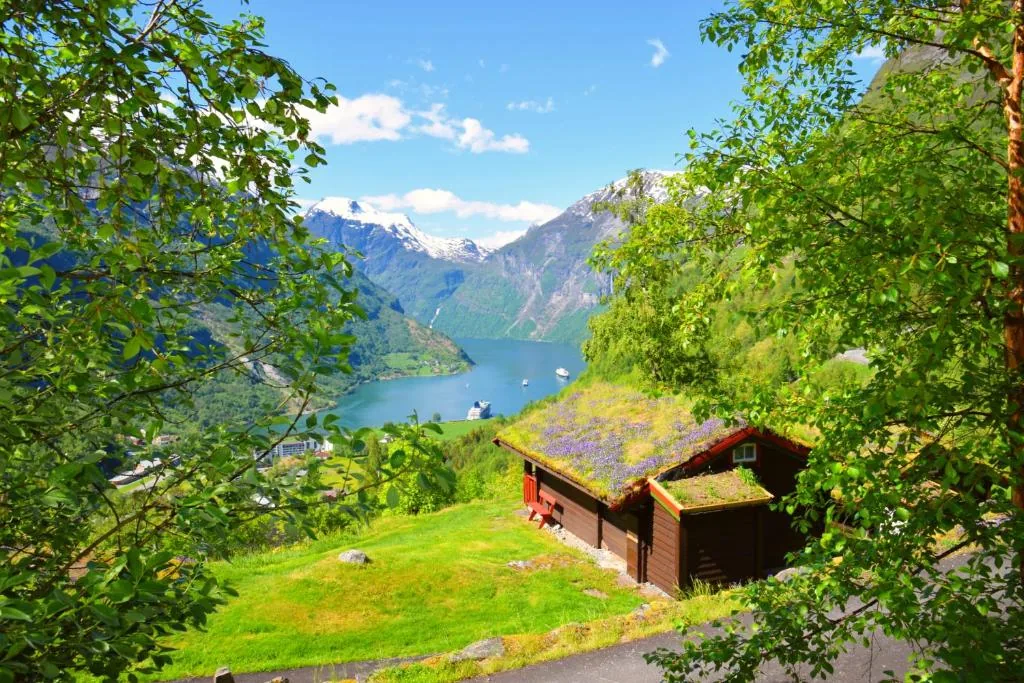
📍 Geiranger · Flydalsjuvet heights
A small hamlet of red wooden cabins perched on the heights. The authentic chalet option with a plunging view.
- Equipped kitchen, terrace and barbecue
- 500 m from the Flydalsjuvet viewpoint
- Bed linen and towels extra (145 NOK/pers.)
Free cancellation
From 125 € / night

📍 Geiranger · Fjordside
Panoramic restaurant on the 6th floor and a plunging fjord view from most rooms.
- Free shuttle to the village (2 km away)
- Fabulous breakfast (9.4) and jacuzzi
- 2,860 Booking reviews, a safe bet
Free cancellation
From 160 € / night

📍 Geiranger · Flydalsjuvet heights
A historic hotel set 100 m from the famous Flydalsjuvet Cliff. Panoramic view and refined Norwegian cuisine.
- 100 m from Flydalsjuvet Cliff (iconic viewpoint)
- À la carte restaurant with local produce
- 2 Kople charging points for electric cars
Free cancellation
From 180 € / night

📍 Geiranger · Historic 4★ resort
A historic resort with 3 pools, sauna, jacuzzi and 3 restaurants. Great Norwegian comfort.
- 3 pools (indoor + heated outdoor) + spa
- 3 restaurants including the Fjorden local-produce buffet
- Vintage car museum and charging points
Free cancellation
From 250 € / night
FAQ — Geiranger–Hellesylt ferry
Do you need to book the Geiranger–Hellesylt ferry?
On foot, no: buy your ticket at the quay before departure. By car, it’s recommended in high season (May–September) as spaces are limited.
How do you buy your ferry ticket?
You buy them from the operators directly if you want to book in advance (recommended in summer). Otherwise it’s super simple: an agent from the company walks down the queue of cars and takes payment by card, as easy as that.
How long does the crossing take?
About 1 hour: 1h05 with Fjordtours, 1h10 with Fjord1.
Does the ferry take cars and motorhomes?
Yes, both companies take cars, motorhomes, bikes and foot passengers.
Does the ferry run in winter?
It runs from March to mid-December depending on the company. Only January and February have no ferry. I was there in April: the road south was closed by snow, but the ferry was running — it’s often the best way to get out of the fjord at that time of year.
Which company to choose, Fjord1 or The Fjords?
It doesn’t matter: same panorama, almost identical duration. Take the departure that best fits your schedule.
Is the ferry paid for on foot?
Yes: 390 NOK (~€34) with Fjordtours, 420 NOK (~€37) with Fjord1. It’s not free, as it’s a private tourist ferry.
Can you pay with AutoPASS ferje?
No, this private line does not use the public-ferry AutoPASS system: you buy a classic tourist ticket.
Is it better to take the ferry or the road between Geiranger and Hellesylt?
The ferry, without hesitation: a good hour of magnificent crossing versus nearly 2 hours and 125 km of mountain road. And above all, the cruise is stunning.
In short
The Geiranger–Hellesylt ferry is the rare case where the most practical route is also the most beautiful. By car or on foot, it takes you across the heart of the Geirangerfjord in a good hour, saves you 2 hours of road, and opens the doors to the Hjørundfjord and Stryn. Book if you’re driving in summer, show up at the quay if you’re on foot, and settle on the deck: the Seven Sisters are waiting for you.
To go further, my other useful articles:
- What to see in Geiranger and its fjord
- The best cruises to do in Geiranger
- What to do in the fjord region of Norway
- Roads closed in winter in Norway
- How to pay tolls and ferries in Norway
- The ferry between Bodø and the Lofoten Islands
- The best 2-week itinerary in the fjords of Norway – a loop to see everything between Bergen and Ålesund
- What to do in Bergen in summer – discover the most beautiful city in Norway
- The most beautiful cruises in Norway – there are incredible alternatives to Geiranger, discover them!