Last updated on
It is without a doubt the most famous Norwegian road in the world (alongside the Trollstigen). You’ve definitely seen it: a road arching up over the ocean, a twisted bridge that seems to plunge into thin air, waves crashing over the asphalt under a stormy sky. Every “most beautiful roads in the world” list puts it at the top.
Since we were heading back from Tromsø to Paris in April and wanted to make the most of the trip, we thought “hey, there’s a super famous scenic road that’s open, let’s go!” Because the Atlantic Road is yes, very well-known, but not the easiest to reach. This time, we had the time, so why not. Except.
To be honest with you (the article starts well :D), because it’s more useful than an enthusiastic write-up: I came back a little disappointed. Not that it’s ugly — it’s pretty, the sequence of bridges is very photogenic, and there are some really nice stops. But I was expecting more. More spectacular, longer, more memorable.
The issue, in my opinion, is that Norway had already set my bar very high. When you’ve driven the Trollstigen the day before, cruised along the Geirangerfjord with its jaw-dropping elevated viewpoints, or crossed the roads of the Lofoten Islands, you arrive at the Atlantic Road with eyes that I wouldn’t call jaded, but you’re expecting something more wow. It’s a victim of its extraordinary neighbors.
That said, it’s still a nice thing to do if you’re in the area (Møre og Romsdal). Just don’t make a 400 km detour for it alone, unless you have time like we did. In this article, I give you all the practical information to enjoy it properly, combine it smartly with other gems in the region, and know what to truly expect.
Worth noting: we mostly did the short version, not having had much time to dedicate to it between Trondheim and Ålesund, so I’ll also share info about places we didn’t get to visit. Let’s go!
What Exactly Is the Atlantic Road?
An important first clarification: there’s the Atlantic Road in the strict sense and in the broader sense.
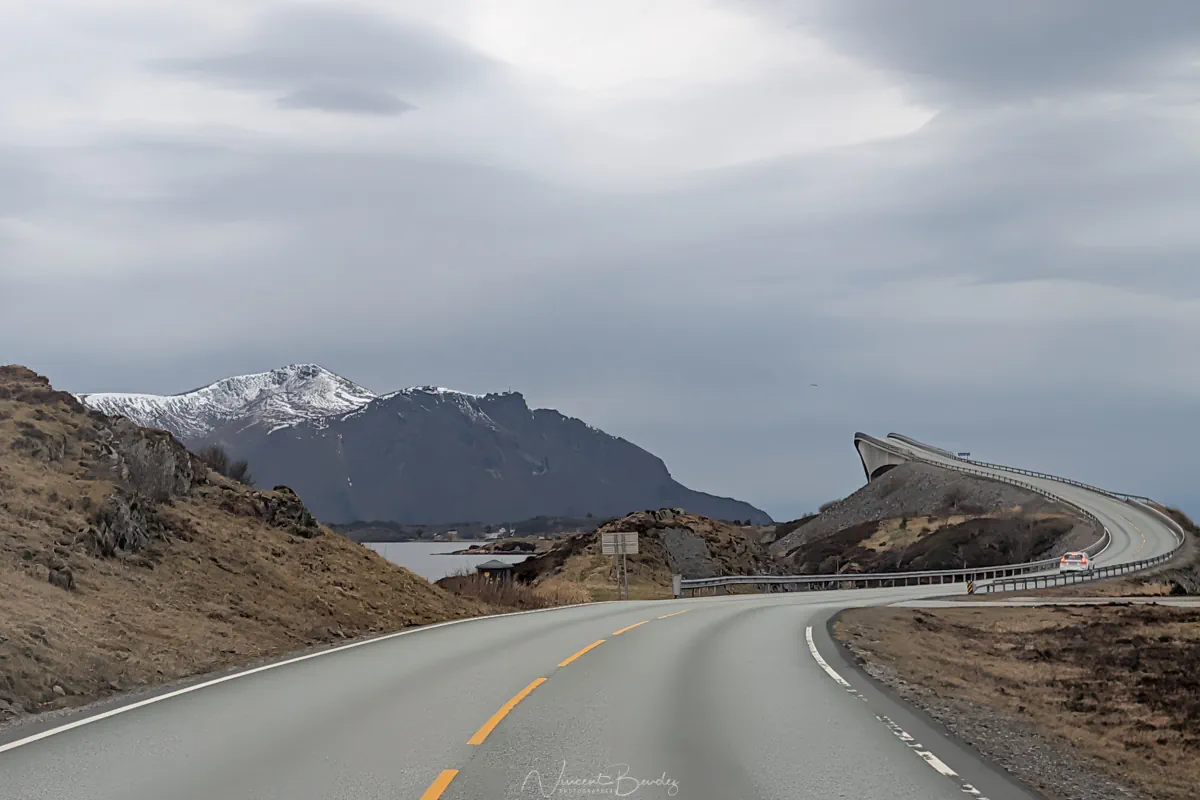
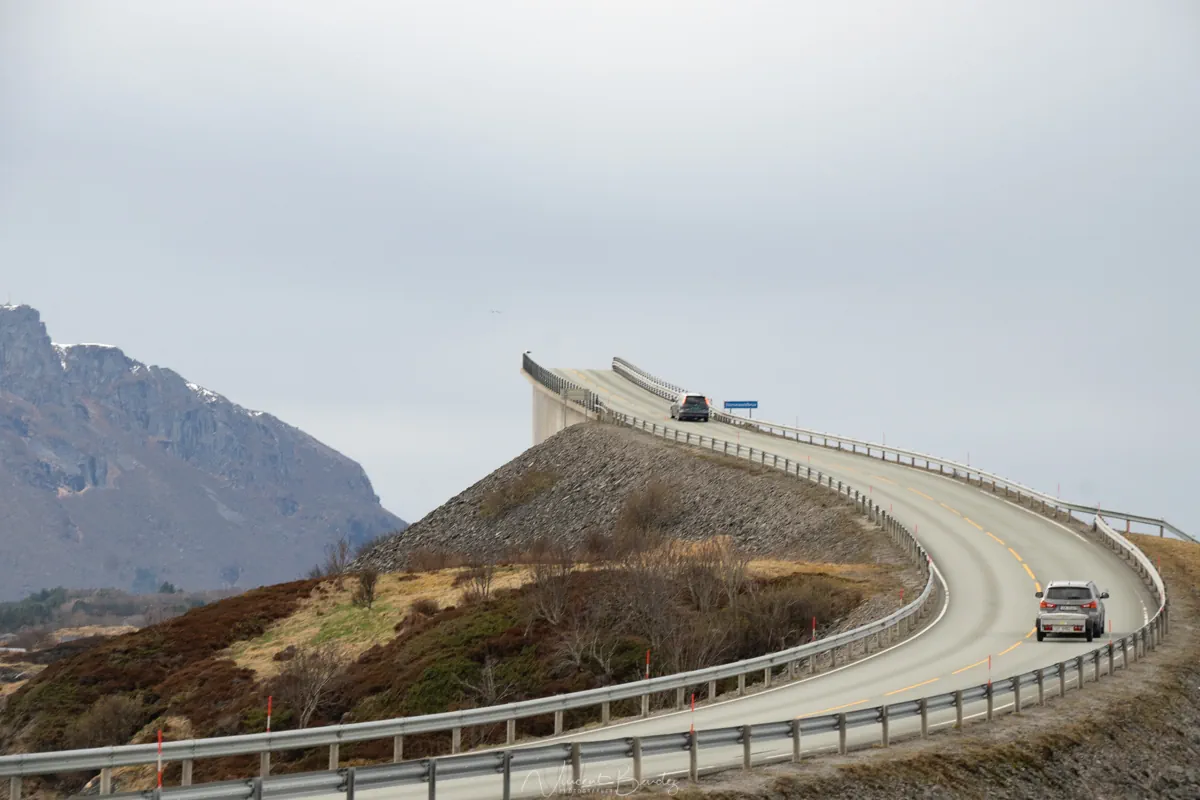
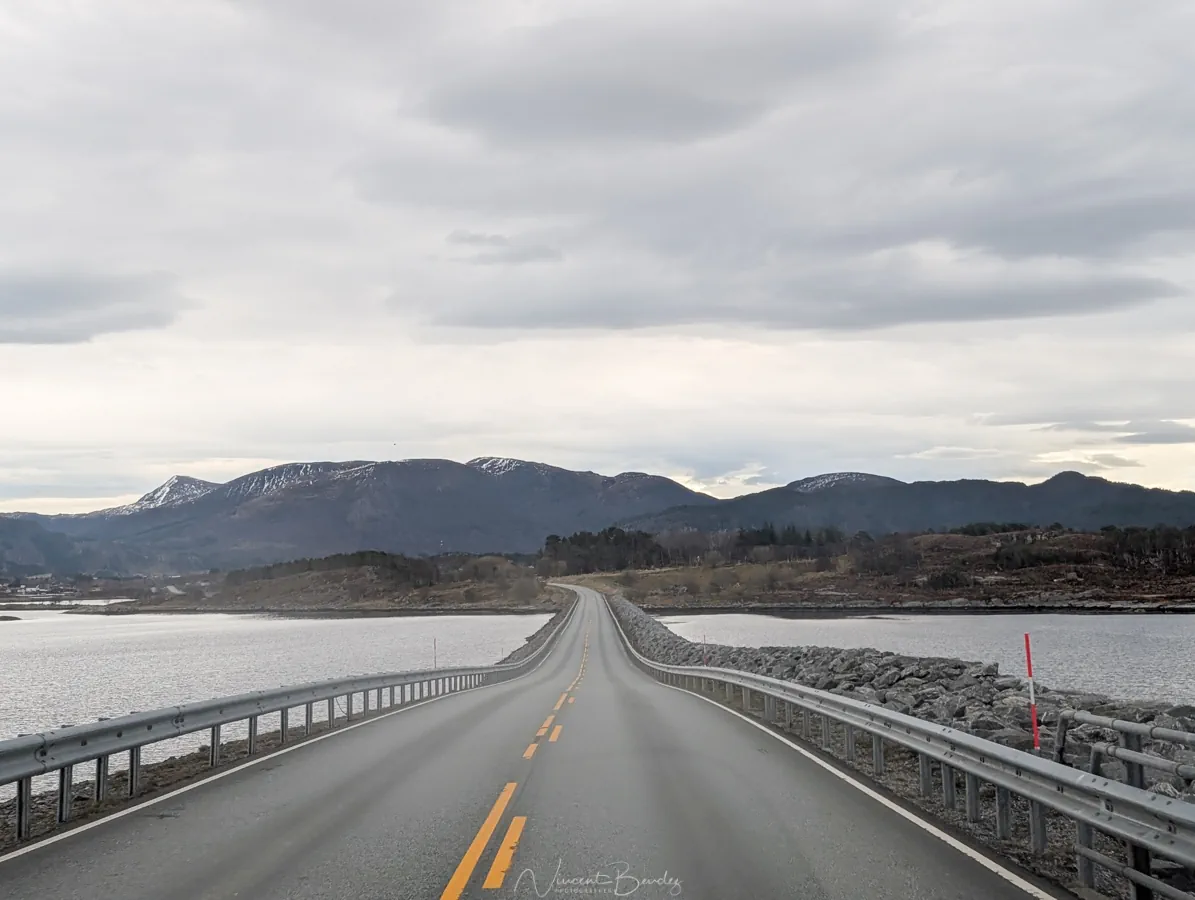
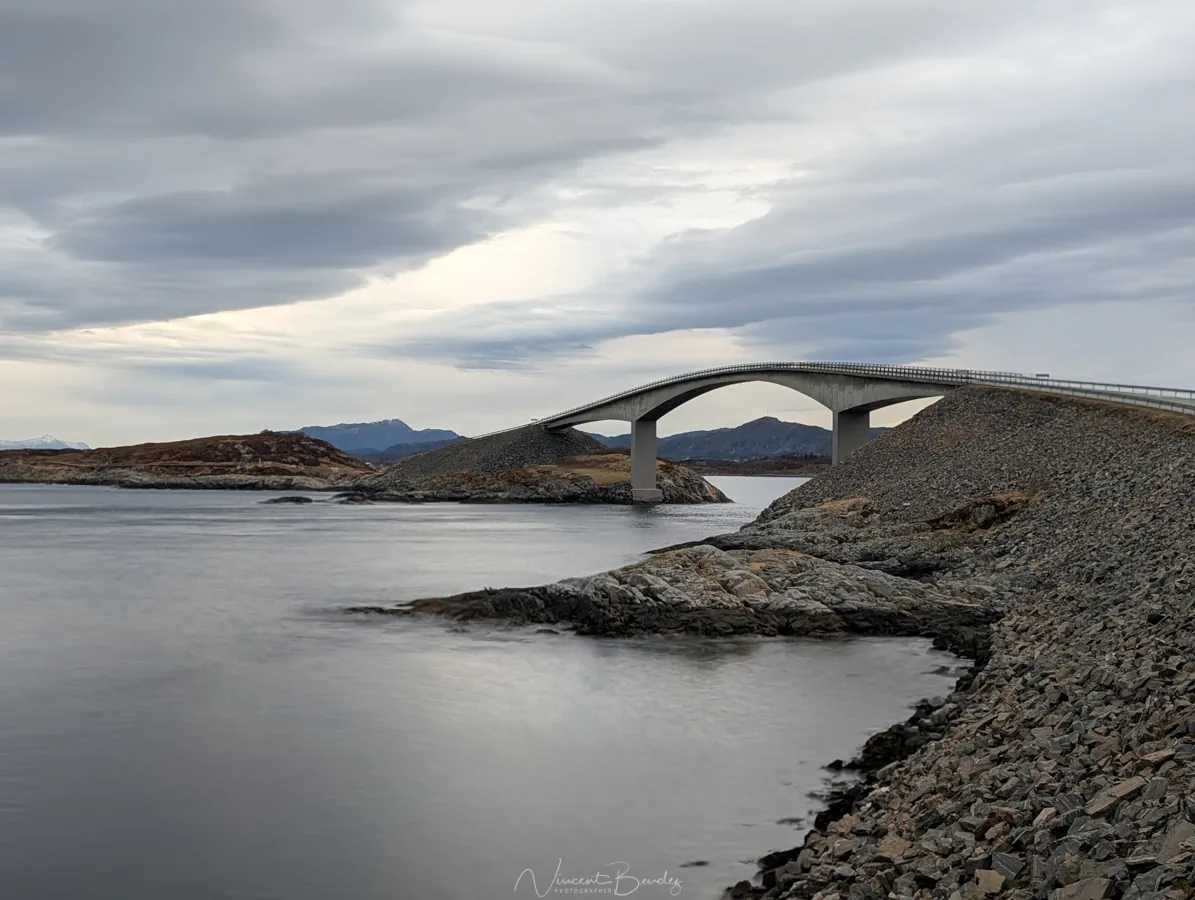
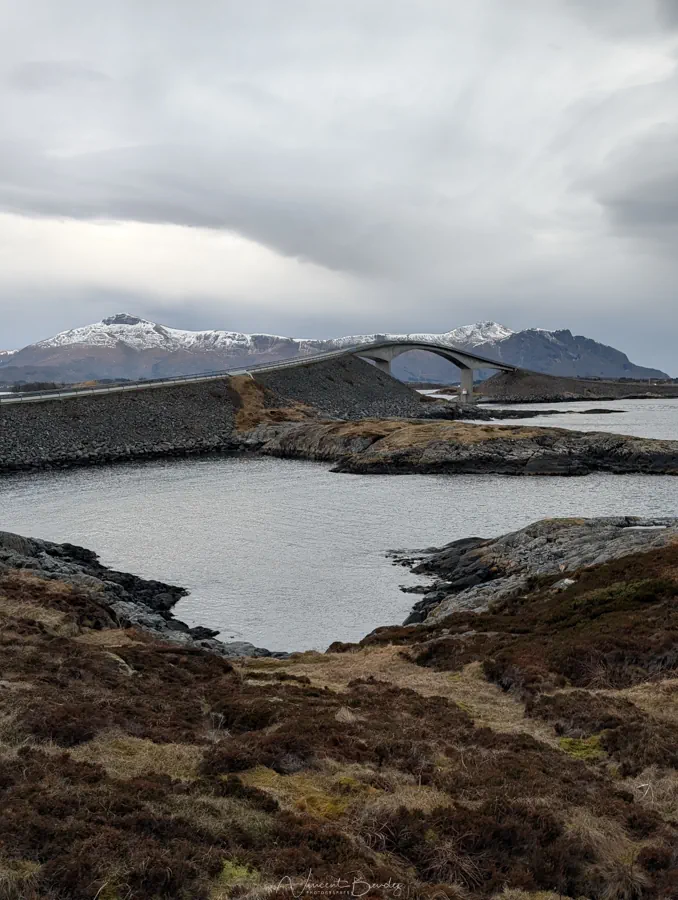
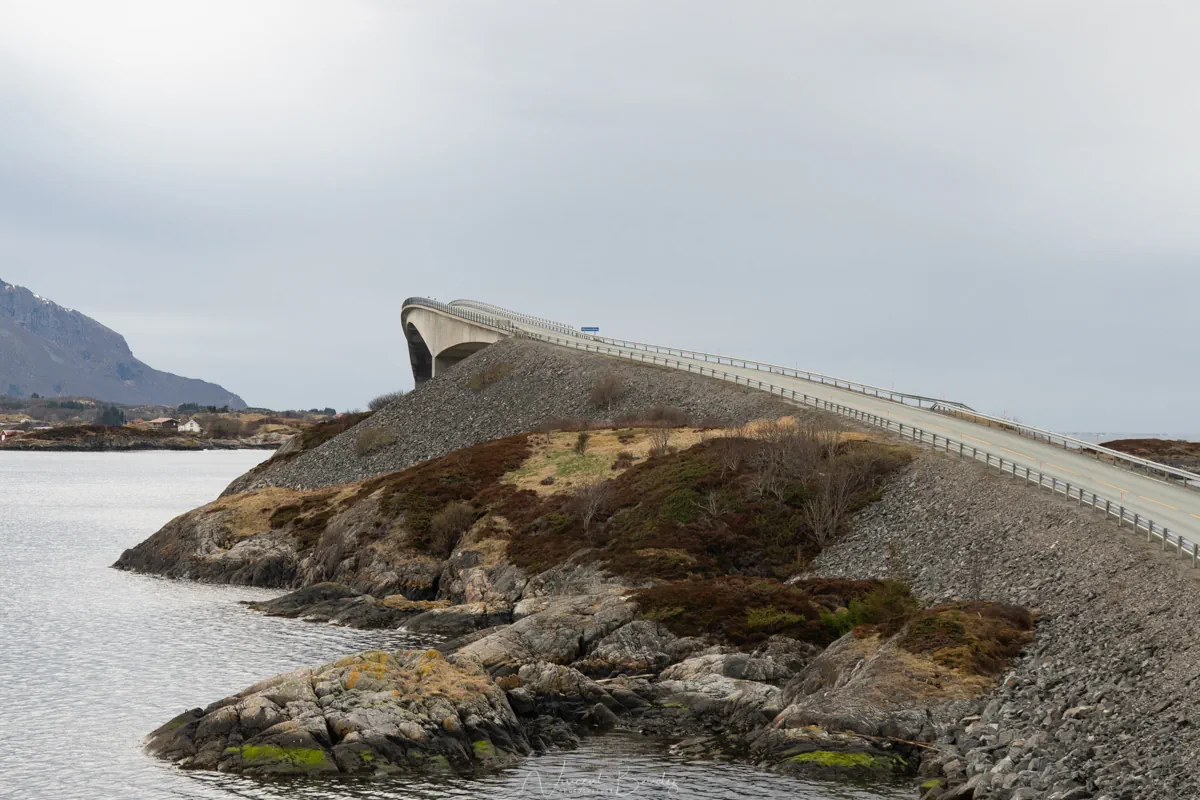
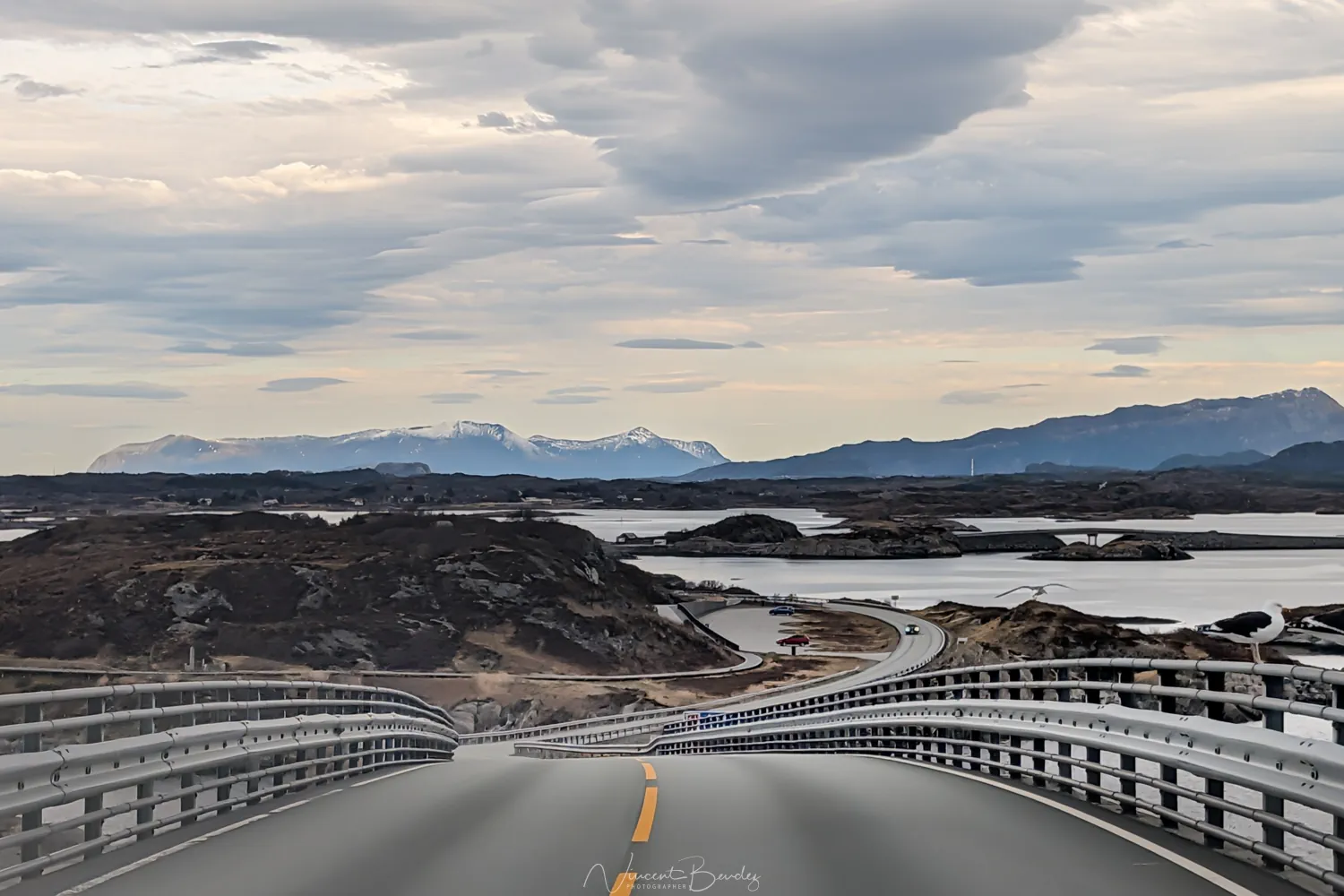
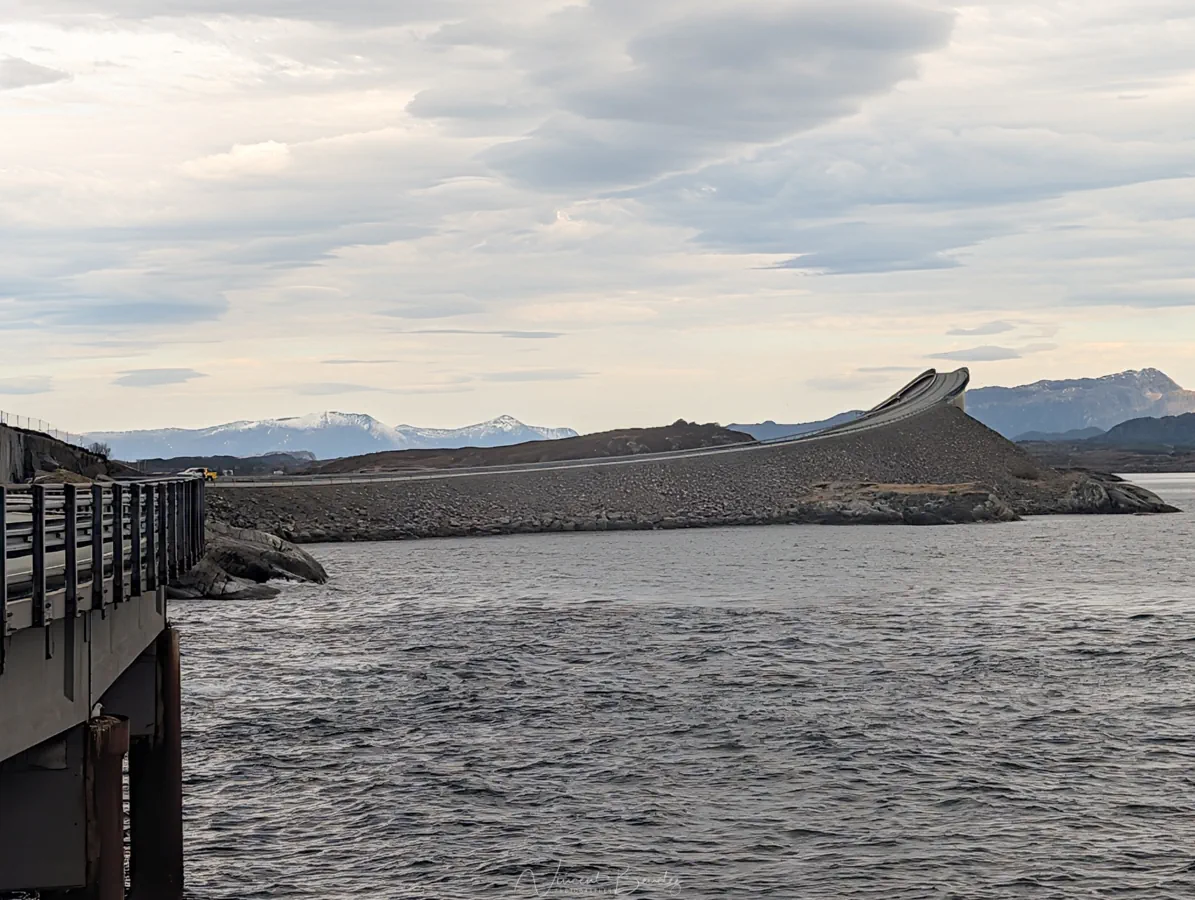
The Atlantic Ocean Road in the strict sense (the Atlanterhavsvegen, the one in all the photos) is an 8.3 km stretch that links the island of Averøy to the mainland by hopping from islet to islet via 8 bridges and several viaducts. It’s that ribbon of asphalt over the water, surrounded by reefs, with its famous Storseisundet Bridge (260 m long, the most iconic, the one that appears to stop mid-air when approached from the right angle).
The Atlanterhavsvegen National Tourist Route (in the broader sense) is the route classified as a “national scenic route,” which spans 36 km in total, stretching from Kårvåg (on the Averøy side) to Bud (a small fishing village on the mainland). The 8.3 km of bridges are at its heart, surrounded by beaches, rest areas, villages, and the stave church of Kvernes.
When someone says “I did the Atlantic Road,” they generally mean the bridge section. But the real experience is to drive the full 36 km end to end, stopping along the way. If you only do the 8 km stretch for photos, you’ll spend 30 minutes there and leave (quite rightly) wondering why everyone makes such a fuss.

How to Get There: The Three Entry Points
The road is in the Møre og Romsdal region, on the west coast, roughly halfway between Bergen and Trondheim but far from both. Here are the three realistic options for getting there.
Option 1: From Kristiansund (the shortest)
This is the most direct option. Kristiansund is a small coastal town with an airport (Kvernberget) that has daily connections from Oslo. Once there:
- Take road 64 south-west
- Go through the Atlanterhavstunnelen (a 5.7 km underwater tunnel, free since July 2020)
- You’ll reach Kårvåg on the island of Averøy in 25 to 30 minutes
- Start the Atlantic Road right away
From Kristiansund to Bud (end to end): about 1h15 driving, not counting stops.
This is the ideal option if you’re doing a day trip or want to minimize travel time. Allow 2h30 to 3h for the round trip Kristiansund → Bud → Kristiansund with stops.
Option 2: From Molde (the scenic option)
Molde is the “city of roses” and also has an airport (Årø) with flights from Oslo. From Molde:
- Take road 64 north-west
- Pass through Eide then Bud
- Start the Atlantic Road from the south (Bud → Kårvåg)
From Molde to Kristiansund via the Atlantic Road: about 2h30 driving, not counting stops.
This is, in my opinion, the best option if you have time: you cross the road in its entirety, and you can continue on to Kristiansund for the night (or vice versa). It’s also the logical combination with a road trip that includes the Trollstigen and the Geirangerfjord, which are also easily accessible from Molde.
Option 3: From Trondheim, Ålesund or Bergen (on a road trip)
If you’re on a broader road trip, the Atlantic Road is rarely a standalone stop. It’s usually combined with:
- From Trondheim: 3h30 drive to Kristiansund via roads 65 and 70. Doable in a day but it’s long.
- From Bergen: 8 to 10 hours minimum, ferries included. Not something to do as a day trip. It’s a road trip leg, not an excursion.
- From Ålesund: 3 hours via Molde, so it could make for a day combining the Atlantic Road and a visit to Molde, or on the way to Kristiansund
Ideally, plan at least one night in the area (Molde, Kristiansund, or Averøy) so you don’t rush through the bridges and have a chance of catching good light. We drove from Trondheim to Ålesund via the Atlantic Road — it’s a long day and perhaps the disappointment partly came from not taking enough time to explore the surroundings.
Which Direction to Drive It?
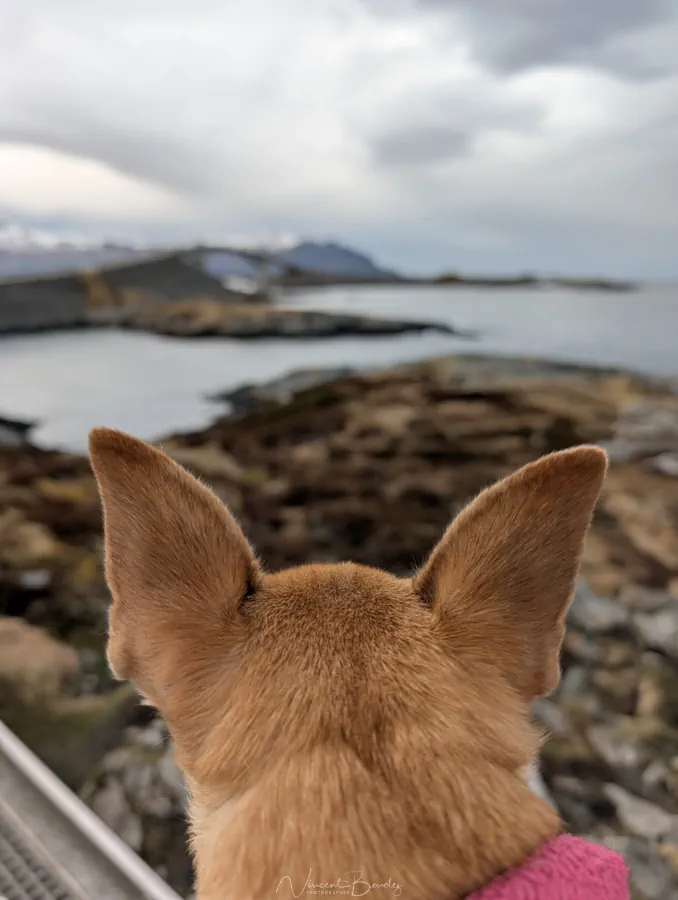
Honestly, it doesn’t really matter. Unlike the Nærøyfjord cruise (where the direction genuinely matters), the Atlantic Road works just as well in either direction. The stops are on both sides, the bridges look great from both ways, and the light favors one direction or the other depending on the time of day. Besides, since it’s so short, you’ll end up driving it both ways anyway, like we did.
My tip though: if you arrive in the late afternoon, drive it from south (Bud) to north (Kårvåg). The light will be behind you for photos, and the setting sun lights up the bridges nicely coming from the west.
If you’re there in the morning, it’s the opposite: set off from Kårvåg to have the morning light shining on the bridges.
📍 Kristiansund · Storgata, plein centre
📍 Kristiansund · Storgata, central
📍 Kristiansund · Storgata, pleno centro
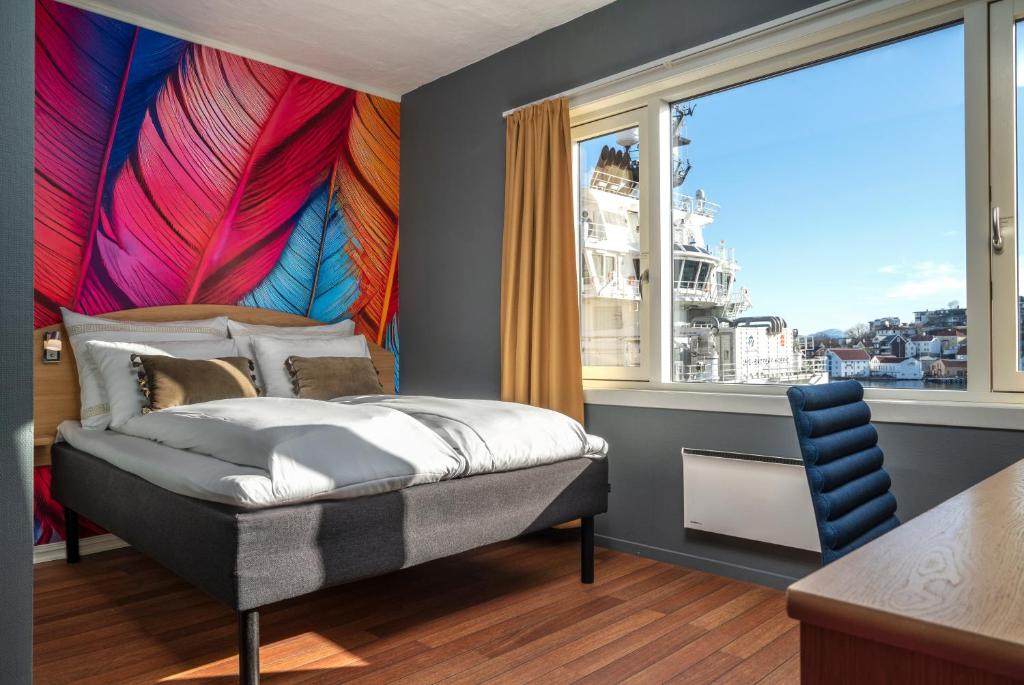
Hôtel central et compact au cœur de Kristiansund, à deux pas du terminal du Sundbåt et des restaurants. Petit-déjeuner exceptionnel, gaufrier en libre-service à la réception et personnel noté 9,0/10 — le plan malin pour explorer la ville sans se ruiner.
Central, compact hotel in the heart of Kristiansund, steps from the Sundbåt ferry terminal and restaurants. Exceptional breakfast, self-service waffle maker in the lobby and staff rated 9.0/10 — the smart pick to explore the city without breaking the bank.
Hotel céntrico y compacto en pleno corazón de Kristiansund, a dos pasos de la terminal del ferry Sundbåt y de los restaurantes. Desayuno excepcional, gofrera en autoservicio en la recepción y personal valorado 9,0/10 — la opción inteligente para explorar la ciudad sin disparar el presupuesto.
- Petit-déjeuner exceptionnel et gaufrier libre-service
- Centre de Kristiansund, près du ferry Sundbåt
- Personnel noté 9,0/10 et Wi-Fi très bien noté
- Exceptional breakfast and self-service waffles
- Central Kristiansund, near the Sundbåt ferry
- Staff rated 9.0/10 and excellent Wi-Fi
- Desayuno excepcional y gofrera en autoservicio
- Centro de Kristiansund, cerca del ferry Sundbåt
- Personal valorado 9,0/10 y Wi-Fi excelente
Annulation gratuiteFree cancellationCancelación gratuita
À partir de 150 € / nuitFrom €150 / nightDesde 150 € / noche

📍 Kristiansund · au bord du port, vue sur la mer
📍 Kristiansund · on the harbour, sea views
📍 Kristiansund · junto al puerto, vistas al mar
Hôtel posé au bord du port avec jetée maritime privée, à quelques pas du centre. Chambres élégantes avec vue sur la mer pour la plupart, sauna et salle de sport — l'option confort pour observer le Hurtigruten entrer dans le détroit.
Hotel set right on the harbour with a private pier, a few steps from the centre. Most rooms feature sea views, plus a sauna and a fitness centre — the comfortable choice to watch the Hurtigruten enter the strait.
Hotel a orillas del puerto con embarcadero privado, a pocos pasos del centro. La mayoría de las habitaciones disfrutan de vistas al mar, más sauna y gimnasio — la opción confortable para ver al Hurtigruten entrar en el estrecho.
- Vue mer depuis la plupart des chambres
- Sauna, salle de sport et borne de recharge
- Jetée privée pour observer le Hurtigruten
- Sea views from most rooms
- Sauna, fitness centre and EV charging
- Private pier with Hurtigruten views
- Vistas al mar desde la mayoría de las habitaciones
- Sauna, gimnasio y carga para vehículos eléctricos
- Embarcadero privado con vistas al Hurtigruten
Annulation gratuiteFree cancellationCancelación gratuita
À partir de 110 € / nuitFrom €110 / nightDesde 110 € / noche
📍 Molde · au bord du quai, face aux Alpes de Romsdal
📍 Molde · on the quay, facing the Romsdal Alps
📍 Molde · junto al muelle, frente a los Alpes de Romsdal
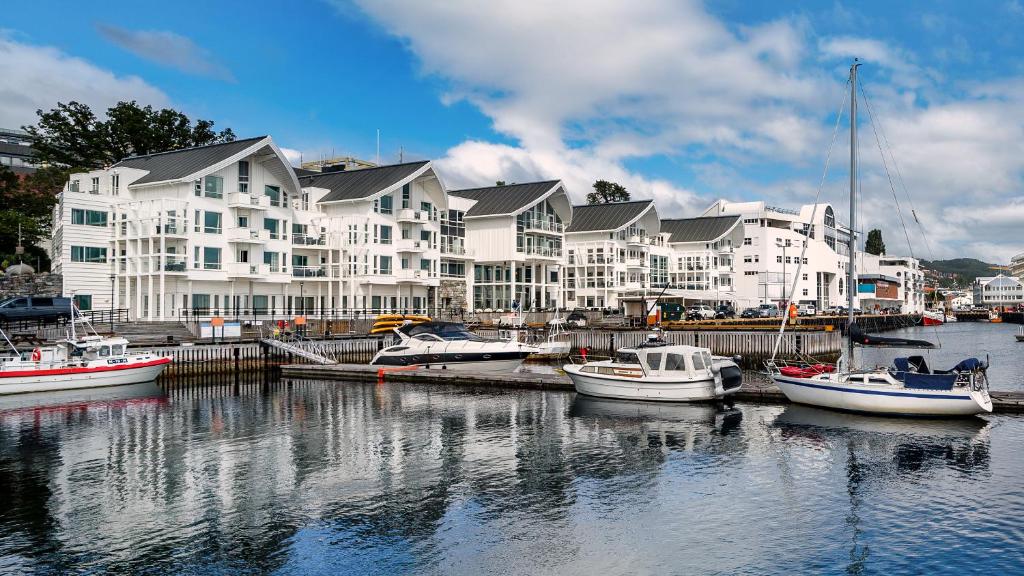
Hôtel posé sur le quai de Molde, avec un panorama sur les 222 sommets enneigés des Alpes de Romsdal. Chambres avec balcon vue fjord, restaurant Hav réputé pour ses fruits de mer — emplacement noté 9,6/10 et adresse plébiscitée par les couples (9,7/10).
Hotel set on Molde's quay, with a panorama over the 222 snow-capped peaks of the Romsdal Alps. Rooms with fjord-view balconies, the acclaimed Hav restaurant for fresh seafood — location rated 9.6/10 and a favourite among couples (9.7/10).
Hotel a orillas del muelle de Molde, con un panorama de las 222 cumbres nevadas de los Alpes de Romsdal. Habitaciones con balcón y vistas al fiordo, restaurante Hav reputado por sus mariscos — ubicación 9,6/10 y dirección plebiscitada por las parejas (9,7/10).
- Vue panoramique sur les Alpes de Romsdal
- Restaurant Hav réputé pour ses fruits de mer
- Emplacement noté 9,6/10 sur Booking
- Panoramic Romsdal Alps view
- Hav restaurant acclaimed for its seafood
- Location rated 9.6/10 on Booking
- Vista panorámica de los Alpes de Romsdal
- Restaurante Hav reputado por sus mariscos
- Ubicación 9,6/10 en Booking
Annulation gratuiteFree cancellationCancelación gratuita
À partir de 140 € / nuitFrom €140 / nightDesde 140 € / noche

📍 Molde · sur le fjord, dans une voile architecturale
📍 Molde · on the fjord, inside an architectural sail
📍 Molde · sobre el fiordo, en una vela arquitectónica
Hôtel-icône en forme de voile posé sur le fjord de Romsdal. Skybar au 14ᵉ étage avec vue à 360° sur les fjords, spa Seilet attenant et grandes baies vitrées dans toutes les chambres — pour une nuit qui ressemble à une carte postale norvégienne.
Iconic sail-shaped hotel rising from the Romsdal fjord. 14th-floor Skybar with 360° fjord views, adjoining Seilet spa and floor-to-ceiling windows in every room — for a night that looks like a Norwegian postcard.
Hotel-icono con arquitectura en forma de vela elevada sobre el fiordo de Romsdal. Skybar en la planta 14 con vistas 360° al fiordo, spa Seilet contiguo y grandes ventanales en cada habitación — para una noche de postal noruega.
- Skybar panoramique au 14ᵉ étage
- Spa Seilet et centre de bien-être attenants
- Architecture iconique posée sur le fjord
- Panoramic 14th-floor Skybar
- Adjoining Seilet spa & wellness centre
- Iconic architecture rising from the fjord
- Skybar panorámico en la planta 14
- Spa Seilet y centro de bienestar contiguos
- Arquitectura icónica sobre el fiordo
Annulation gratuiteFree cancellationCancelación gratuita
À partir de 95 € / nuitFrom €95 / nightDesde 95 € / noche
The Must-Stop Points Along the Road
This is where the real difference lies between “I crossed the road in 30 minutes” and “I really took my time.” Here’s what’s worth stopping for, from north to south.
The Storseisundet Bridge. The main stop, the icon. There are free parking areas on both sides of the bridge. You can walk out onto the bridge (narrow footpath but manageable), and the best viewpoint for the classic photo is from the south parking area, by climbing a little on the path that goes up the hill behind. That’s where you get the angle that gives the illusion the road climbs toward the sky and stops abruptly.
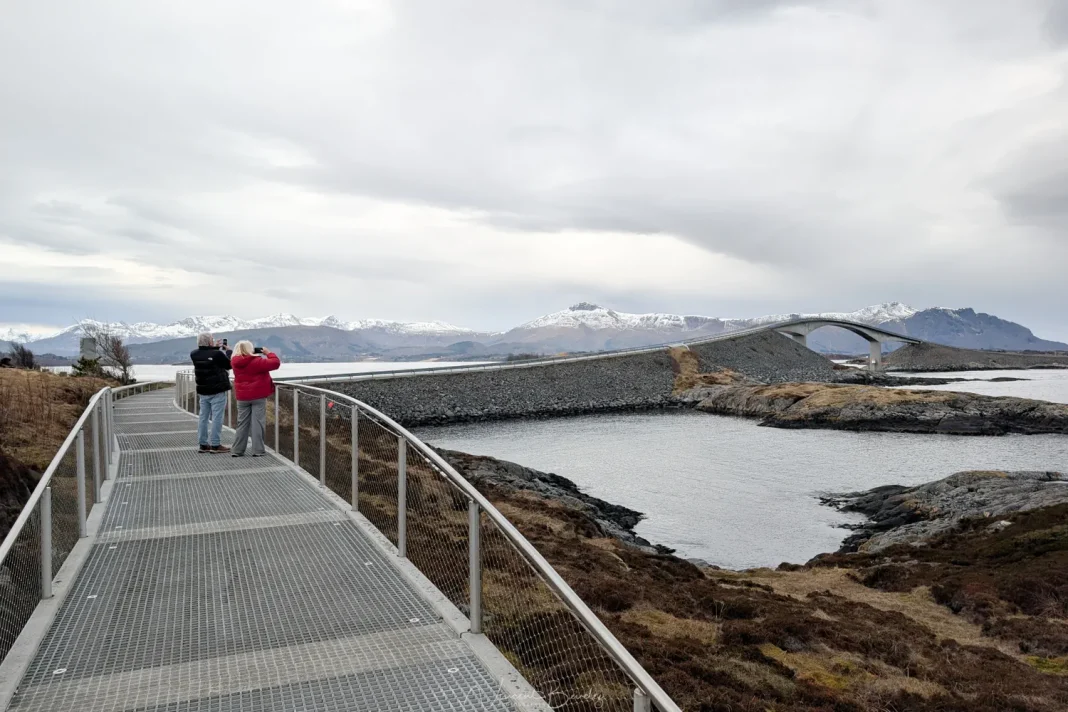
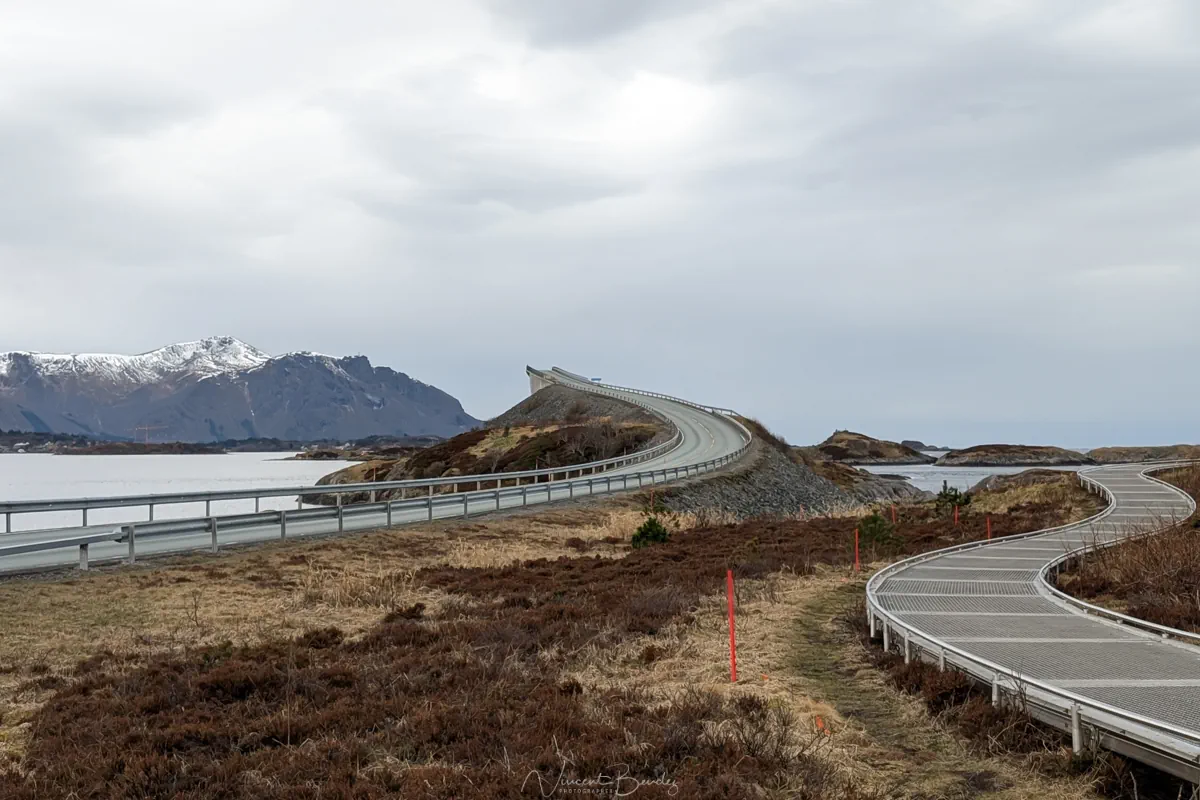
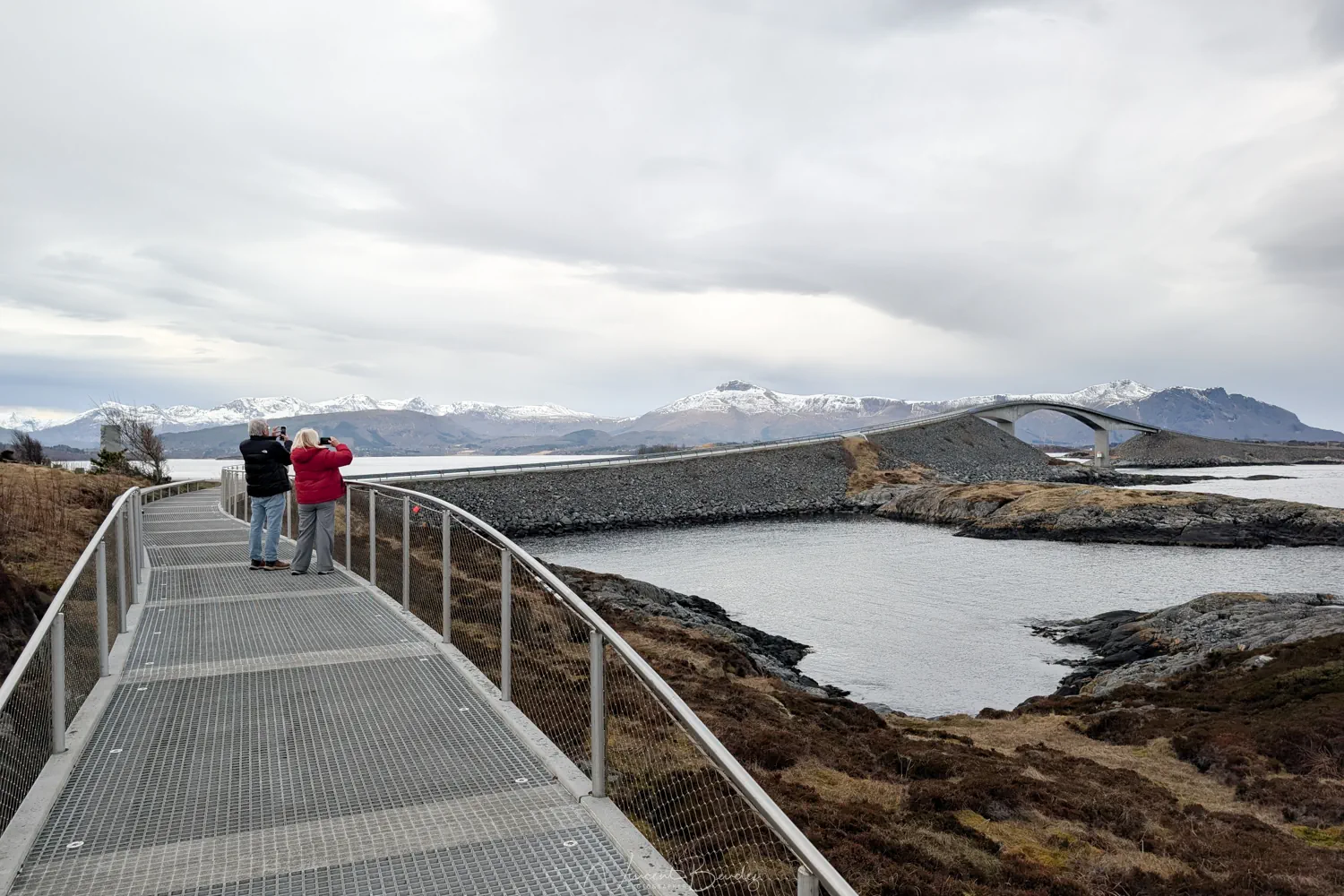
Eldhusøya rest area. Probably the most unique stop on the route. It’s a rocky islet circumnavigated by a 700 m aluminium floating walkway that snakes around the island between the rocks. Allow 15 minutes for a relaxed loop. Free.
Myrbærholm Bridge. The “fishing bridge.” There’s a platform on the bridge where locals fish (the spot is well-known for sea fishing). If you’re travelling with a rod and a permit, it’s worth a try; otherwise, it’s just a pleasant viewpoint.
Askevågen rest area. A stunning architectural belvedere (designed by Reiulf Ramstad Arkitekter), with a glazed platform overlooking the ocean 360°. It’s a bit off the main route (about 10 minutes from the road, on a small peninsula) but worth the detour. On stormy days, the view is incredible.
The village of Bud. The southern end of the scenic route. A small fishing village with a harbour, red wooden warehouses, and a good fish restaurant (Bryggjen i Bud). There’s also the Ergan museum, a former German coastal artillery battery from World War II carved into the cliff (interesting for military history enthusiasts, otherwise skippable).
The stave church of Kvernes (Kvernes Stavkirke). On the island of Averøy, about 25 minutes from the road. It’s one of the last stave churches built in Norway (1631-1633), and one of only two with external wooden pillars (the other being Rødven). Open for visits in summer (June to August, approx. 80 NOK). If you’re into stave churches, it’s worth the detour; otherwise, skip it. Personally, I wasn’t at all prepared — I had no idea it was there. Annoying, because the interior looks stunning.
Håholmen. A former fishing village on a small island, accessible by boat from the road’s central rest area, in high season only. Now converted into a hotel/restaurant. Beautiful, but pricey.
How Much Time to Allow?
- To cross the 8.3 km bridge section without stopping: 15 to 20 minutes.
- To do the full 36 km end to end (Kårvåg ↔ Bud), with the essential stops: 2 to 3 hours.
- To really do it justice, with time for all the stops, photos, and lunch in Bud: half a day, roughly 4 to 5 hours.
- For a full day including Kvernes, Bud, Ergan, and a coffee at Eldhusøya: a full day, around 6 to 7 hours.
My advice: allow at least half a day — it’s the right balance between not rushing and avoiding overkill. If you’re just going for photos of the bridges, you may be a little disappointed (see my verdict below).
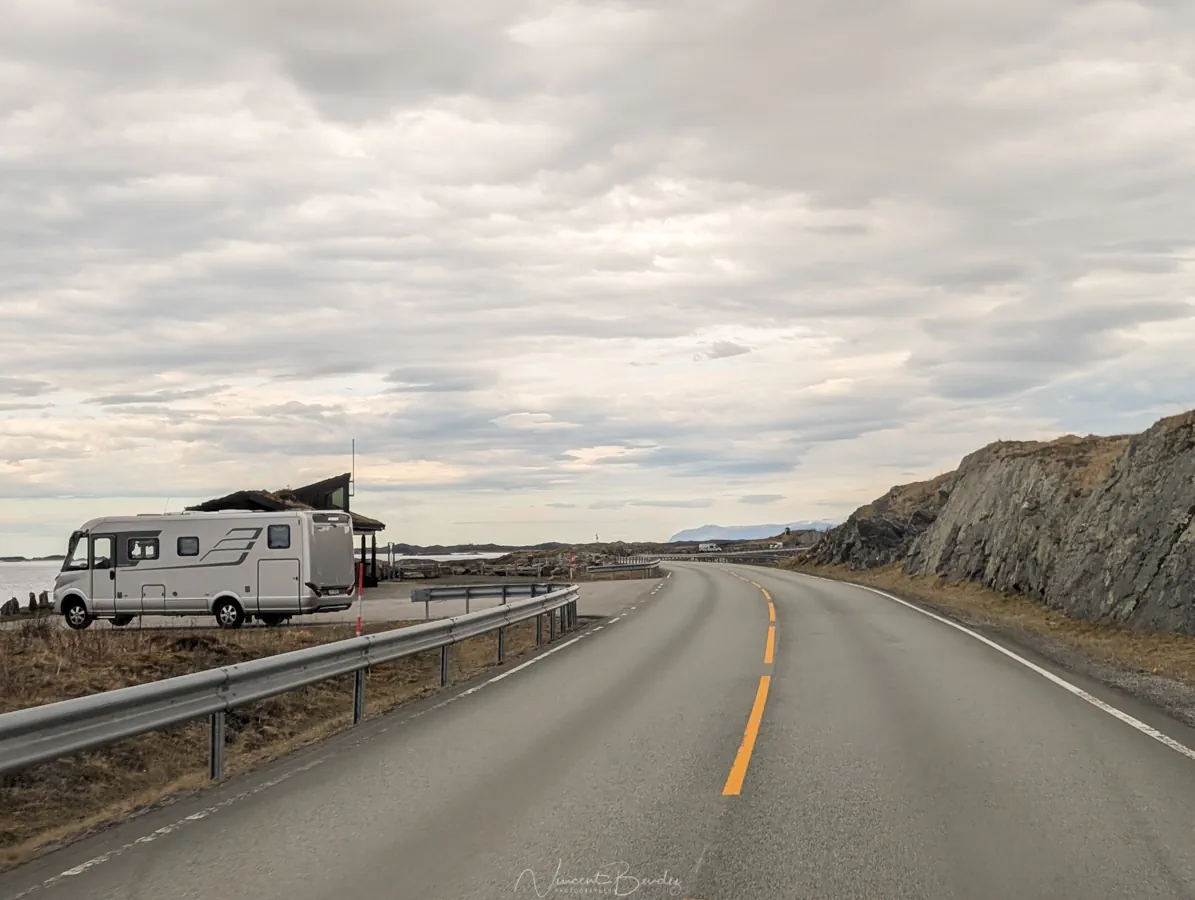
If you’re in a motorhome, this is the perfect place to settle in. You pull up in the afternoon, there are plenty of spots to park and sleep. It’s actually the type of traveller you’ll encounter the most here.

📍 Molde · 3h30 · West Norway Travel
The budget option: 3h30 by bus with audio guide (EN/DE via the GuideToGo app). Iconic bridges of the Atlantic Road, wild Hustadvika coast and Varden viewpoint at 407 m — the highlights of Molde without a live guide.
- Atlantic Road: spectacular bridges & photo stop
- Varden viewpoint (407 m): Molde, fjord & 222 peaks
- Hustadvika coast, Farstadsanden & Molde Panorama
Free cancellation
From 81 € / pers.

📍 Molde · 4h30 · West Norway Travel
The full option: 4h30 with a live local guide. On top of the Atlantic Road highlights, you get an interior visit of Kvernes stave church and Farstad beach — the richest experience to discover the Romsdal region.
- Interior visit of Kvernes stave church
- Atlantic Road & Varden viewpoint
- Farstad beach — the northernmost dunes in Europe
Free cancellation
From 118 € / pers.
When to Go: The Real Seasonal Question
The road has a very different flavour depending on the time of year.
Summer (June to August): the “easy” version
This is the season when everyone goes, and it’s also the easiest to manage. Roads open, ferries running, restaurants open, decent weather (15-20°C on average, with spells of rain).
The summer trap: the road gets very busy, especially between 11am and 4pm. You might find the Storseisundet and Eldhusøya car parks packed. Go early in the morning (before 9am) or in the evening (after 7pm): it stays light very late, the light is gorgeous (weather permitting), and you’ll nearly have the place to yourself.
This is the season to choose if it’s your first trip to Norway and you don’t want any hassle.
Autumn (September to November): the spectacular version
This is the season to see the road at its most dramatic. From October onwards, the first big Atlantic storms roll in, and waves start going right over the road. This is what you see in those viral videos: walls of water shooting 5-8 m into the air, photographers in waterproofs wading around the bridge, and occasional temporary closures of the road.
Practical notes:
- The road stays open most of the time, except during major storms
- Closures are announced by the authorities on the vegvesen.no website (check before you leave)
- Never stop on the bridges during a storm: cars can be swept away, it has happened. And even outside storms, never stop on a bridge — traffic moves fast and it’s dangerous.
- Dress very warmly and waterproof — wind speeds can reach 100-150 km/h
Worth knowing: the locals are completely unfazed. They drive across in the middle of a storm without even slowing down. You, however, will struggle to get out of the car.
This is the season to choose if you’re returning to Norway and want the “real” experience.
Winter (December to March): for the adventurous
The road remains passable but conditions are tough: roads sometimes icy, very short days, frequent storms, and most rest areas deserted.
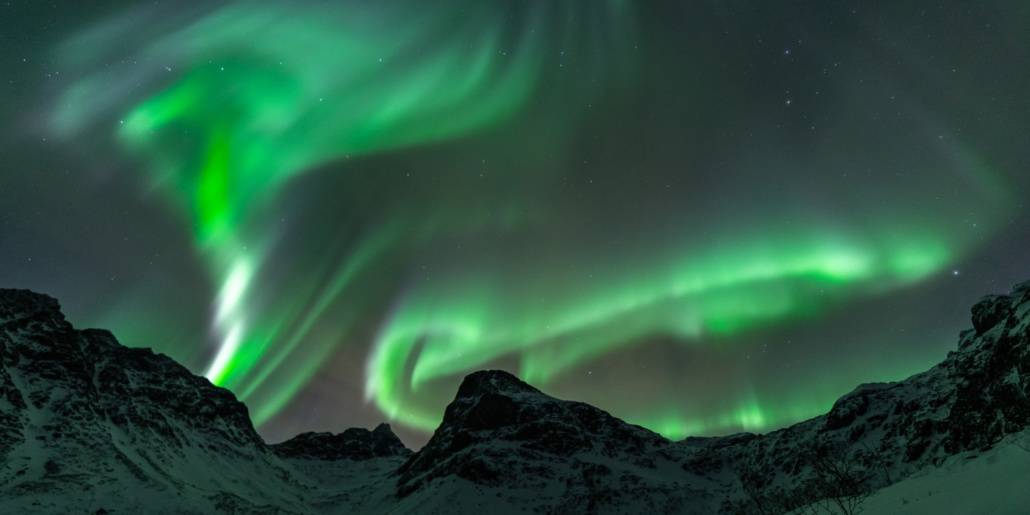
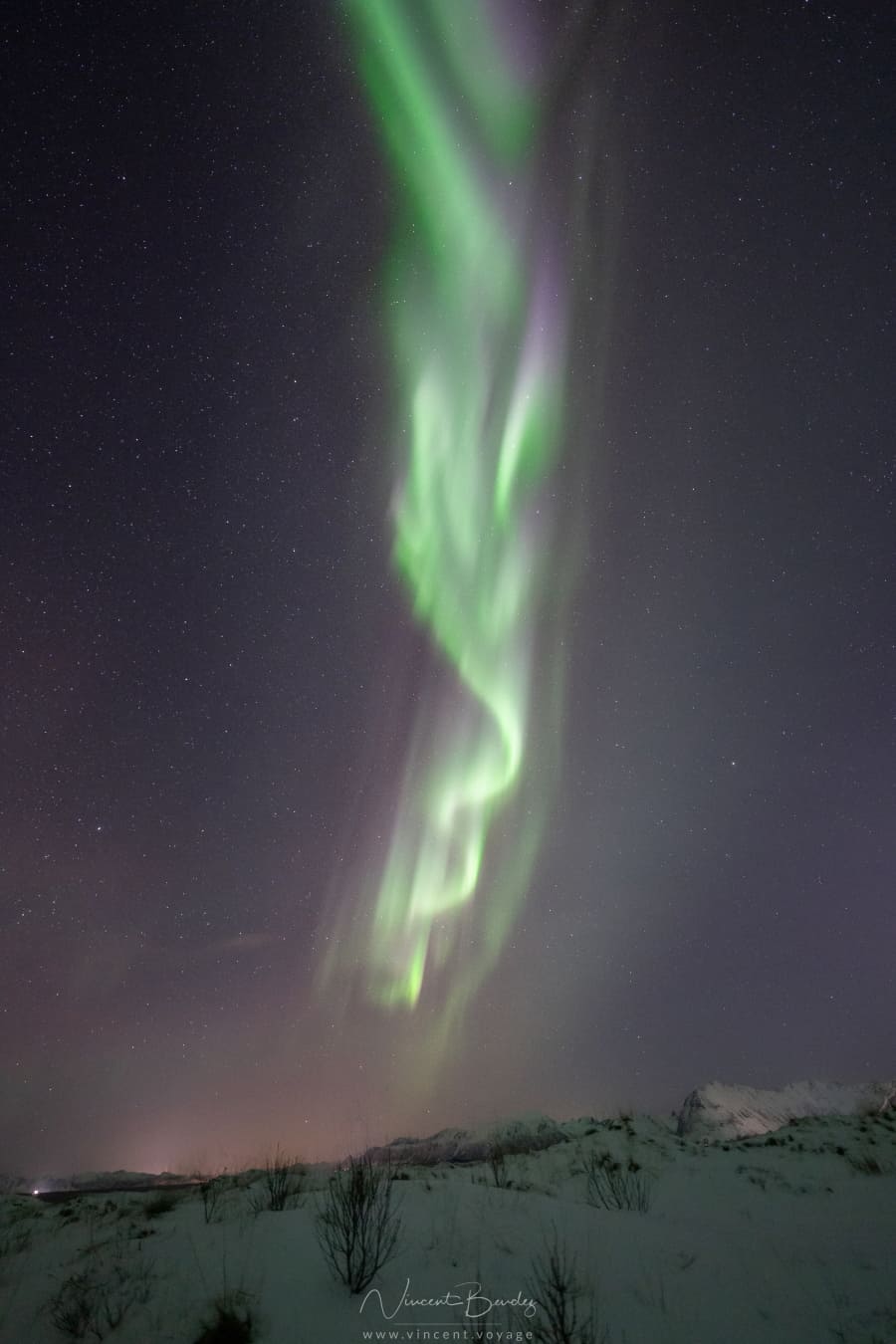
The upside: you’ll have the place to yourself, the light is beautiful, and there’s a chance of seeing the northern lights (yes, it’s far enough north to see them occasionally). However, driving requires experience on snow and winter tyres are mandatory (compulsory in Norway from November to April).
Best saved for those who are properly equipped, passing through the region in winter, and enjoy winter driving.
Spring (April to May): the off-season
Typically: unstable weather (often still cold, sometimes snow), few tourists, some restaurants/museums still closed. Not the worst time, but not the best either. We were there in April — it was 15°C, and locals were telling us it was absolutely not normal. Normally it’s 5°C, lots of rain, wind.
How Much Does It Cost?
Good news: the road is completely free. No toll, no entry fee, no paid parking at the main viewpoints. You drive, you stop, you leave.
The Atlanterhavstunnelen (the underwater tunnel between Kristiansund and Averøy) used to be toll-paying, but it’s been free since 1 July 2020. So you can do the entire round trip without spending a single øre on tolls. Except for urban tolls (Molde and Kristiansund).
In short, it’s a genuinely cheap excursion by Norwegian standards.
What to Combine It With? (The Real Question)
This is where the road really comes into its own. On its own, it doesn’t warrant a major detour. But combined with what’s around it, it becomes a logical stop on a road trip.
The best combo: Trollstigen + Geiranger + Atlantic Road. This is the golden triangle of the Møre og Romsdal region. You climb the Trollstigen (the most jaw-dropping switchback road in the country), drop down to the Geirangerfjord (the most famous fjord, UNESCO-listed), and head up to Molde then the Atlantic Road. Allow 3 to 4 days minimum for this circuit, ideally 5-6 days if you take your time. It’s in this context that the Atlantic Road finds its place: as the conclusion of an already impressive journey.
Romsdal and the Atlantic Ocean Road by bike. For the sporty, the road is also beautiful by bicycle (little elevation gain, often strong wind). Several rental shops in Molde and Kristiansund. Allow a full day.
The Farstadsanden / Vevang coastal walk. On the stretch between Vevang and Bud, there’s a marked coastal path that follows the beaches and low cliffs. 5-7 km on flat ground, suitable for everyone. A great option if you want to “get out of the car” and experience the landscape differently.
Trondheim afterwards. If you’re heading north after the road, Trondheim is 3h30 from Kristiansund. Beautiful student city, Nidaros Cathedral (the largest in Scandinavia). A great extension.
My Honest Take: Overrated?
I said it in the intro, and I’ll say it again here more calmly.
What I liked:
The sequence of bridges is really nice, especially when you approach Storseisundet and get that impression the bridge dives into the sky with its ultra-photogenic little curve. The rest areas are very well done (Eldhusøya in particular is an architectural achievement — you can tell real design work went into it). The practical side is unbeatable: it’s free, it’s short, it’s easily accessible, and you can do the whole thing without any reservation.
Drone footage is where you’ll really get your money’s worth, I think — you’ll see all the little islands too, and in summer you’ll have that turquoise water below.
What disappointed me:
It’s shorter than you’d imagine. And fewer bridges than I expected. 8 km goes by fast. When you’ve seen image after image on social media, you expect 30 km of road clinging to the ocean; in reality, the “wow” experience lasts 10-15 minutes.
The surrounding landscape, outside the main bridge section, is pleasant but nothing special. Flat moorland, sheep pastures, a few fishermen’s houses: it’s nice, but when you’ve spent the previous days in Geiranger or on the Trollstigen, the contrast is stark. Everything feels more understated, more modest.
The “spectacle” factor depends heavily on the weather. Without a storm and without waves crashing over, it’s just a pretty road. If the weather is grey and slightly windy but not too much, it’s nice but the light isn’t great. If you go on a sunny day with a flat sea, you’ll get nice calm photos but without the epic quality sold by the tourist websites.
My verdict: do it if you’re in the area — don’t miss it, but don’t build up the expectation too high. It’s a good “while you’re there” on a road trip, not a stop that justifies 6 hours of driving one way. And if you have to choose between the Atlantic Road and the Trollstigen, go for the Trollstigen without hesitation.
If you’re not in the area, don’t make a detour just for this. You can always come for Molde, Kristiansund, and then head either towards Ålesund or the Trollstigen.
One last thought that struck me: Norway is a victim of its own scale. When every day throws a fjord with 1,500 m of cliff face at you, dozens of waterfalls, and vertiginous switchback roads, 8 km of bridges 5 m above the ocean feels almost tame.
Taken in isolation (say, as part of a trip around Belgium or the Netherlands), this would probably be the most beautiful road of the whole holiday. In Norway, it’s just “nice” I think.
In Summary: Is It Worth Going?
Yes, if:
- You’re already in the Møre og Romsdal region (Molde, Kristiansund, Trondheim)
- You’re on a road trip that naturally passes through the area
- You’re going in autumn for the storms (that’s when it’s truly spectacular)
- You enjoy beautiful engineering and the architecture of the rest areas
- You want to tick off the iconic Storseisundet bridge photo
No, if:
- You’re in Bergen and considering 8 hours of driving just for this
- You’re expecting grandeur on a par with the Trollstigen or Geiranger
- You’re going in calm weather in the middle of summer at noon (you’ll be disappointed)
- You have limited time in Norway and a long list of other must-sees
There you have it — I hope this guide has helped you know what to expect. The Atlantic Road is a nice stop on a Norwegian road trip, not the absolute masterpiece it’s sold as. But done right, in the right season, with the right stops, it’s still a good memory.
Safe travels!
More Resources for Your Norway Trip
Here are a few more articles that should help you plan your stay in Norway:
- What to see in Norway – discover all the essential information for your future trip in this pillar article
- How to pay ferries and tolls in Norway – here I explain the procedures for getting a badge or having your plate recognised
- What to do in Bodø – a quick look at the gateway to the Lofoten Islands
- Exploring the fjords of Norway – an essential guide to discovering one of the most beautiful regions in Norway
- A two-week itinerary in the Norwegian fjords – step by step, road by road, discover the most beautiful spots!
- What to see in Bergen – here’s what you shouldn’t miss in the Hanseatic city!
- Where to stay in Bergen: the best hotels – here’s a great selection of the best accommodation, including affordable options!