Last updated on
Okay, let me just say it straight away: if you’re travelling through the fjord region of Norway and you don’t hop on the Flåm railway, you’re going to regret it. I know, I know, you’re going to read a lot of “Flåm is to be avoided, the train isn’t all that great”. But honestly, no. Well, everyone’s entitled to their opinion of course (mine is worth no more than anyone else’s), but the journey really is super nice, it’s gorgeous, and above all you probably won’t be coming back any time soon so you might as well do it! If everyone talks about it this much, there’s surely something to it 🙂
20 km of railway, 866 m of elevation gain, 20 tunnels (18 of which were dug by hand by Norwegian workers between 1923 and 1940, yes really, with pickaxes), a maximum gradient of 5.5% which makes it one of the steepest standard-gauge railways in the world, and in the middle of all that the Kjosfossen waterfall crashing down 225 m. Lonely Planet named it the most beautiful train journey in the world back in 2014, and National Geographic ranked it in the global top 10. So between the old-timers (who dug it), the guidebook publishers, and the hundreds of thousands of travellers who ride it every year, pretty much everyone agrees: there’s something here, it’s one of the most beautiful train journeys on the planet.
And for a little personal note: I just did it again in early April 2026, having already done it a few years back. And even having seen it before, even knowing what was waiting for me, even with a waterfall a bit worn out by the end of winter (more on that below), well, it’s still really stunning. Especially since it was a different season (spring, before summer).
So yes, I can confirm it, it’s a must-do in the fjord region of Norway. Just like the Nærøyfjord cruise, which people often do as a combo, by the way.
In this article I’ll tell you everything: why you should take the Flåmsbana, the 2026 prices, the timetables, how to book (and where, because there are a few traps), which side to sit on (the real question nobody settles clearly), what time to show up to get a window seat, the notable stops, the dried-up-waterfall trap in late summer, the zipline and the Rallarvegen bike ride for getting back down, what you can do nearby, and where to stay.
Let’s go!
Why you absolutely should take the Flåm railway
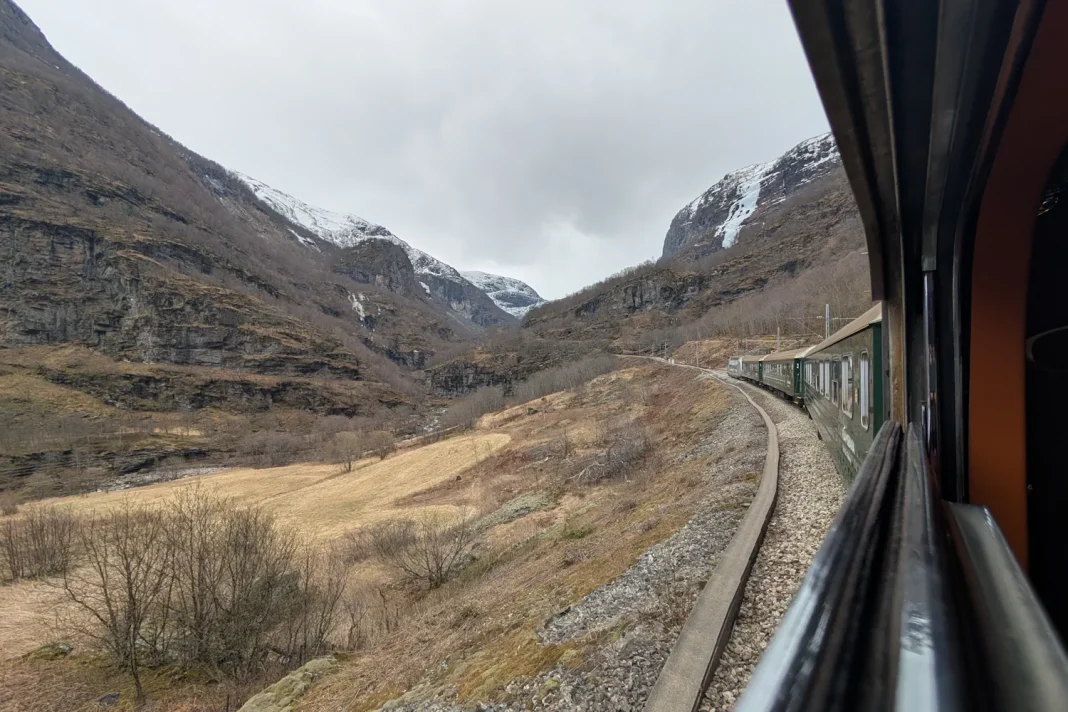
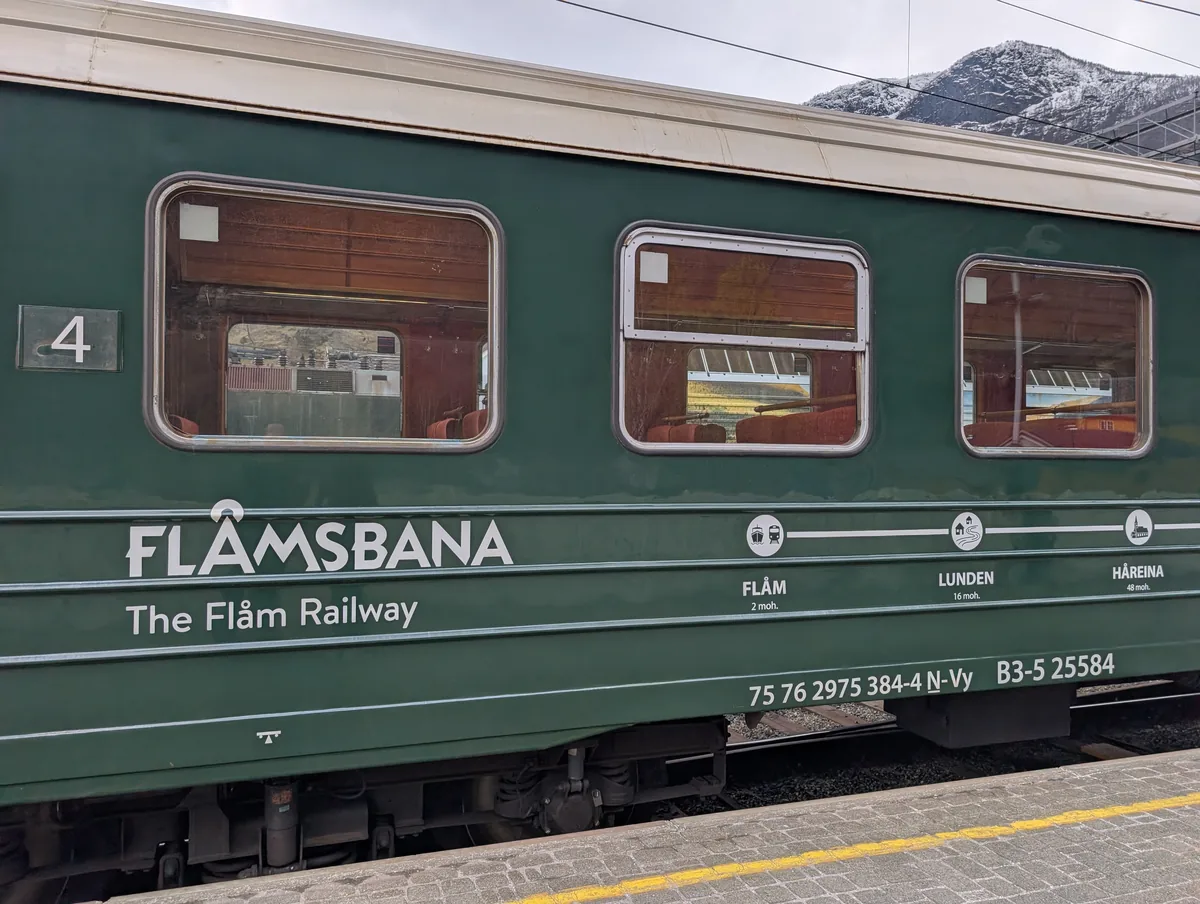
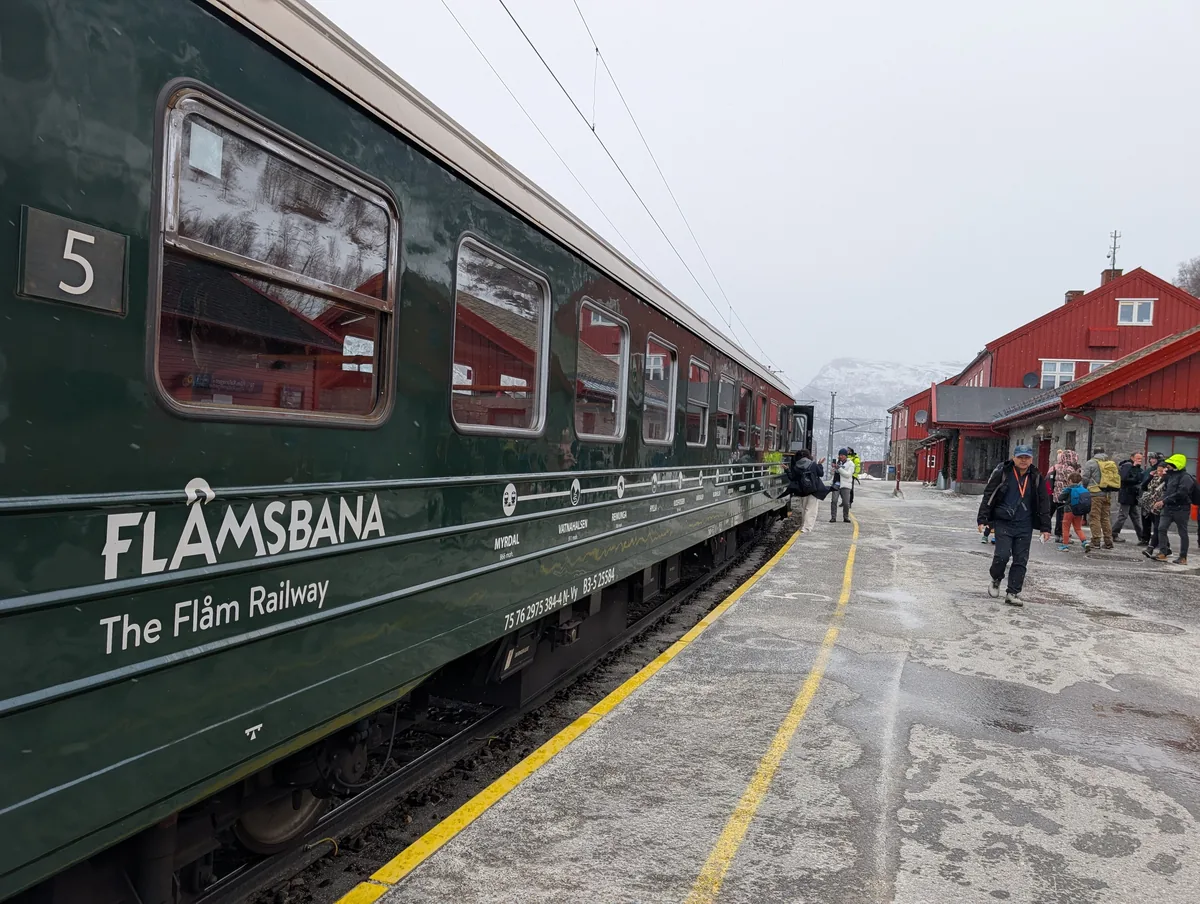
It starts in Flåm, that little village at the head of the Aurlandsfjord. You climb aboard a dark green train (the carriages have been renovated, old-fashioned light-wood atmosphere, big picture windows, it’s comfortable), a whistle blows, and the train sets off very gently along the Flåmselva river.
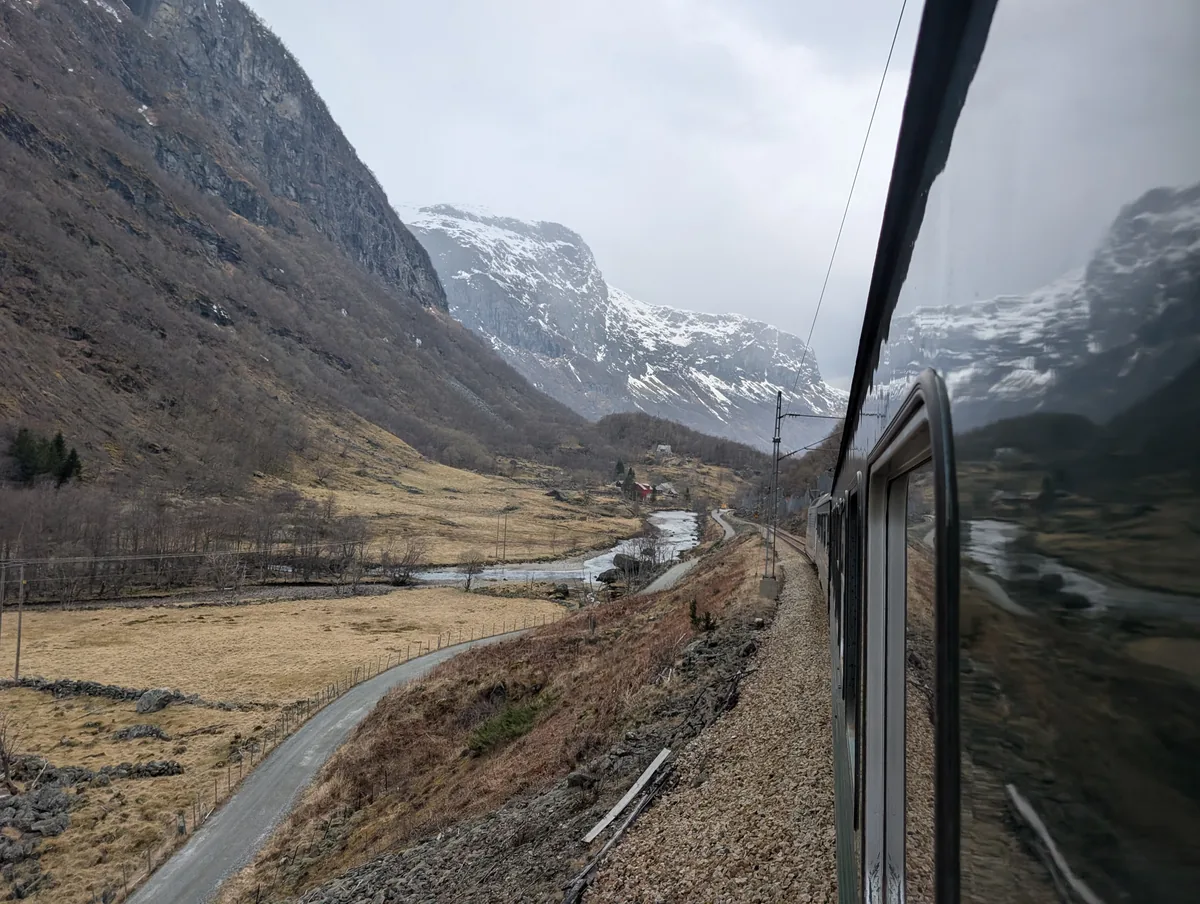
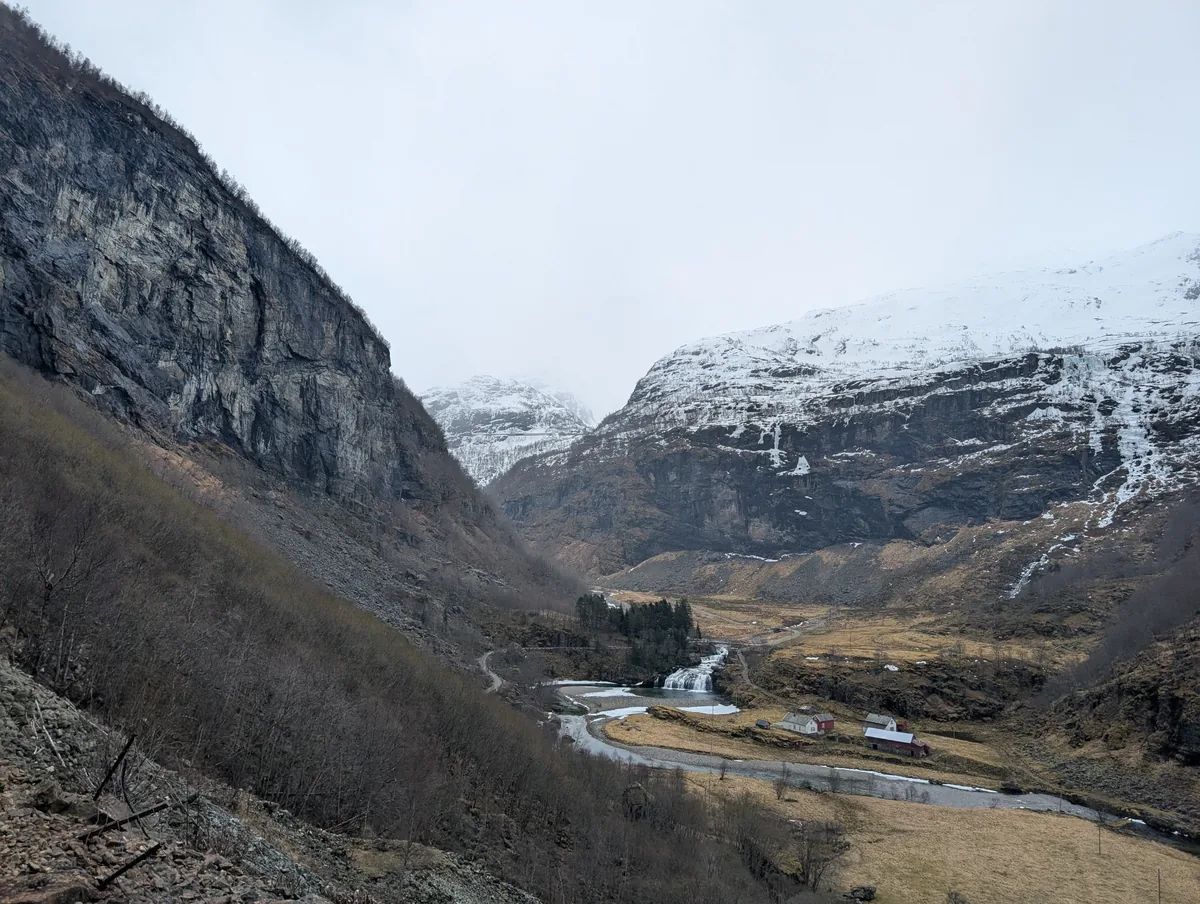
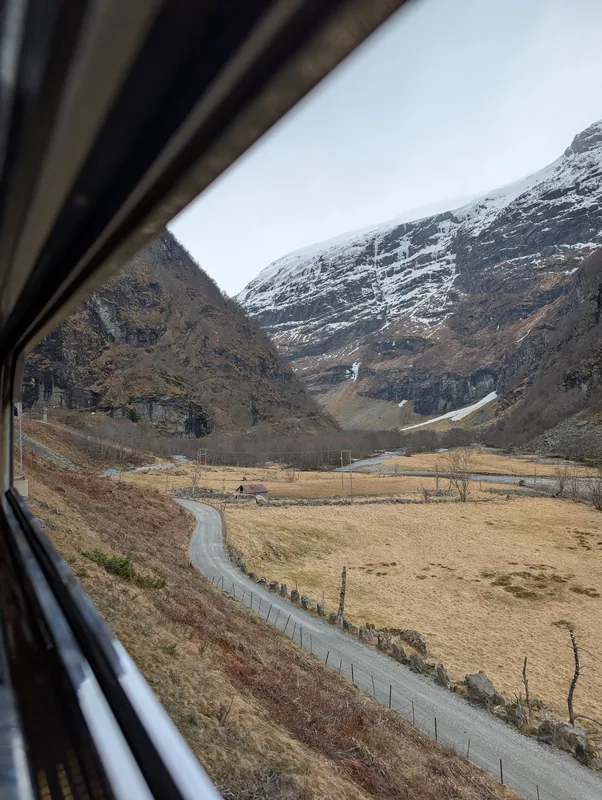
For the first few minutes, you follow the bottom of the fjord. Little farms, paddocks, a wooden church standing in the distance (Flåm Kyrkje), the river winding along. It’s all rather peaceful, you tell yourself “OK, it’s pretty but it stays mellow”. And then it starts to climb. Gently, then more steeply. The cliffs close in. You pass your first freight train going the other way at Berekvam (the only double-track station, this is where trains cross every hour on the hour, by design of the system). And that’s when you realise things are about to get serious.
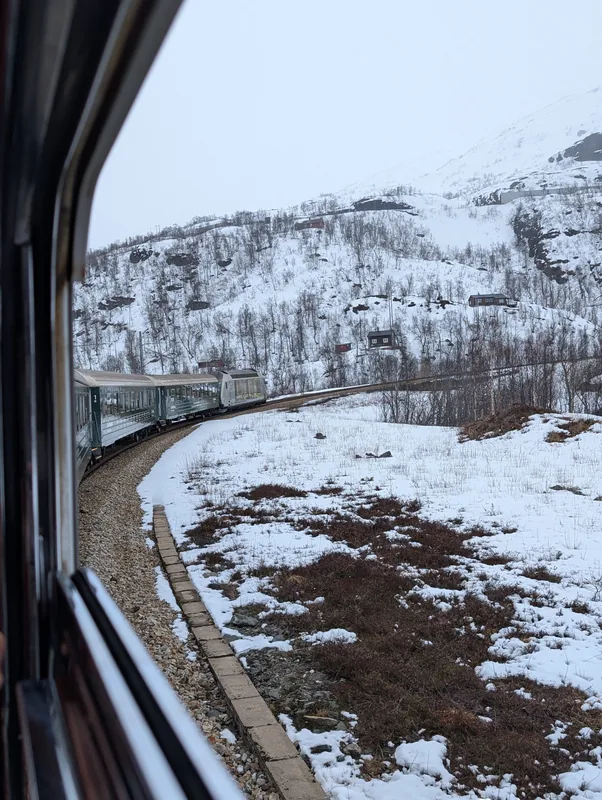
As the kilometres go by, the landscape changes completely. Birch forest, then firs, then nothing but bare rock, patches of snow even in the middle of summer (well, I can tell you that in spring we had quite a lot of snow :D), waterfalls tumbling down in curtains, and tunnels (there are 20 of them, including a double-S spiral inside the mountain — you feel the train turning back on itself in the dark, it’s a strange sensation). All while climbing a 5.5% gradient, which makes it one of the steepest adhesion-only railways in the world (yes, there are steeper rack railways elsewhere, but without a rack the Flåmsbana is among the world’s steepest).
And then comes Kjosfossen. The train slows, stops at a little platform in the middle of the mountain, you step out, and there you have 225 m of waterfall crashing down just 30 m from you. Plus the Huldra show (more on that below, it’s the “postcard” moment of the trip). A 5-minute stop, photos, videos, and back on board.
The train sets off again, passes through Vatnahalsen (the second-to-last station, perched at 811 m, the starting point for the zipline) and arrives at Myrdal at 866 m of altitude. This is the junction with the main Bergen-Oslo line. Many people do the direct round trip (1h each way, 2h total), others head back down on foot or by bike along the Rallarvegen, others carry on towards Bergen or Oslo by train.
The thing is, no matter the formula, no matter the season, no matter the weather: the journey is always stunning. I did it the first time under a blazing summer sun a few years ago, I just did it again in April 2026 with still loads of snow around the upper stations, and both times I found it magnificent. The landscapes change radically from one season to the next, which is even an argument for doing it several times if you come back to the region.

Flåm railway: prices, timetables and booking in 2026
Right, let’s get down to the practical stuff. Here’s everything you need to know before clicking “book”.
How much does a Flåm to Myrdal train ticket cost in 2026
Prices vary by season (high season = mainly June to August, spilling over a bit into May and September), and by where you buy. Here are the ballpark figures, checked on Vy.no and Norway’s Best in April 2026.
- One-way Flåm → Myrdal: from about 430 NOK (~37 €) in low season, up to 510 NOK (~45 €) in high season
- Round trip (the most popular option): from about 620 NOK (~55 €) in low season, up to 730 NOK (~64 €) in high season
- Children 6–17: 50% discount
- Under 6: free
- Eurail / Interrail pass: -30%, but be careful, you have to buy the ticket directly at a station counter or by phone with Vy (impossible online with the pass)
If you see a price somewhere that’s well above these ranges, it’s probably a middleman reseller (Rail Ninja, Klook, certain tour operators) taking a hefty margin. Buy directly on Vy.no or Norway’s Best, it’s exactly the same train, exactly the same carriages, but without the middleman markup that can climb to +50 or +80%. Never book with Rail Ninja. It’s a real rip-off. So the official links to buy are:
- Norway’s Best
- VY.no (the Norwegian railways)
So yes, it’s a bit of a budget item when you’re travelling as a family. And I understand it can make you hesitate. But look at the children’s prices, that’s not bad at all.
Flåmsbana timetables: how many trains per day depending on the season
The train runs all year round, and that’s one of the big perks: you can do it in the height of summer or the depths of winter, the scenery is just very different. The frequency changes with the season.
- High season (1 May – 30 September): around 6 departures a day from Flåm, roughly between 8:20 a.m. and 4:00 p.m. First departure at 8:20 a.m., last at 4:00 p.m. (typical departures 8:20, 9:35, 10:50 a.m., 12:10, 2:45, 4:00 p.m.). Returns from Myrdal roughly 1h after each arrival.
- Summer peak (July – mid-August): extra departures possible (8 to 10/day on the busiest days), to be checked case by case on the official calendar.
- Low season (1 November – 31 March): 4 departures a day, later (9:00, 11:45 a.m., 2:30, 4:50 p.m.). On 24, 25 and 31 December, even fewer (worth checking).
For the exact timetable on your specific day, here’s the official link: flamsbana.no/rutetider. It’s the up-to-date source, no middleman.
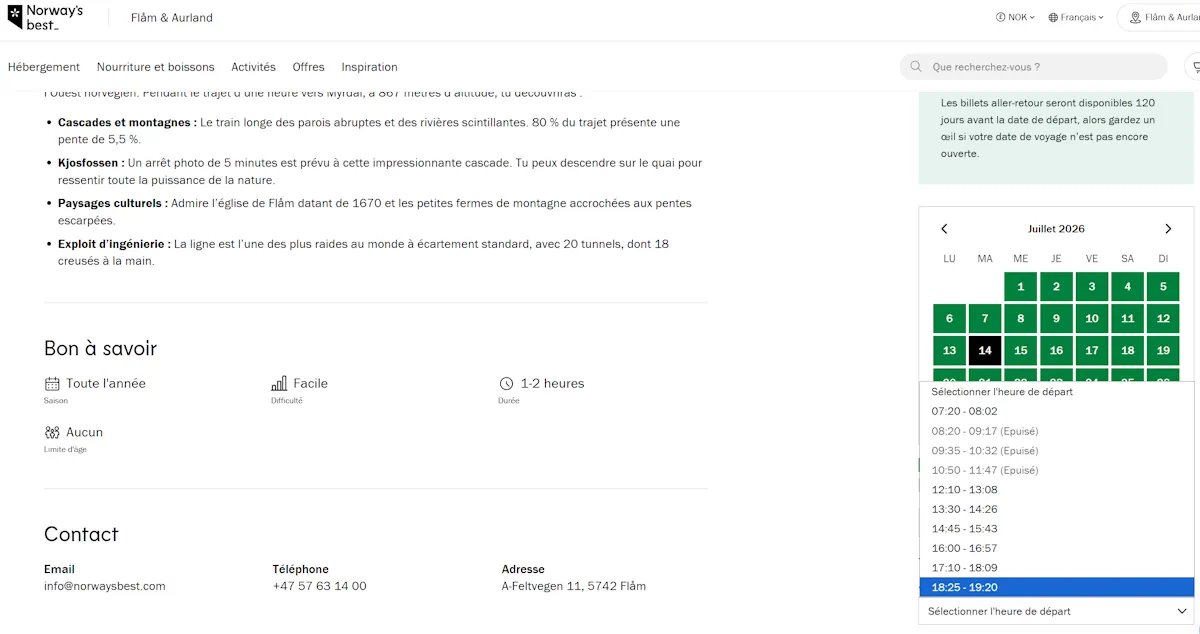
But above all, in the table below you can select your visit date and see which trains are available. So no, I haven’t yet managed to get the trains’ real-time availability (still trying!) to give you even more visibility, but already some estimates on how full they are.
When and where to book your ticket
This is important, because the strategy isn’t the same depending on the season.
In low season (October to April), honestly, you can book the day before for the next day, or even buy your ticket the same morning at the Flåm or Myrdal counter. When I was there in early April 2026, I took the second train of the morning having booked the day before, the carriage was almost completely empty, I got the seat I wanted, window on the right-hand side, with zero stress. And it was great.
In high season (June to August), you need to book at least 2 to 3 weeks in advance, and ideally 3 to 4 weeks for the most popular departures (10 a.m.-2 p.m.). Tickets open for sale about 60 days before the date. In July-August, I’ve seen several travellers recount finding everything “sold out” on every departure of the day, 2 or 3 days out.
A little-known timing tip: if you’re unsure about the time slot and want to secure a seat, book the return train first (Myrdal → Flåm), which is tied to the main Bergen-Oslo line and therefore fills up first. The uphill train (Flåm → Myrdal) has a bit more wiggle room.
Where to book in practice:
- Vy.no — the Norwegian railway company, the official source, the lowest price, payment in NOK or EUR
- Norwaysbest.com / flamsbana.no — the official platform that bundles the region’s train + boat + bus tickets; same price as Vy, more convenient if you’re combining (for example train + Nærøyfjord boat)
- At the Flåm or Myrdal counter — possible if you want to try your luck on the day in low season
And so what to avoid: Rail Ninja, Trainline, Klook and other English-speaking resellers who take a big margin on this route and present their price as “the official fare”. It is not the official fare.

What is the best time to do the Flåm railway
Short answer: each season has its arguments. Here’s my honest summary after doing it twice and comparing quite a few opinions.
- May – early June: my favourite period. Snowmelt, so Kjosfossen roars (the waterfall is at its peak), there’s still snow on the summits around Vatnahalsen-Myrdal, the days are already very long, and the crowds stay reasonable. The Huldra show at Kjosfossen starts on 1 June, so from that date you get that too.
- June: the “gold” month in theory. Everything works, the light is superb, water cascades everywhere. It’s also when the cruise ships start arriving in force.
- July – August: very pretty, but it’s also the big crowds. You have to book well in advance, arrive early at the station, queue up. And another point: in a dry midsummer, Kjosfossen can be very underwhelming, because the waterfall is partially regulated and the snowmelt is over. If you want the waterfall in all its glory, go for May-June.
- September: very pretty too, the first autumn colours on the birches, crowds dropping off from mid-September. The Huldra show stops on 31 August, so no more dancer, but the waterfall is still there.
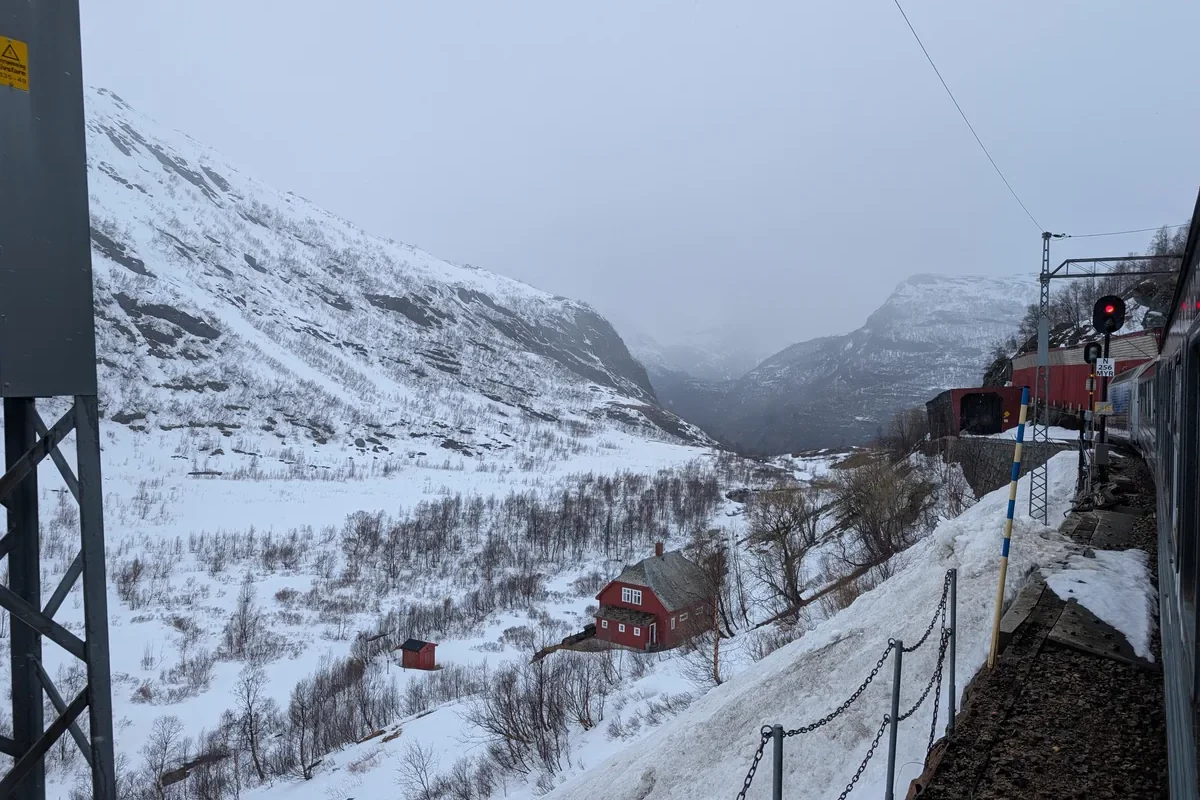
- October – April: a totally different atmosphere. Snow, ice, partially frozen waterfall, few people, magical light in the middle of the day. No Huldra, and some tourist functions close (zipline, Rallarvegen bike). But the on-board experience is almost more magical in winter, because it feels like you’re crossing a Narnia-style set. That’s what I experienced in early April, it was really lovely.
So if I had to recommend a single window to combine “impressive Kjosfossen + Huldra + crowds that aren’t too crazy”: the first half of June. But know that it’ll be great in any case, you’ll always get something different.

How to make the most of the journey: seats, windows, timing
The right seat, the right window and the right timing are what make the difference between a “nice” trip and a “completely insane” one.
Which side should you sit on in the Flåm train
A recurring question, rarely settled clearly. Here’s the clear answer:
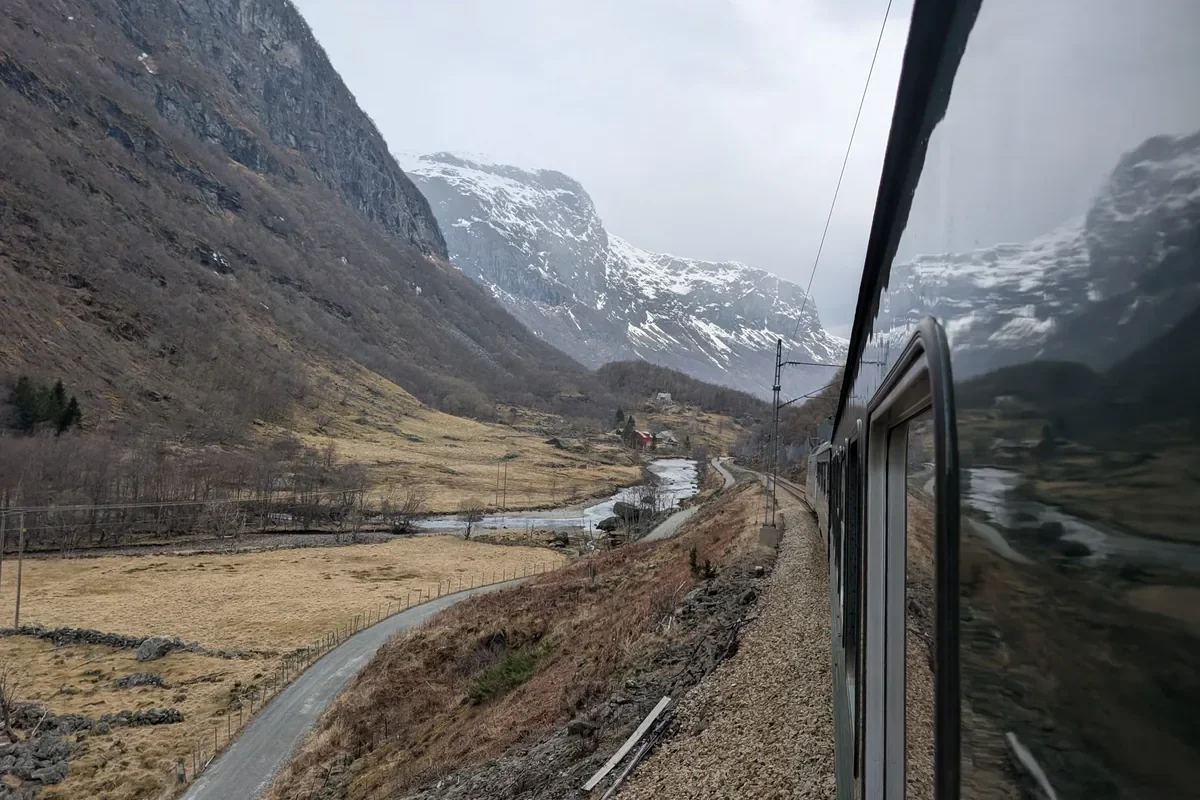
- Flåm → Myrdal direction (going up): sit on the RIGHT in the direction of travel. That’s the side where the Flåmselva river, the main waterfalls of the route go by; Kjosfossen is on the other side but you get off the train anyway. I’ve done two round trips, the right side really is better.
- Myrdal → Flåm direction (going down): sit on the LEFT in the direction of travel, so the right-hand side of the carriage as seen from the ground. You get the same views but in reverse, and Kjosfossen will be on your left.
Well, if you do the round trip, you can enjoy both sides, so you can swap once you reach the top. As long as there’s room on the train, that is!
A little tip: at Kjosfossen, everyone gets off the train, so the side of the carriage matters little for the waterfall itself (you’ll be on the platform). What matters is your side for ALL THE REST of the journey — the valleys, the perched farms, the tunnel spiral — and there, it really is the right side going up that wins.
If you can, open the windows while the train is moving, to take photos (mind you don’t drop your camera), to stick your nose out. Especially if there aren’t many people around, no one will complain!
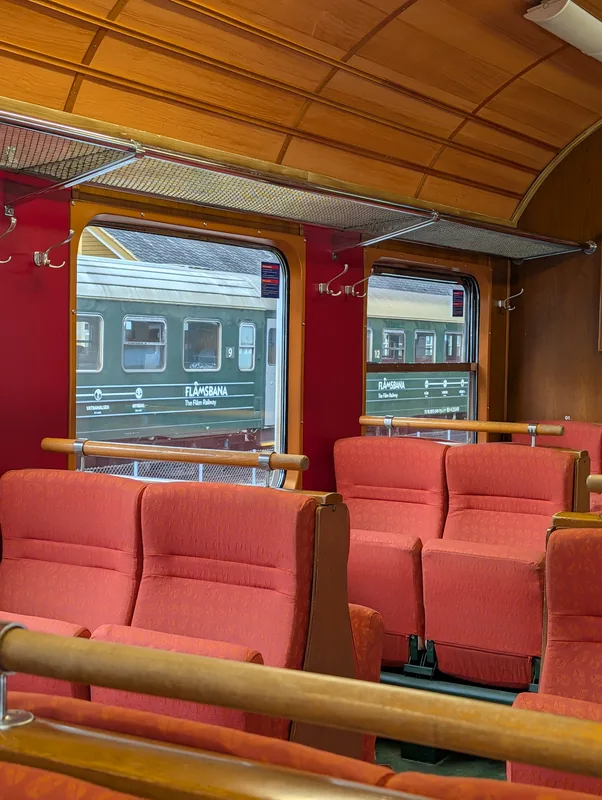
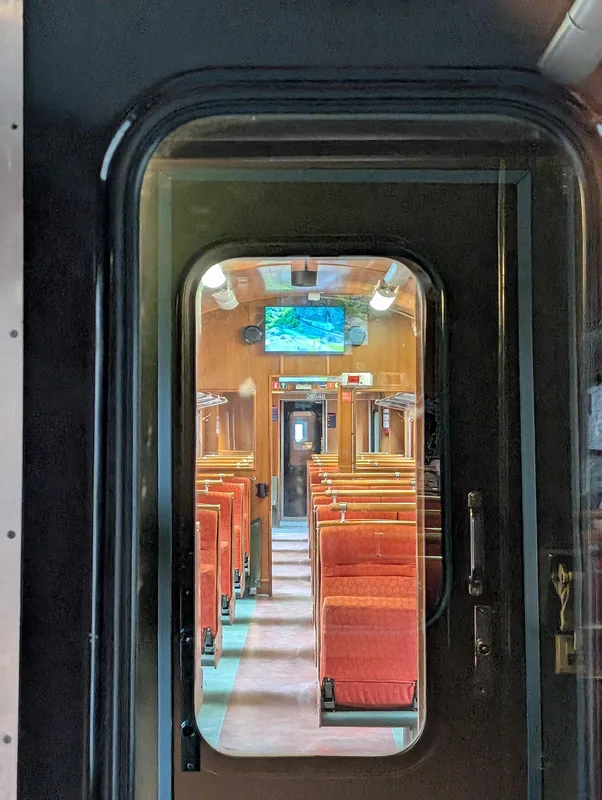
What time to arrive at the station to get a good seat
There are no seat reservations on the Flåmsbana. It’s free seating, first come first served. So your arrival time at the station is just as important as the ticket itself. Bear in mind that access to the train opens 30 minutes before departure, not before.
- Low season (October to April): 10-15 minutes before is enough. I was in Flåm in early April 2026, I arrived on the platform 20 minutes before the departure of the second morning train (around 9 a.m.), we were obviously the first there, I could pick absolutely any seat I wanted. Zero stress.
- Mid-season (May, September): 25-30 min before to be safe. The queue starts forming half an hour before departure.
- High season (June to August): at least 30 min before, ideally 45 min, especially if you want the right side + an openable window. When one or two big cruise ships are docked in Flåm in the morning, it can be 60 min before to have a real shot.
Cruise ship warning: to completely avoid the wave of cruise passengers, take the first train of the morning (8:20 a.m.) or the last of the afternoon (4:00 p.m.). The cruise ships are docked roughly between 9 a.m. and 5 p.m., and their passengers take the midday trains (10:50 a.m., 12:10, 2:45 p.m.). The 8:20 and the 4:00 are noticeably quieter even in the middle of July.
And head for the carriages at the back of the train. Most passengers pile into the front carriages as they reach the platform (especially the latecomers), so the end of the train is often much less crowded for the same fare.
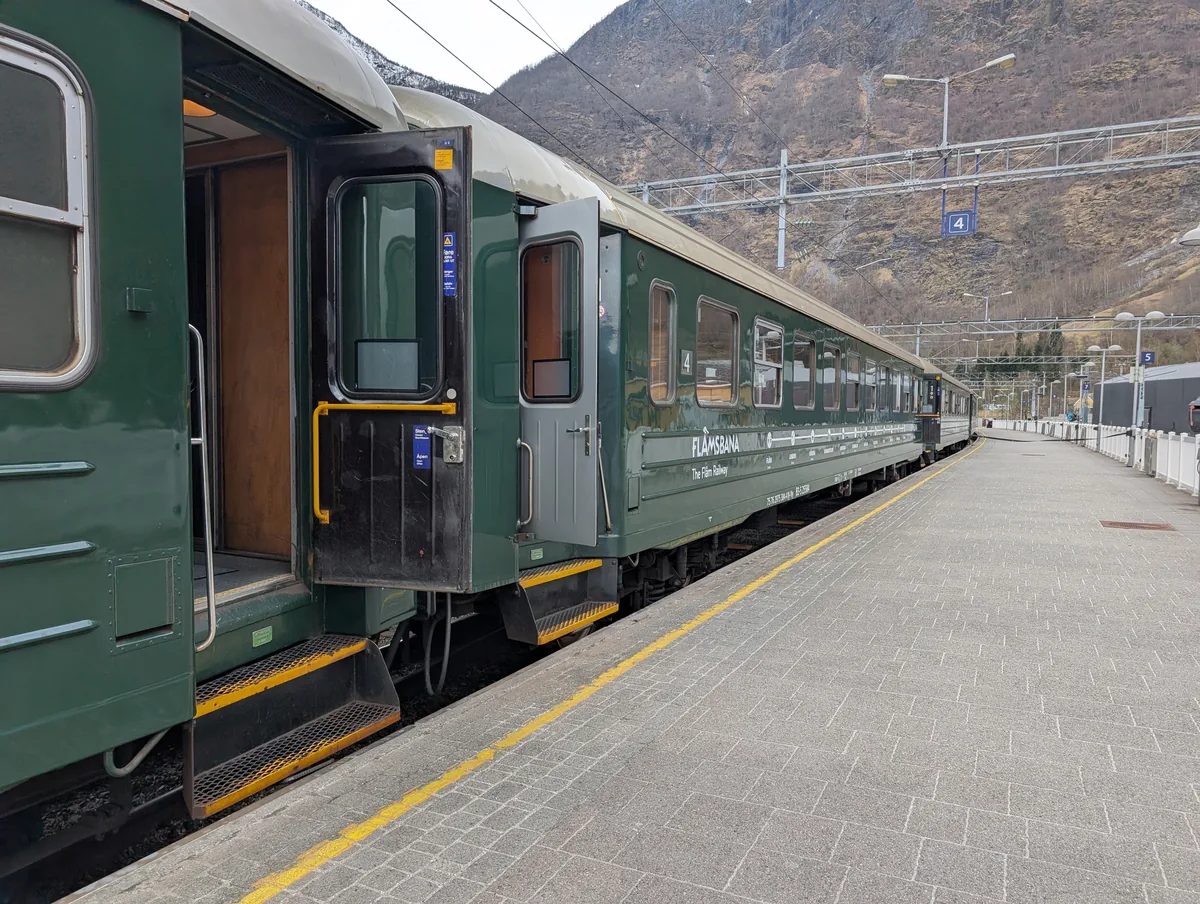
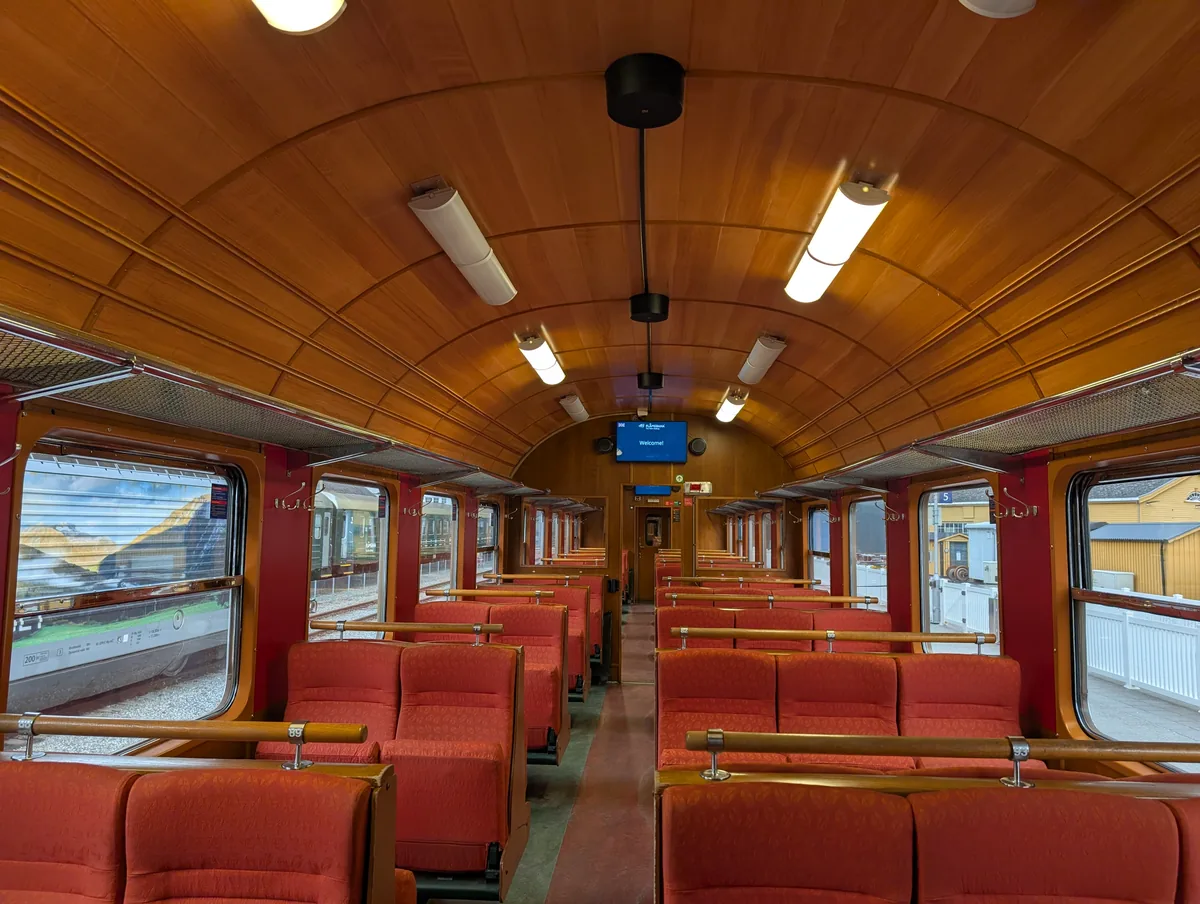
The windows that open (the photo tip)
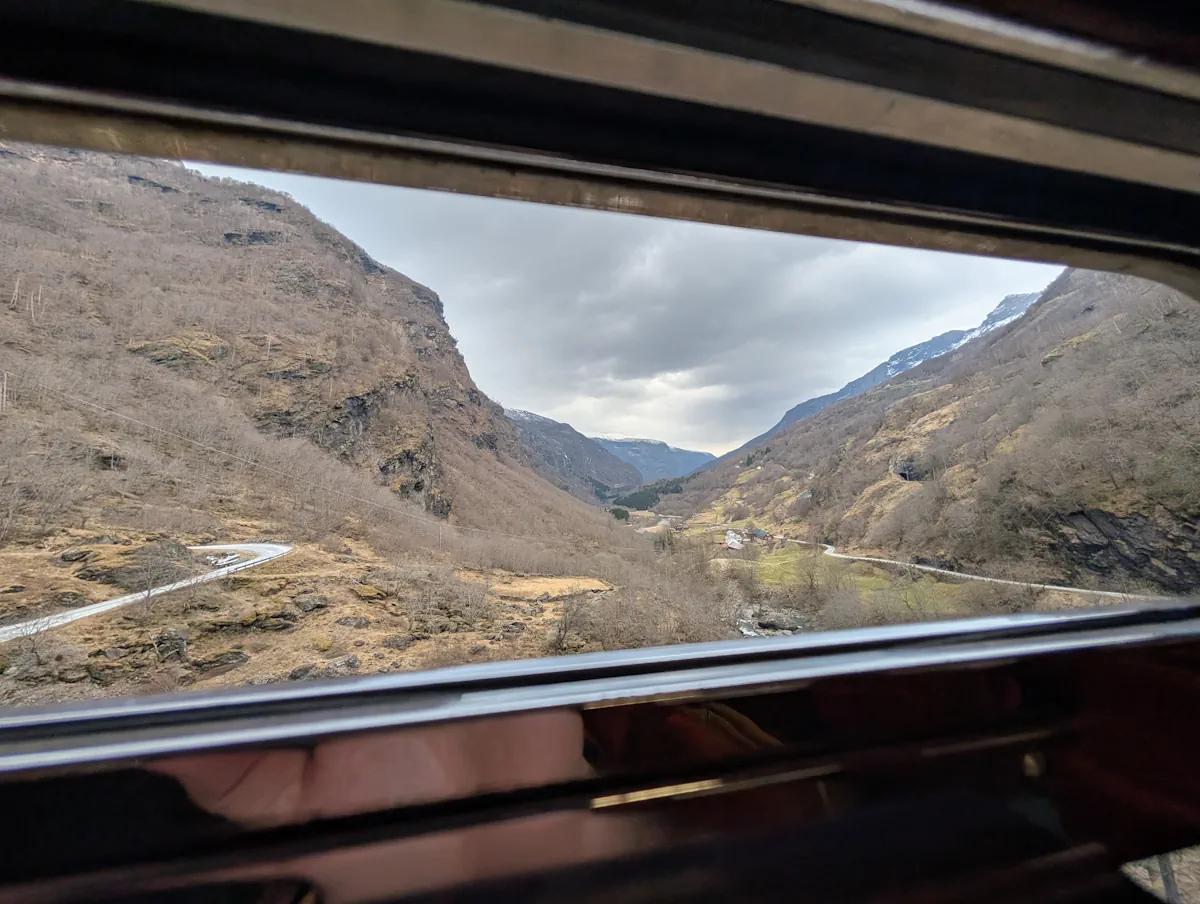
A little secret rarely mentioned: in each carriage, roughly one window in three opens. They’re the ones with a visible double metal frame (two glass panels separated by a thick frame), instead of one single large picture window.
Why does this matter? Because the train runs slowly (30-40 km/h), it stops often, and if you have an openable window you can stick your camera out for photos with no reflection, no dirty glass, and no 15 people in the background. It’s the difference between a “generic internet souvenir” photo and a photo that really pops.
Spot these windows as you board and position yourself next to one. Obviously, in the depths of winter, you’ll freeze fast (and so will your fellow passengers) so remember to close them between stops — but the tip still stands.
The notable stops along the Flåmsbana route
Over the 20 km of the line, there are 9 stations between Flåm (2 m) and Myrdal (866 m). Most tourist trains stop only at the main ones, but some are worth knowing about in case you want to do more.
- Flåm — the start, on the edge of the Aurlandsfjord, right next to the ferry terminal from which the boats to the Nærøyfjord depart. Everything is concentrated within 200 m: station, port, hotels, Ægir brewery, shops, bike shop. Very touristy, it’s heaving in summer.
- Berekvam — the station in the middle of the route, the only double-track one. It’s the crossing point of the trains: every day, at an almost fixed time, an uphill train and a downhill train cross here. For railway fans, it’s lovely to watch.
- Blomheller — a little stop used mostly by hikers doing the Rallarvegen route or mountain trails. Don’t get off here by mistake.
- Kjosfossen — the iconic photo stop, I’ll talk about it in detail right after.
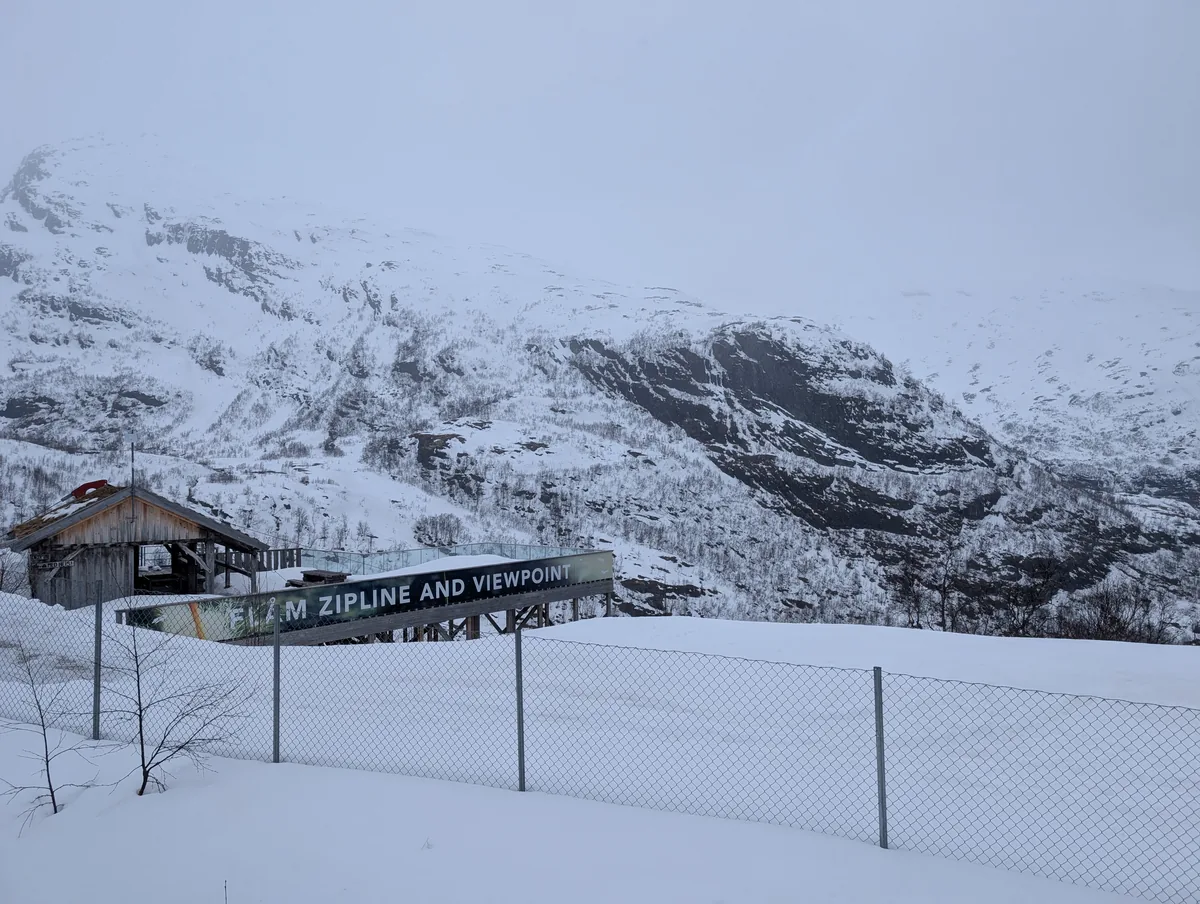
- Vatnahalsen — perched at 811 m, it’s the starting point for the zipline (I talk about it in the activities section). It’s also a historic mountain hotel (Vatnahalsen Høyfjellshotell) where some travellers choose to get off to spend a night at altitude before carrying on the next day. A pretty magical “slow travel” idea.
- Myrdal — the arrival at 866 m, it’s the junction with the Bergen-Oslo line. Otherwise there’s nothing at Myrdal, it’s just a connecting platform and a small bar/café. If you were planning to stay an hour, drop the idea and catch the next train.
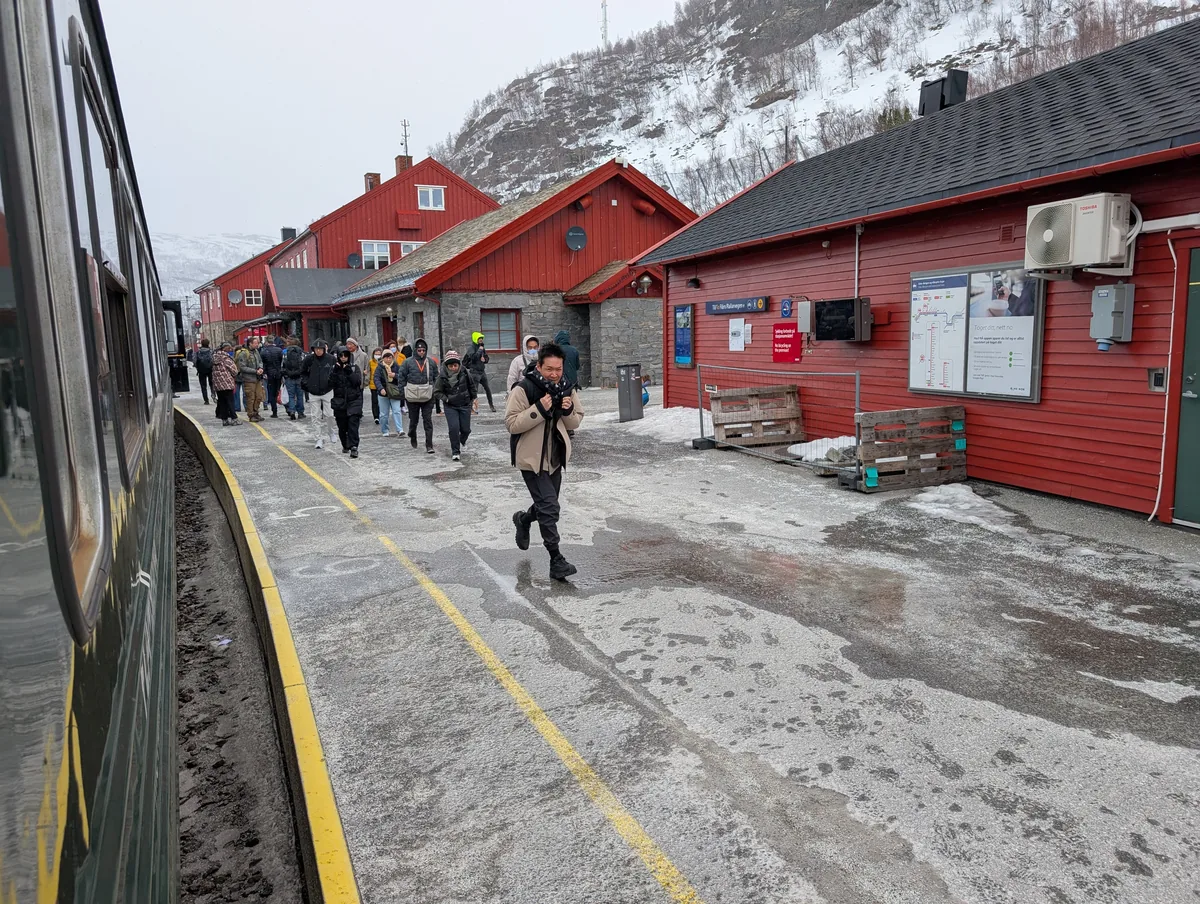
The Kjosfossen stop and the Huldra show
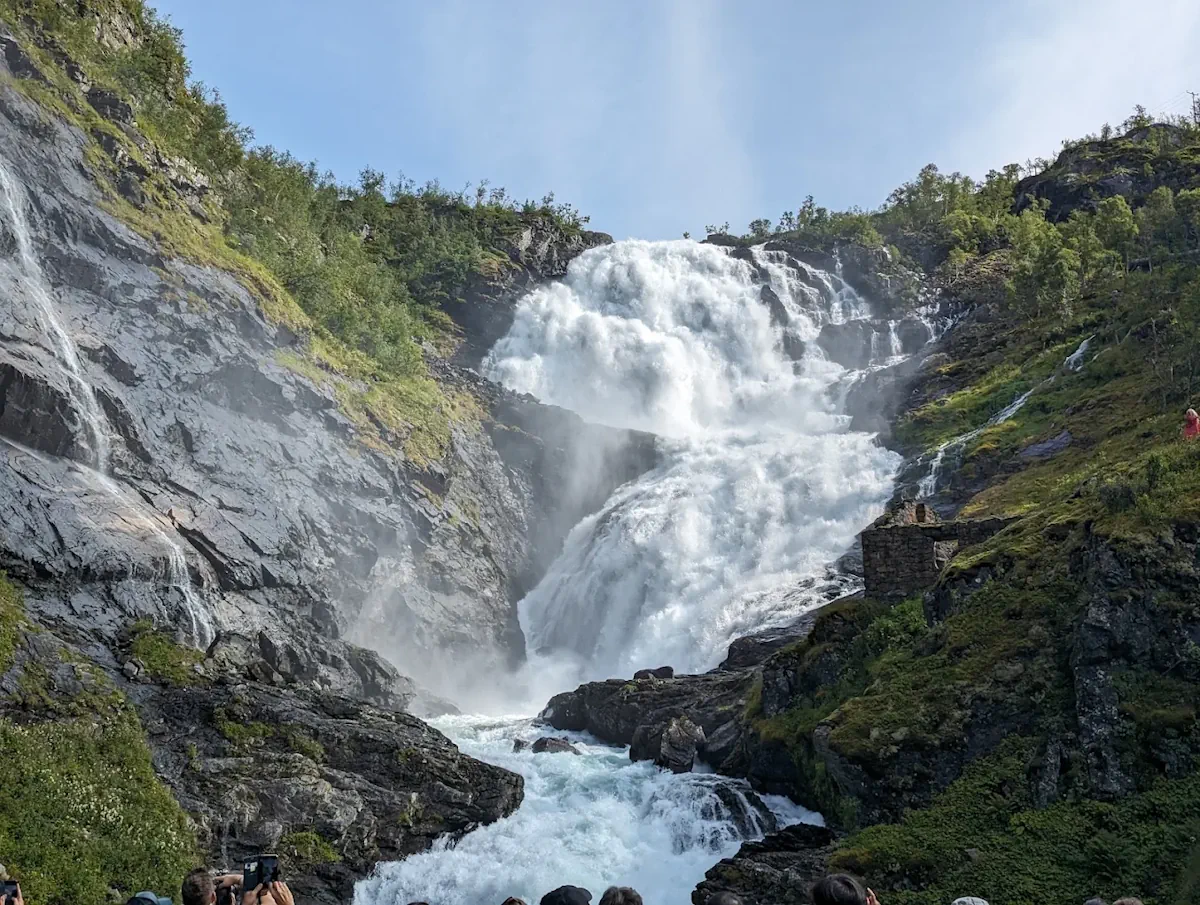
This is THE iconic moment of the trip. The train slows halfway along, stops on a concrete platform suspended in the middle of the mountain, you step out, and 30 m from you Kjosfossen tumbles down 225 m in two tiers.
The stop lasts 5 minutes. It’s short, but plenty for photos and video.
The Huldra show: between 1 June and 31 August, at each stop, a “Huldra” (a Norwegian mythological creature, part witch, part siren, in a red dress) appears on the rocks beside the waterfall and dances to folk music played over speakers. Is it kitsch? A little. Is it touristy? Yes. Does it work anyway? Probably! (I say that because I haven’t seen it yet, it didn’t exist on my previous visit, and this time in April it wasn’t the season)
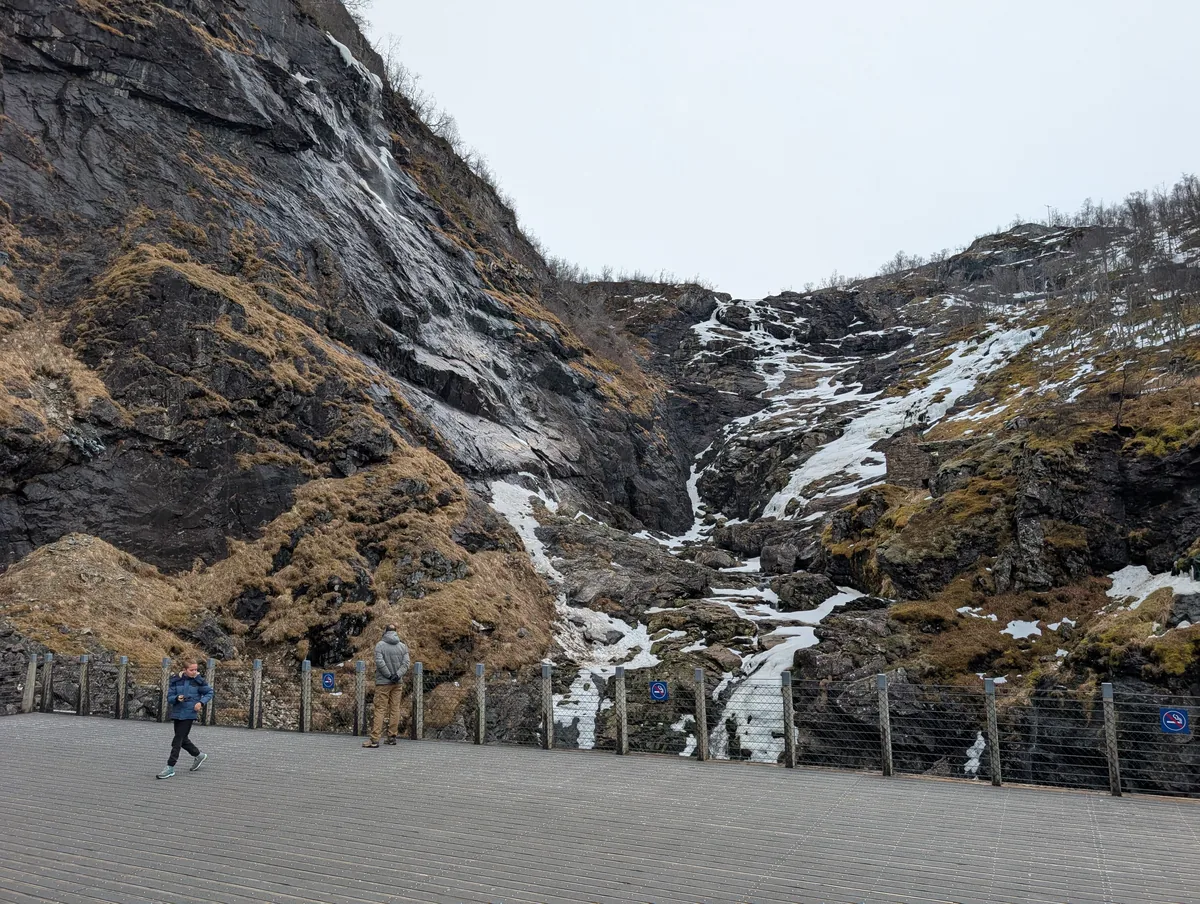
The Kjosfossen warning everyone forgets: the waterfall is partially regulated by a hydroelectric dam upstream (Kjosfossen feeds a Vy power station). So in a dry late summer or a frozen midwinter, the flow can be very reduced, even ridiculous. That’s exactly what I saw on my last visit in early April 2026: quite a bit of ice, little water flowing, and clearly not the cinematic image many come looking for.
So if Kjosfossen is the main reason you’re taking the train, aim instead for May-June (snowmelt) or early September (after the late-summer rains). In a dry July or a frozen winter, don’t be surprised if the waterfall is more modest than expected — the rest of the landscape more than makes up for it, but it’s worth knowing.
And forget the Instagram drone shots of Kjosfossen: drones are strictly forbidden along the entire Flåmsbana route and around Kjosfossen.
In the photo on the left, what I got. In the photo on the right, a picture of what you can get if you’re luckier than me 😀
What to do near the Flåm railway
The train is great, but in and around Flåm there’s really enough to fill a whole day, even two. Here are the experiences that are worth it, in the order I’d recommend them.
The zipline from Vatnahalsen — the longest in Scandinavia
Ah, now this is the experience that really stands out and that few English blogs mention. You get off the train at Vatnahalsen (second-to-last station), you strap on the harness, and you zip 1,381 m down over the valley at more than 100 km/h. 305 m of vertical drop. The longest zipline in Scandinavia.
It’s short (the descent takes about 1 minute), it’s expensive (from about 2,990 NOK, roughly 260 € with the train included), it’s open from April to October only, and you need to weigh between 25 and 140 kg. But the feedback is almost unanimous: it’s insane. A plunging view over the valley, the sensation of flying above the Flåmsbana, and arrival at the Kårdal farm from which you then head back up on foot (a gentle 3.5 km walk) or by bike to Flåm.
It was set up by a farmer, and those who do the zipline land right in his farm and can taste his cheeses. Clever!
To be booked on Norway’s Best or directly with Flåm Zipline. To be avoided in very bad weather (the descent is cancelled in case of storms or strong wind).
Heading down Myrdal → Flåm by bike along the Rallarvegen
The other great classic: take the train up, and ride the 18 km back down from Myrdal to Flåm along the old road of the railway builders (the Rallarvegen, “the navvies’ road”). 850 m of descent, switchbacks on gravel, waterfalls everywhere, perched farms… it’s just sublime. And accessible to anyone who can pedal — the only real difficulties are a few gravel sections.
Allow 2h to 3h for the descent depending on your pace and photo stops.
On the practical side:
- Season: mid-May to late September, off-season the road is snow-covered and closed
- Bike rental: around 400 to 500 NOK a day in Flåm. The simplest is to rent the bike in Flåm before going up, load it onto the train (allow ~80 NOK extra for the bike ticket), get off at Myrdal and ride back down the road.
- Rental shops: Flåm Bike Rental is the safe bet, with pickup right at the Flåm station
- Helmet: recommended, the downhill gravel can catch you off guard
If you have the day and a bit of leg, it’s probably the best way to experience the valley — far more immersive than the simple round trip by train.
Kayaking in the Aurlandsfjord
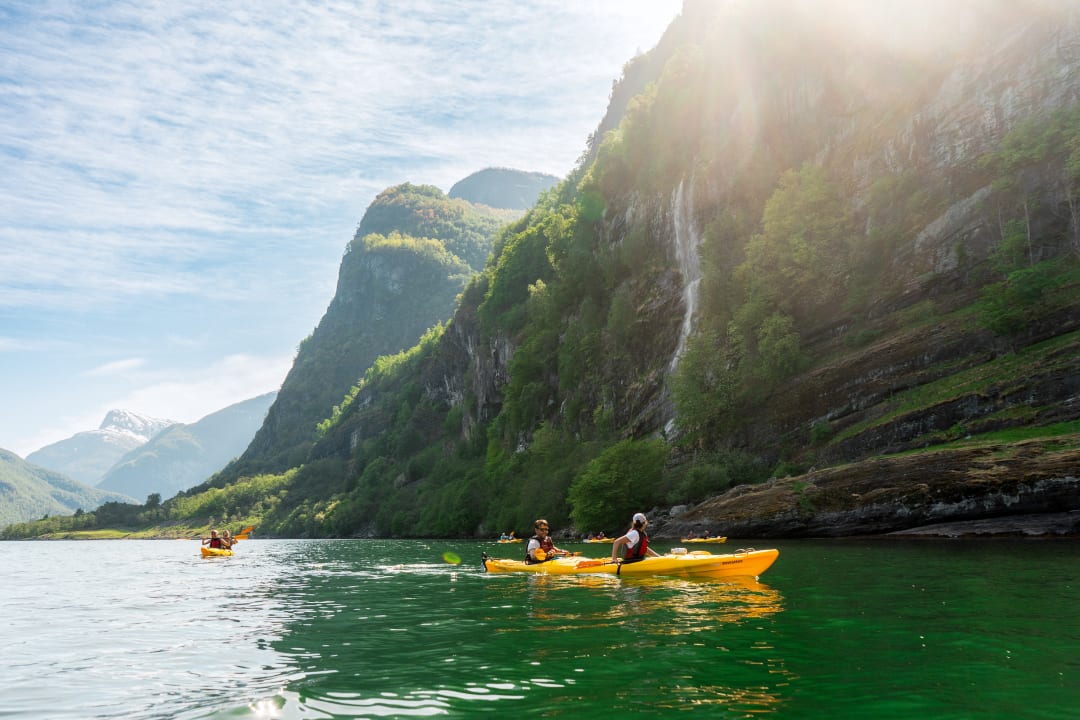
If you’re staying several days in Flåm, kayaking in the Aurlandsfjord is a great option. The water is calm, the fjord fairly narrow so you won’t get lost, and you see the landscapes from the water instead of from the deck of a big boat. Allow about 825 NOK for a guided 3h outing, accessible to beginners. Season from May to late September.
The Stegastein viewpoint
A wood-and-steel platform that juts out into the void 650 m above the Aurlandsfjord. The view is insane. You get up there by car (a switchback road, scenic in itself), or by electric minibus from Flåm (~450 NOK round trip, about 1h30). An absolute must if you get the chance.
If you don’t have a car, you can still come. Either by bus, or with an agency that does a tour of all the lovely spots around Flåm (Borgund, Stegastein, Lærdal).

📍 Flåm · 5h · Maresia Tours · air-conditioned vehicle
5 hours to discover the essentials around Flåm: the Stegastein viewpoint, the 800-year-old Borgund stave church, the village of Lærdal and the longest road tunnel in the world.
- Stegastein + Borgund stave church (800 years old)
- Lærdal tunnel (24.5 km) & snow road
- Live guide (EN/DE/ES) · port pickup
Free cancellation
From 119 € / person

📍 Flåm · 1h30 · Eidfjord Shuttle Bus · minibus
1h30 round trip to the Stegastein Skywalk platform, 650 m above the Aurlandsfjord. Audio on board, no in-person guide — a quick, affordable option ideal for cruise stops.
- Skywalk platform 650 m above the fjord
- 1h30 round trip · ideal for cruise stops
- Audio on board (no in-person guide)
Free cancellation
From 45 € / person
The Ægir brewery and the centre of Flåm
The Viking brewery Ægir Brewpub in Flåm is the perfect stop after a day of train, bike or boat. Award-winning craft beers, “Viking” platters with Nordic specialities, a wood-and-fireplace atmosphere. Open all year round. Booking advised in the evening in high season. It’s silly, I thought it was a tourist trap, but actually no, they really do have their craft beers and apparently it’s really nice.
Next door, you also have the Flåmsbana museum (free, nice for understanding the history of the line’s construction — the 20-year build, the workers with pickaxes), and the port from which the boats to the Nærøyfjord depart.
Doing the Flåm railway from Bergen in a day, with or without a car
If you’re staying in Bergen and you only have one day, yes, it’s perfectly possible to do the Flåmsbana from there. Here are the options.
On your own:
- Train Bergen → Myrdal → Flåm: take the main Bergen-Oslo line to Myrdal (2h-2h30), then the Flåmsbana goes down to Flåm (1h). You have a bit of time in Flåm (visit, lunch), then you head back the other way. Long but magical. Allow the full day.
- Car to Flåm + Flåmsbana round trip: 2h30 of driving from Bergen to Flåm, then a round trip by train (2h). More flexibility, ideal on a road trip.
- Bus NW420: it links Bergen to Sogndal via Flåm. Few services, check the timetables on entur.no.
On an organised guided tour: frankly it’s the easy solution, especially if you want to combine train + boat + Stegastein in the same day. Let’s look at the two options that are worth it.
Option 1 — Bergen tour equivalent to “Norway in a Nutshell” (train + Nærøyfjord boat)
The legendary formula: Bergen → Voss → Gudvangen → cruise on the Nærøyfjord to Flåm → Flåmsbana from Flåm to Myrdal → return to Bergen via the main line. A complete loop combining the 3 must-dos.
- Early-morning departure from Bergen, return in the evening
- 2h cruise on the Nærøyfjord aboard an electric catamaran
- A ride on the Flåmsbana, one of the most beautiful train journeys in the world
- Return to Bergen by bus
Ideal if you only have one day and want to tick off the region’s must-dos
Option 2 — “Premium” Bergen tour with Stegastein, cruise and train
The most complete version for the day: minibus from Bergen, photo stop at the Tvindefossen waterfall, Nærøyfjord cruise, Flåm railway, and the climb up to the Stegastein viewpoint. All in one day, without a car, without multiple bookings to manage.
- Departure 8 a.m. from Bergen, return ~6:30 p.m.
- Minibus of 30 people max, more intimate than the classic tour
- 2h cruise Gudvangen → Flåm aboard an electric catamaran
- Flåmsbana ride included
- Climb up to the Stegastein viewpoint (650 m above the fjord)
Ideal if you want the ultimate combo Nærøyfjord + Flåmsbana + Stegastein without organising a thing

📍 Bergen · 13h · Fjordrive Tours · minibus + train + cruise
A 13-hour day with a 2h cruise on the UNESCO Nærøyfjord, a climb to the Stegastein viewpoint (650 m) and a ride on the famous Flåm Railway — return by train via Myrdal.
- 2h cruise on the UNESCO Nærøyfjord by electric boat
- Stegastein viewpoint (650 m above the fjord)
- Flåm Railway + return by train via Myrdal
Free cancellation
From 381 € / person

📍 Bergen · 10h30 · Guided Fjord Tours · bus + train + cruise
A 10h30 day with a visit to the Njardarheimr Viking village in Gudvangen, a cruise on the UNESCO Nærøyfjord and the Flåm Railway — a well-oiled tour with over 1,191 verified reviews.
- Njardarheimr Viking village (Gudvangen)
- 2h cruise on the UNESCO Nærøyfjord by electric boat
- Flåm Railway (Flåmsbana) + Kjosfossen waterfall
Free cancellation
From 323 € / person
Do you need a car to get to Flåm and do the train
Having a car helps you be much more independent and flexible for visiting the fjord region. And in particular the Flåm railway.
Especially since at Flåm there’s a huge free car park, it’s super handy! It’s right next to the departure point for the train or the boat to the Nærøyfjord. So coming by car is super simple. It has the advantage that you can stay outside Flåm itself, which is expensive and very touristy in peak season (in low season, there’s nobody, or almost).
So yes, don’t hesitate to rent a car (and to compare prices)!
If you don’t have a car, then as we saw just above you can come by train or bus very easily. You’ll “just” need to coordinate your train times with those of your mode of transport, so as not to have any nasty surprises.
And otherwise, as we saw just before, you have the agencies that take you on the Flåm railway but also the other top activities around here like the Nærøyfjord cruise, Stegastein or the Viking village of Gudvangen. It’s expensive, but it’s super convenient.
Where to stay in Flåm and the surrounding area
If you want to take the first train of the morning (8:20 a.m.) without rushing, the best thing is obviously to sleep in Flåm the night before. And if possible 2 nights, because with the boat on the Nærøyfjord, the train, the zipline and Stegastein, there’s really enough to fill 48 hours. Be careful, in the region you really need to book quite far in advance for peak season.
Three interesting areas:
- Flåm centre: the most convenient for the train. Concentrated around the station and the port. Perfect for 1-2 nights. I particularly recommend:
- the Svingen Guesthouse of course
- the Flamsbrygga Hotel
- the Flam Marina, superb but not cheap!
- Aurland (10 min by car): a bit quieter, more authentic, magnificent view over the fjord. That’s where I prefer to settle if I have the time. But there are surprisingly fewer options.
- Vangsgaarden Gjestgiveri
- Winjum Apartments, nothing amazing in itself, but an incredible view and not too pricey
- Undredal (15 minutes by car): to sleep in a remote little village tucked away in the fjord with its slightly mystical atmosphere. Very few options but the setting is top
I have a full article coming up on where to stay in Flåm with my favourite addresses (I detail the best hotels in each area there). In the meantime, here’s the village’s iconic hotel, the one I recommend without hesitation if the budget allows.

📍 Flåm · up on the heights facing the fjord
A 1938 house perched above Flåm, run by the lovely Cathy & Wayne. Retro charm and an unbeatable fjord view.
- Panoramic view of the Aurlandsfjord from every room
- Shared equipped kitchen, free coffee and tea
- 500 m from Flåm station and the boat pier
Free cancellation
From 160 € / night
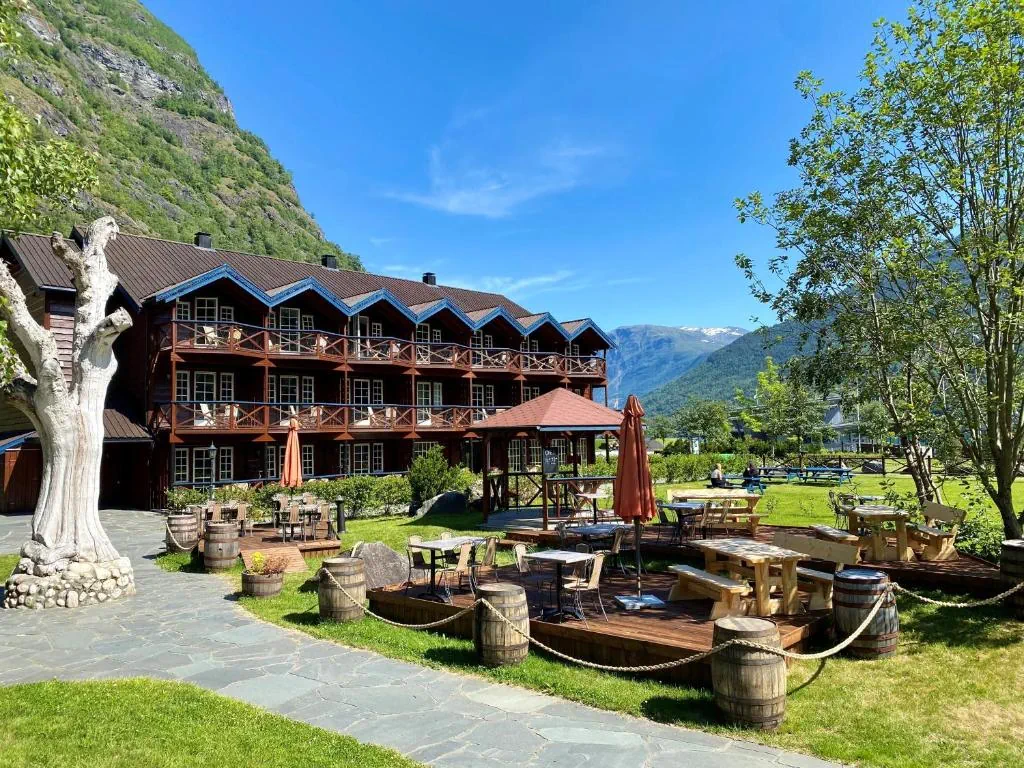
📍 Flåm · 150 m from the station
At the foot of the station, rooms panelled in Norwegian pine and the in-house Ægir brewery. 3★ comfort steps from the fjord.
- Ægir Brew Pub: craft beer brewed on site
- Nærøyfjord cruises (UNESCO) 50 m away
- Children's playground and family rooms
Free cancellation
From 210 € / night

📍 Flåm · on the marina, Sognefjord view
Apartments by the harbour with a spectacular view over the Sognefjord. Kitchenette, private terrace and total silence.
- Equipped kitchen and fjord-view terrace in most units
- On-site restaurant and café with sea view
- 550 m from Flåm station
Free cancellation
From 250 € / night
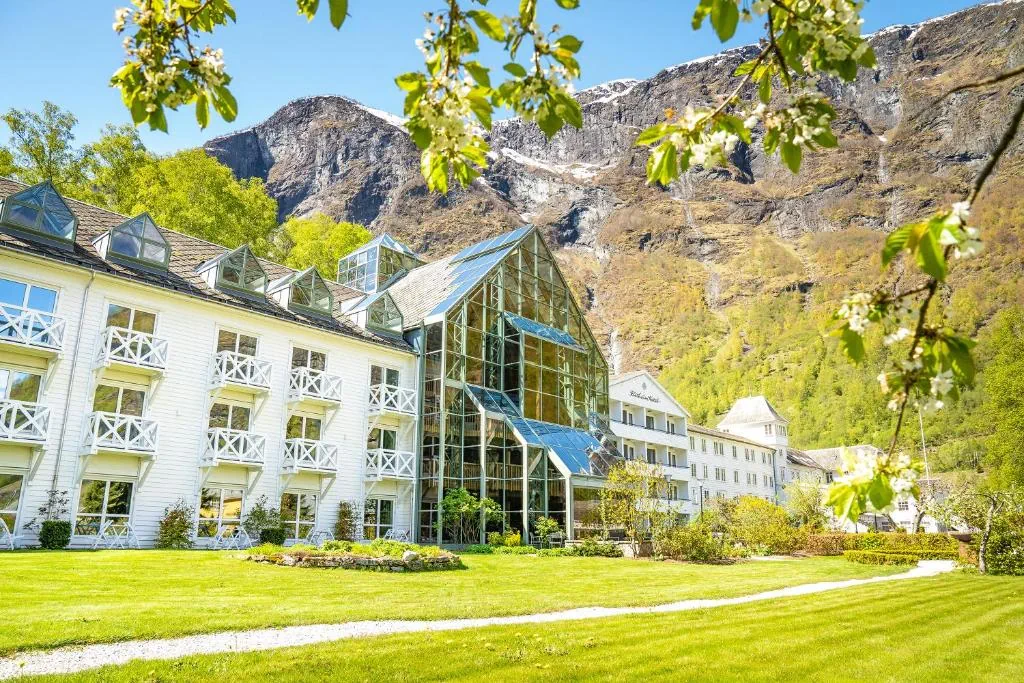
📍 Flåm · 200 m from the Aurlandsfjord
Renovated 19th-century manor, lounges with fireplaces, a library and a large garden facing the fjord.
- 2 restaurants (local Arven, international Utsyn)
- Gym and large garden facing the fjord
- Shuttle service and staff rated 8.8/10
Free cancellation
From 230 € / night

Frequently asked questions about the Flåm railway
How much does the Flåm railway cost in 2026?
The one-way Flåm-Myrdal starts at around 430 NOK (~37 €) in low season and rises to 510 NOK (~45 €) in high season. The round trip, which is the most popular option, ranges from 620 NOK (~55 €) to 730 NOK (~64 €). Children 6-17 at -50%, free for under 6s. Eurail/Interrail pass: -30% by buying the ticket directly at the station counter or by phone with Vy. Buy directly on Vy.no or Norway’s Best, never via the middleman resellers who take big margins.
How long does the Flåm – Myrdal journey take?
1h going up, 1h going down, so 2h round trip including a 5-minute photo stop at the Kjosfossen waterfall. The train covers 20 km at 30-40 km/h on average over 866 m of elevation gain, with a max gradient of 5.5% which makes it one of the steepest standard-gauge railways in the world. Most travellers do the direct round trip; others ride back down by bike along the Rallarvegen road, which adds 2h to 3h.
Do you need to book the Flåm railway in advance?
In low season (October to April), no need: buy the day before or even the same morning at the counter, it works without a hitch. In high season (June to August), you need to book at least 2 to 3 weeks in advance, ideally 3 to 4 weeks for the most popular departures (10 a.m.-2 p.m.). Tickets open for sale about 60 days before the date. A little-known tip: book the return train first (Myrdal to Flåm), which is tied to the main Bergen-Oslo line and fills up first.
What is the best time to do the Flåm railway?
The first half of June is ideal: the Kjosfossen waterfall is still at full flow thanks to the snowmelt, the Huldra is already dancing (from 1 June), and the crowds stay reasonable. May and September are also very pleasant with few people. July-August is busy but very pretty, to be avoided if you’re fleeing the crowds. In winter, the snowy atmosphere is magical but the waterfall can be very reduced or even frozen, and the zipline as well as the Rallarvegen bike are closed.
Which side of the train should you sit on?
In the Flåm to Myrdal direction (going up), sit on the right in the direction of travel: that’s the side where the Flåmselva river, the main waterfalls of the route and the Kjosfossen stopping platform go by. In the Myrdal to Flåm direction (going down), on the left in the direction of travel. There are no seat reservations on the Flåmsbana, it’s free seating: you need to arrive early at the station to choose your seat. Photo tip: spot the openable windows (about one in three), they have a double metal frame.
Can you bring a bike on the Flåm train?
Yes, it’s even very common in summer. Allow about 80 NOK extra on the ticket to bring the bike aboard. The most convenient: rent a bike in Flåm before going up (from 400-500 NOK a day at Flåm Bike Rental, pickup right at the station), take the train to Myrdal, and ride the 18 km back down along the Rallarvegen road, the old track of the railway builders. The cycling season runs from mid-May to late September; outside that period, the road is snow-covered and closed.
Does the Flåm railway run in winter?
Yes, the Flåmsbana runs all year round. In winter (November to March), there are 4 departures a day, generally between 9:00 a.m. and 4:50 p.m., compared with 6 in high season. On 24, 25 and 31 December, the service is reduced further; check on flamsbana.no before setting off. The winter atmosphere is magnificent with snow and ice everywhere, but the Kjosfossen waterfall can be very underwhelming or even frozen, and some side activities (zipline, Rallarvegen bike) are closed.
What time should you arrive at the station to get a window seat?
In low season, 10-15 minutes before departure is enough. In high season (June to August), allow at least 30 min, even 45 min if one or two cruise ships are docked in Flåm in the morning. The queue starts forming half an hour before departure. Tip: to avoid the wave of cruise passengers, take the first train of the morning (8:20 a.m.) or the last of the afternoon (4:00 p.m.), noticeably quieter even in the middle of July. Also head for the carriages at the back of the train, they’re less crowded than the front ones.
When can you see the Huldra dance at Kjosfossen?
Between 1 June and 31 August, at every stop of the train at Kjosfossen. A Huldra, a Nordic mythological creature in a red dress, appears on the rocks near the waterfall and dances to folk music played over speakers. The stop lasts 5 minutes, plenty for photos and video. Out of season (September to May), there’s no show, just the waterfall itself. Be careful: the flow of Kjosfossen is partially regulated by a hydroelectric dam; in a dry late summer or a frozen midwinter, the waterfall can be much less impressive than you’d imagine.
How do you get to Flåm from Bergen without a car?
Three main options.
- The train: Bergen-Oslo line to Myrdal (2h-2h30), then the Flåmsbana goes down to Flåm (1h).
- The NW420 bus, which links Bergen to Sogndal via Flåm and Gudvangen (few services, check the timetables on entur.no).
- A guided day excursion from Bergen, combining train + Nærøyfjord cruise + sometimes Stegastein or the Viking village of Njardarheimr, with no bookings to manage. Allow 2h30 by car if you rent.
Can you do the Flåm railway and the Nærøyfjord cruise in one day?
Yes, it’s even the most popular formula. Three options:
- on your own from Bergen or Oslo via the Norway in a Nutshell formula (train + boat + bus, 7 to 10h round trip)
- by car leaving early from Bergen (2h30 to Flåm, then train round trip + boat, about 10h over the day)
- on an organised guided excursion from Bergen that loops train + boat + Viking village in one day, with nothing to organise.
My advice: take the train early in the morning then the boat in the early afternoon, it’s more comfortable and you avoid the crush of cruise passengers on both sides.
Conclusion and other resources on the fjord region
There you go, you (almost) know everything about the Flåmsbana.
It’s a 2h experience, at a reasonable price for Norway (around 60-65 € for an adult round trip in high season), accessible all year round, and it remains one of the most beautiful train journeys on the planet. Whatever your profile — landscape lover, photographer, family with kids, railway fan, traveller just spending a day in Flåm — you’re going to get an eyeful.
My 3 final tips:
- Book early in high season (3-4 weeks before summer), and directly on Vy.no or Norway’s Best, never via the middleman resellers
- Take the first train of the morning (8:20 a.m.) or the last (4:00 p.m.) to completely avoid the wave of cruise passengers
- Sit on the right going up, and spot an openable window for the photos
And if you combine it with the Nærøyfjord cruise, the Vatnahalsen zipline or the Rallarvegen bike ride, you’ll come away with an unforgettable experience.
And if you have any other questions, doubts about the period or the formula to choose, or want to share your own experience of the Flåm railway, don’t hesitate to get in touch!
As you’re planning your trip to Norway, here are some other articles that should, I hope, interest you!
- The fjord region of Norway: itineraries and most beautiful spots, for the big-picture overview of the country’s most beautiful region
- The Nærøyfjord cruise, the ideal combo with the Flåm railway — all the options, prices and tips
- The free map of the Norwegian fjords, with the most beautiful spots, hikes, accommodation and restaurants pinpointed — download it, it’s a gift!
- Visiting Bergen: what you absolutely must do in a few days, the gateway to the fjords
- How to get from Bergen to Flåm (boat, train, bus, agency), the guide that perfectly complements this article
- A great one-week itinerary around Bergen and the fjords, to slot the Flåmsbana into a real road trip
- The most beautiful day cruises from Bergen, to compare the fjords accessible from Bergen
- What to see in Geiranger, the most impressive fjord in Norway, the other UNESCO-listed fjord — to do as a combo if you have the time
- The most beautiful places in Norway to visit absolutely, my personal top picks for planning a road trip
- Norway in summer, where to go, tips and itineraries for the best season for the Flåmsbana
- Visiting Norway: complete guide, if you’re starting from scratch and want to plan it all in one go