Last updated on
The Lofoten Islands really are a place apart in Norway. Obviously for their landscapes — I keep banging on about that — but not only. In fact, for 900 years they’ve been a hugely important hub for exporting cod and herring, the fish arriving in the islands where the Gulf Stream peters out. So naturally, plenty of fishing villages sprang up, especially from 1860 onwards. Ever since, fishing has remained the main activity of the Lofoten Islands.
And you can feel that in the people on a few points. There’s no Sami (Lapp) culture in the Lofoten Islands, it’s more Viking-oriented. What’s more, unlike in Tromsø, the people of the Lofoten Islands still hunt and eat whale — for 4,000 years, in fact. But they’re still really nice people!
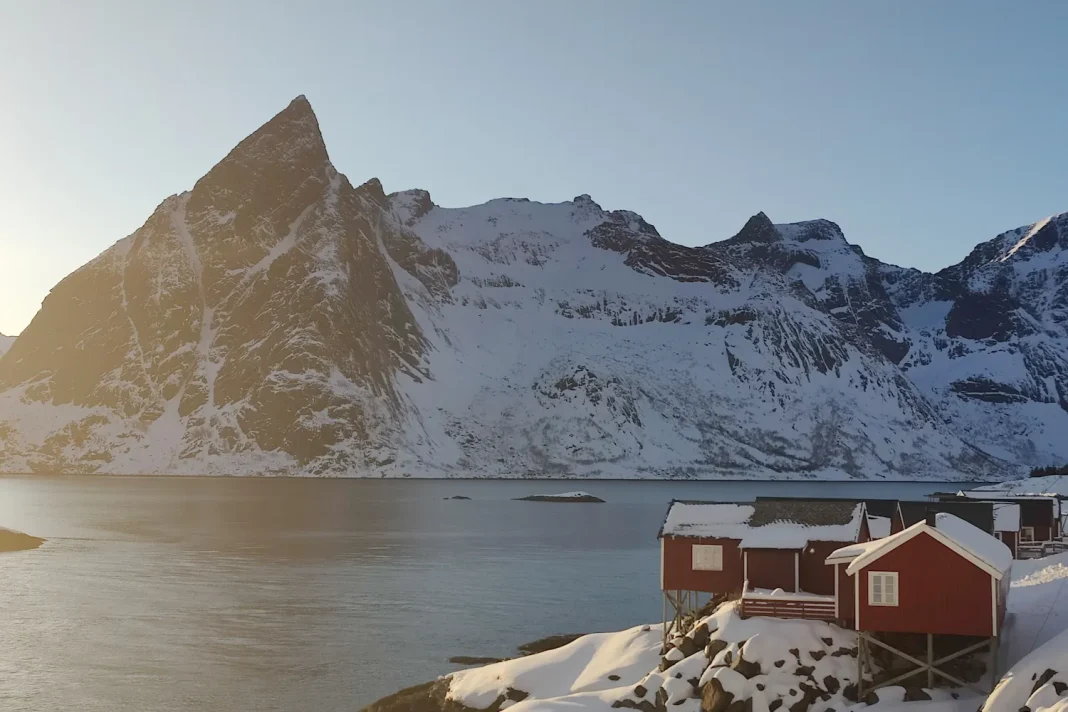
The fishing villages are made up of rorbu, those little red (or orange!) houses on stilts, typical of Norway. And that works out nicely because it’s seriously photogenic. In the Lofoten Islands you’ll find some of the most beautiful fishing villages in Norway. Older and more traditional than what you’ll find in northern Norway, at Senja or around Tromsø.
And among these villages, a few stand out easily, in summer as in winter (I’m lucky enough to have done both seasons). The most famous, Reine with its rather crazy view, the twins Hamnøy and Sakrisøy at the foot of the mountains, Å at the edge of the world or Henningsvær and its busy fishing scene, or Kabelvåg, the pretty old town. I’m going to take you through them here — I hope it makes you want to go and see them and take your time over them!
In practice: nearly all of these villages are in the south of Lofoten, along the E10 (Henningsvær and Kabelvåg are to the north, towards Svolvær). A car is pretty much essential to string them together. To reach the archipelago, it’s all in my article how to get to the Lofoten Islands.

Reine, the must-see village of the Lofoten Islands
Reine is probably the most beautiful view in the Lofoten Islands. In all of Norway too? Quite possibly! Set in the most impressive part of the Lofoten Islands, the island of Moskenesøya, this village is surrounded by very, very steep mountains.
Ideally located on its little peninsula, the village of Reine is linked to the main road by a thin strip of land. And it’s right there that you get a mind-blowing view. A view you pretty much all know: the village of red houses with huge mountains rising out of the water behind it.



Reine isn’t just a postcard, it’s also a lovely little village. Touristy, sure, but not that much given that people don’t stay very long. And you’ll find everything you need to stay a few days. Cafés, bars, restaurants, shops (well, I’m putting that in the plural but I’m not totally sure 😀 ).
The advantage of Reine is that it’s well placed for touring all the southern villages. I stay there 2 or 3 days every time to roam around with the greatest pleasure!
But Reine isn’t just a viewpoint. What is there to do here? The village can be walked in about an hour, between the bridge at the village entrance that gives you the overall view, the jetties, the rorbu and the harbour (not to be missed). You’ll find somewhere to eat, a café or two, a small grocery store and even somewhere to rent a kayak: paddling in the Reinefjord at the foot of the walls is one of the most beautiful water outings in Lofoten.
Above all, Reine is the foot of Reinebringen, THE viewpoint you’ve definitely seen in photos: stone steps (the “sherpa steps”, nearly 2,000 of them) climb up to a plunging view over the village and the fjords. Be careful though: the trail is closed in winter (roughly November to April) and it’s regularly closed the rest of the year because of rockfalls. Always check that it’s open before setting off, and never go around a red ribbon or a no-entry sign at the start: the mountain is unstable and things really do fall. I’ve never been able to do it so far. But be aware that every year, the rescue services come to save reckless people (to stay polite) who ignore the bans and get stuck up there. I can understand wanting to enjoy the view, but not at any cost.
From Reine the little ferry to Vindstad also departs, from where a hike leads to the wild beach of Bunes: a magnificent half-day in summer, when the sea is turquoise. Watch out, there are only one or two boats a day. And it’s the only way to get there, so if you miss it, it’s a night under the stars!
How to get there and park: Reine is on the E10, paid parking at the village entrance and also by the restaurants and petrol station. Allow half a day for the village and the viewpoint, but it’s an ideal base camp to roam around the whole southern Lofoten for 2 to 3 days.


Å i Lofoten, the village at the edge of the world
Å isn’t just a weird letter. First off, it’s pronounced “O” halfway towards an “A”, and it means stream in Old Norse. But above all it’s the village at the very, very end of the Lofoten Islands. And when I say the end, I really mean it. You take the road that crosses them and you go all the way to the end and presto, you’re in Å.


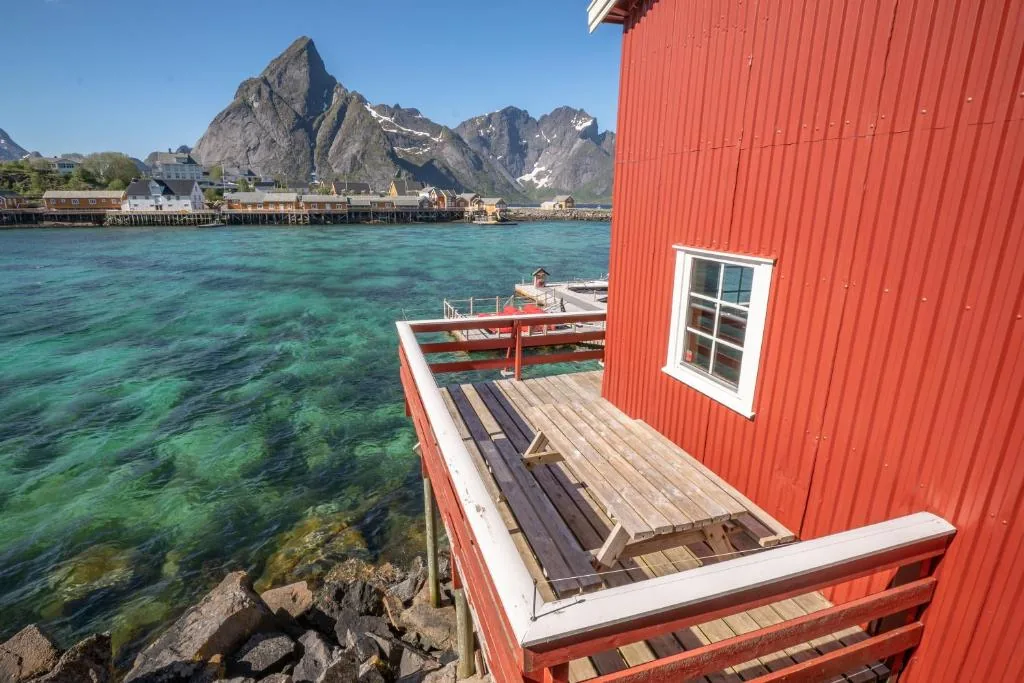
It’s a superb little fishing village, smaller than Reine, very typical. Lots of red houses clustered next to one another, at the foot of the mountains (logical, we’re in Lofoten). It’s obviously one of the most beautiful in the Lofoten Islands for its authenticity. And, surprisingly, it hasn’t completely given in to the lure of tourism, because it’s still a village that’s very active in fishing. Well, it is touristy — you’ll see coaches of Asian tourists who stay for an hour. But I’d advise you to take your time, there are a few walking trails to take (I should tell you sometime how I took a snow-covered one and fell into the river that was hidden under the snow). And in summer, you can in particular walk around lake Ågvatnet, the setting is sublime.
But Å isn’t just red houses. What is there to do here? The village is home to the Norwegian Fishing Village Museum (Norsk Fiskeværsmuseum): seven period buildings, preserved just as they were between 1840 and 1960, telling the story of 200 years of cod fishing.
Right next door, the world’s only Stockfish Museum (dried cod) explains the whole industry, from fishing to export. And don’t miss the historic bakery, founded in 1844: the bread and the famous cinnamon buns are still baked in the wood-fired oven from 1878 (it usually opens from 11am to 5pm, in summer only).
How to get there and park: Å is right at the end of the E10, after Reine. You park in the big car park at the end of the road, after passing through the village, then everything is done on foot. Allow 1hr 30 to 2hr for the village and the museums, more if you walk around the lake. The coaches often make a one-hour stop here in the middle of the day: come early or in the late afternoon to have it to yourself. But the bakery might be closed!


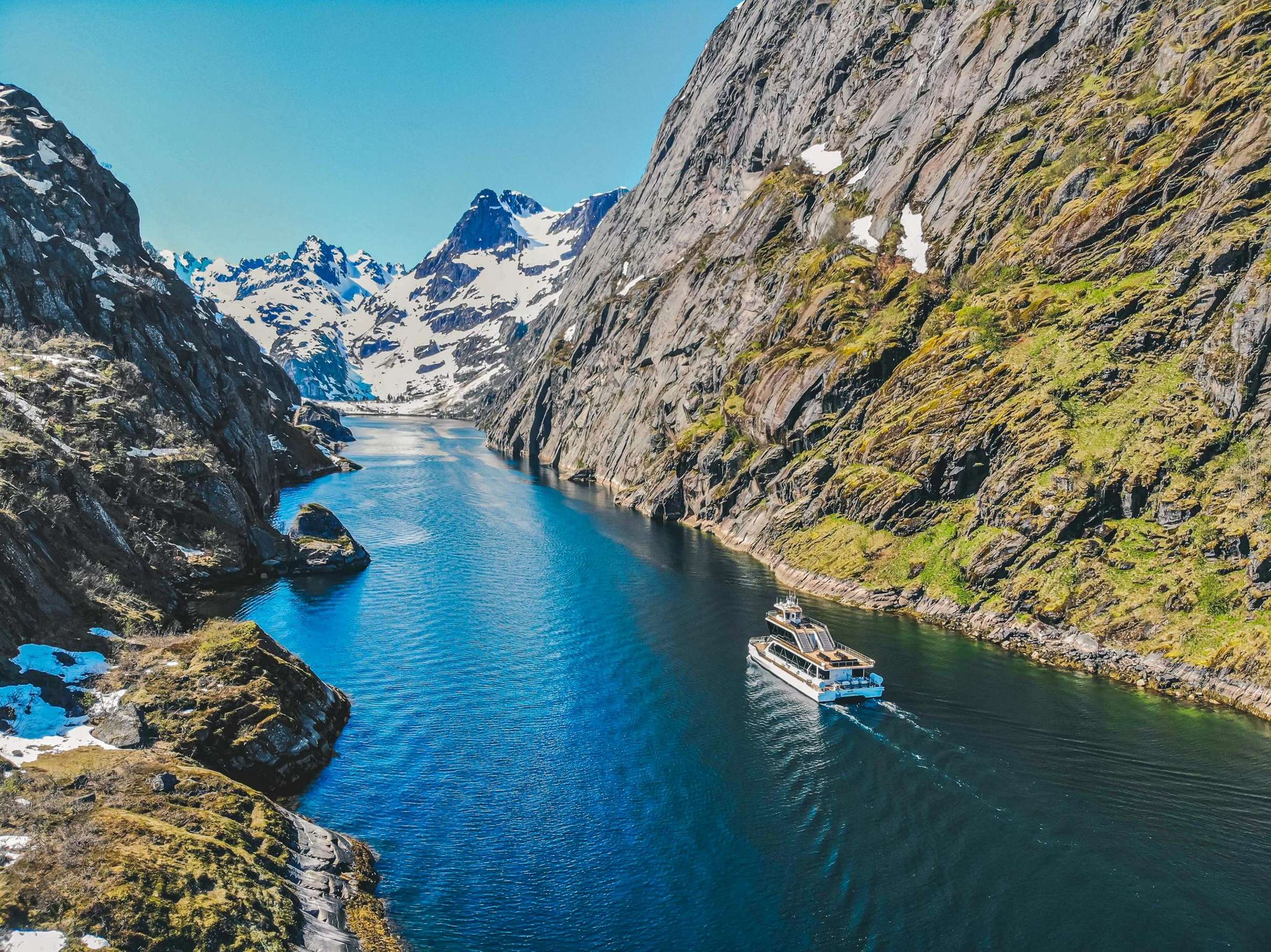
Henningsvær, the fishermen’s village
Henningsvær is a bit different from the others. First, the village sits much further north, near Svolvær. Then, less postcard-like, it’s a real fishing harbour with loads of boats, regular comings and goings, and set in a really lovely spot. What’s nice is that the village of Henningsvær sits on lots of little islands, some linked by small bridges, others reachable only by boat and with guesthouses — pretty cool!
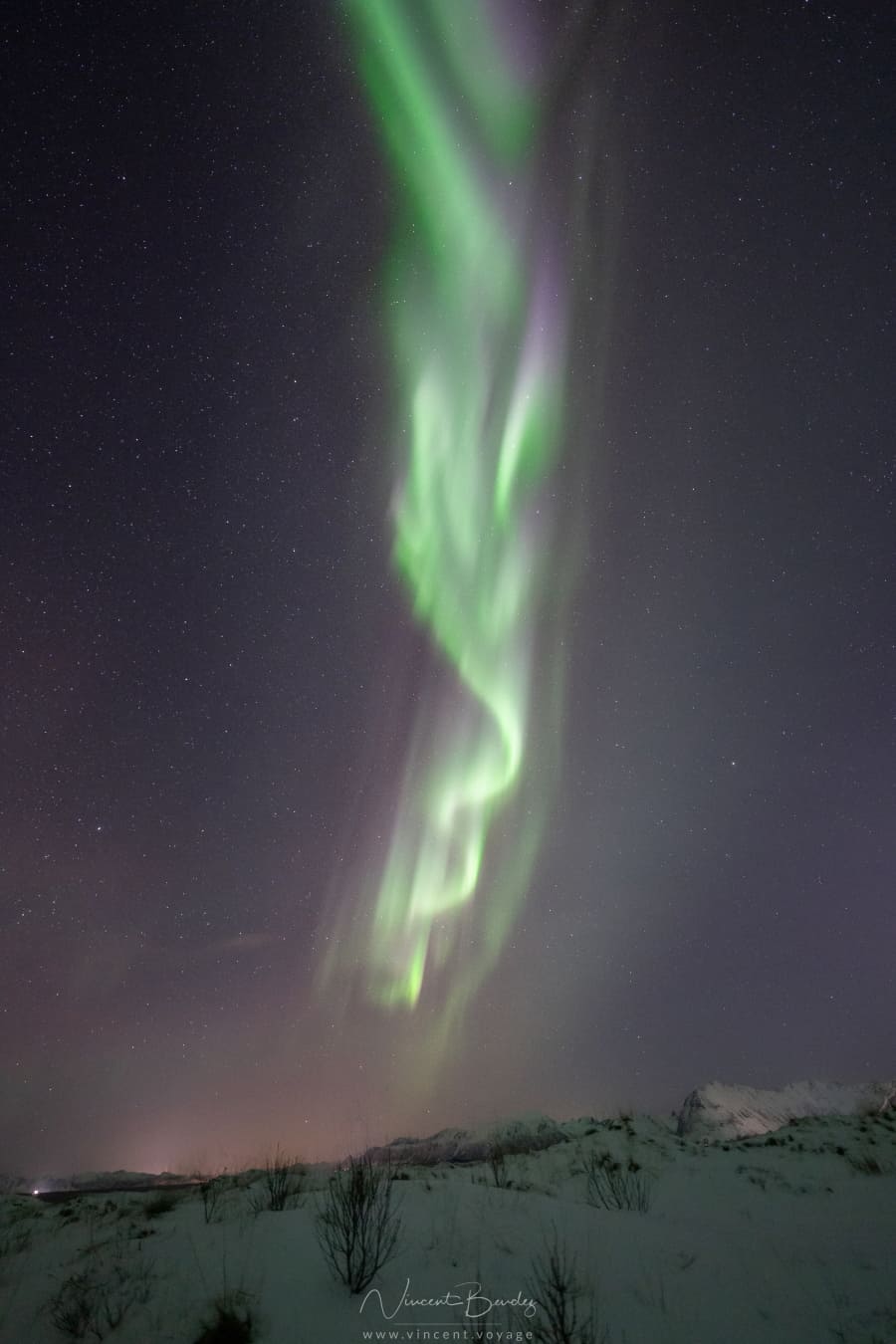
The road to get there is genuinely beautiful, you follow the coast with a view of the mountains as far as the eye can see. A road I particularly enjoy for spotting the northern lights (I’m telling you that totally innocently).
The village is very lively thanks to its fishing, but not only. It would be almost huge compared to the others in the Lofoten Islands. In fact, it tops 440 inhabitants, no less!


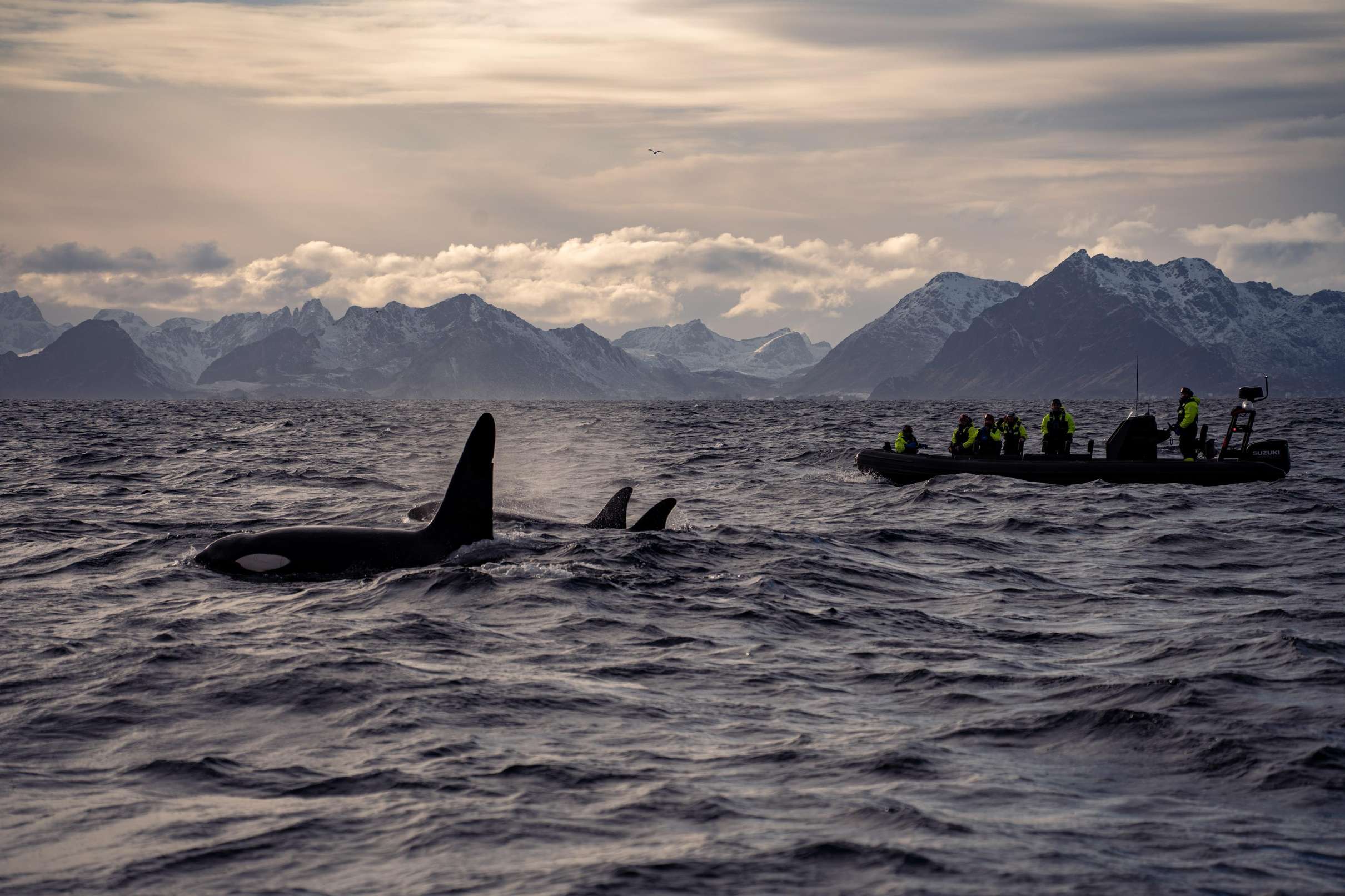
📍 Henningsvær (Lofoten) · 2 hrs 30 · Arctic Adventure Tours · RIB
2 hrs 30 on a rigid inflatable boat hunting for orcas, pilot whales and whales around Henningsvær — sea eagles, seals and seabirds as a bonus. Drysuit and equipment provided.
- Looking for orcas, pilot whales & rorquals
- White-tailed eagles, seals & seabirds
- Flotation suit, life jacket & goggles provided
Free cancellation
From €132 / person

📍 Henningsvær (Lofoten) · 3 hrs · Lofoten Opplevelser · Sabina boat
3 hours aboard the Sabina, an old traditional fishing boat, to catch cod and pollock with a local skipper. Fish soup made on board with your own catch.
- Fishing on the traditional "Sabina" boat · local skipper
- Fish soup made with your own catch
- Rod, flotation suit & life jacket provided
Free cancellation
From €110 / person
Henningsvær is fairly touristy and is developing in that direction, given its proximity to Svolvær, and you’ll find quite a few photo tours here. But honestly, it’s not a problem, there’s plenty of room for everyone. Still, it has to be said it lends itself to it really well! Its harbour is very photogenic, and you’ll also find lots of fish “drying racks” just past the harbour.
What’s more, the village is famous thanks to Instagram. Indeed, its football pitch on its little peninsula seen from a drone is a much-prized hunting ground for aerial photography! I’d have happily shown you a photo but… my drone is keeping the fish of the Lofoten Islands company.
What to do in Henningsvær? It’s the liveliest and most “hip” village in Lofoten. Stroll along the harbour and on Engelskmannsbrygga, push open the door of the KaviarFactory, a contemporary art gallery set up in a former caviar factory (with a superb photography and design bookshop), and take a break at the Trevarefabrikken or the climbers’ café, two local institutions. Henningsvær is also the climbing capital of Lofoten: you can get started with the local climbing school, set off on a white-tailed sea eagle safari, go kayaking or on a photo outing.
How to get there and how long: the access road, which leaves the E10 and follows the coast over causeways and small bridges, is one of the most beautiful in Lofoten — plan some stops. Henningsvær is about 30 minutes from Svolvær. Allow half a day, more if you book an activity.
Anyway, I told you at the start that the village was developing fairly fast — you’ll now find several quality little hotels, but also more restaurants and cafés. So if you fancy sleeping here you won’t feel like you’re alone in the world. Well, except in the depths of November, ok then.


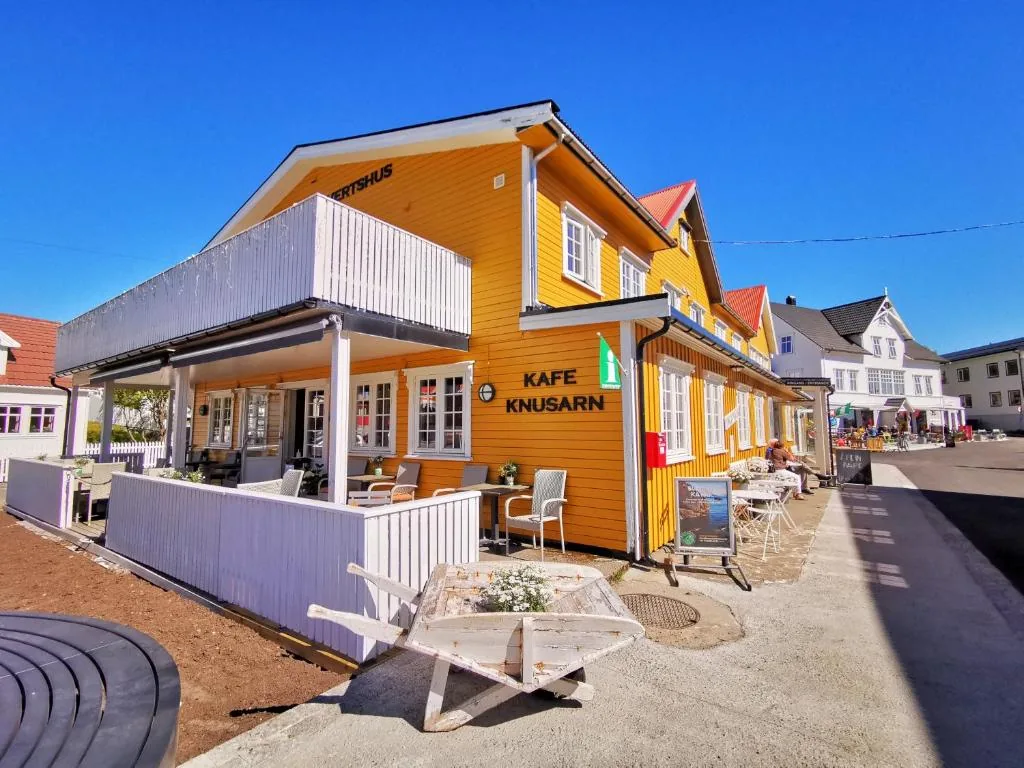
Kabelvåg, the pretty old town of Lofoten
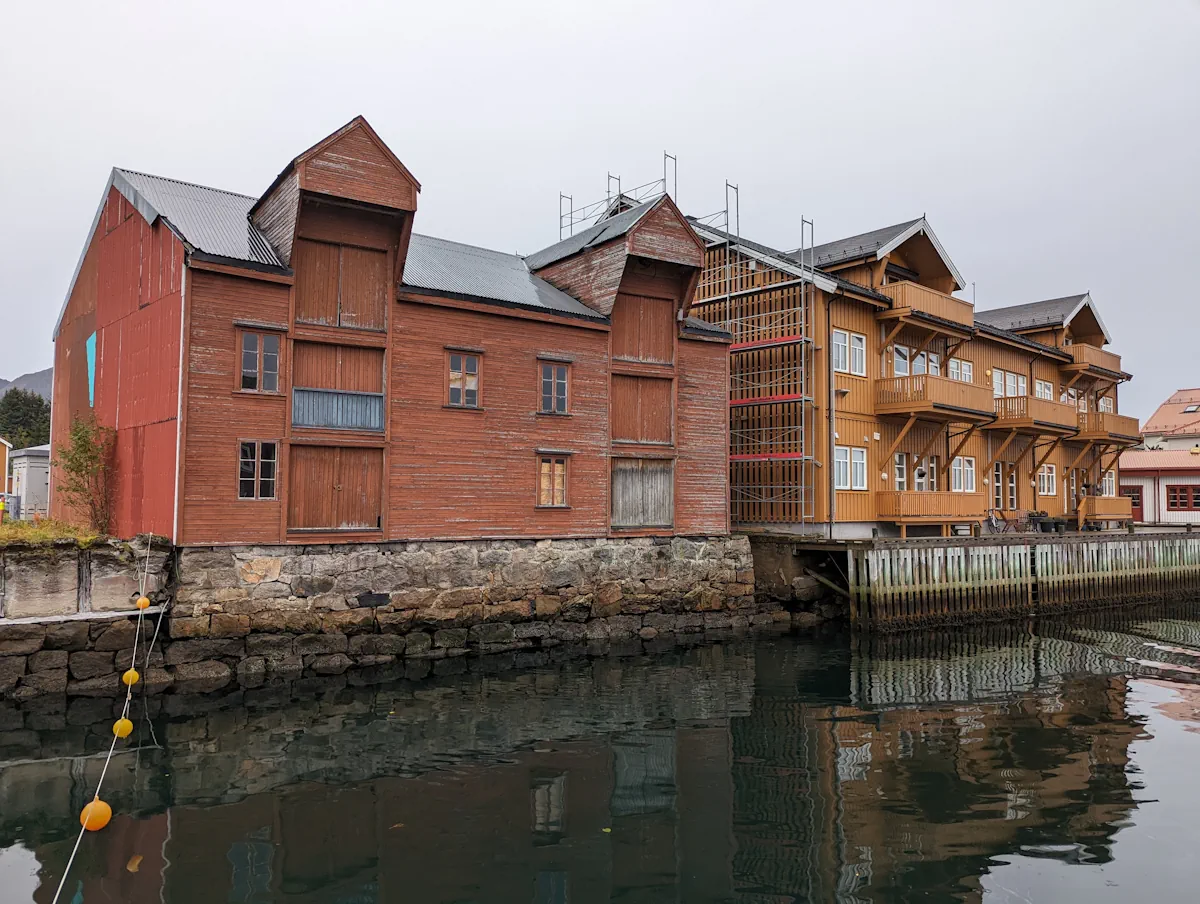
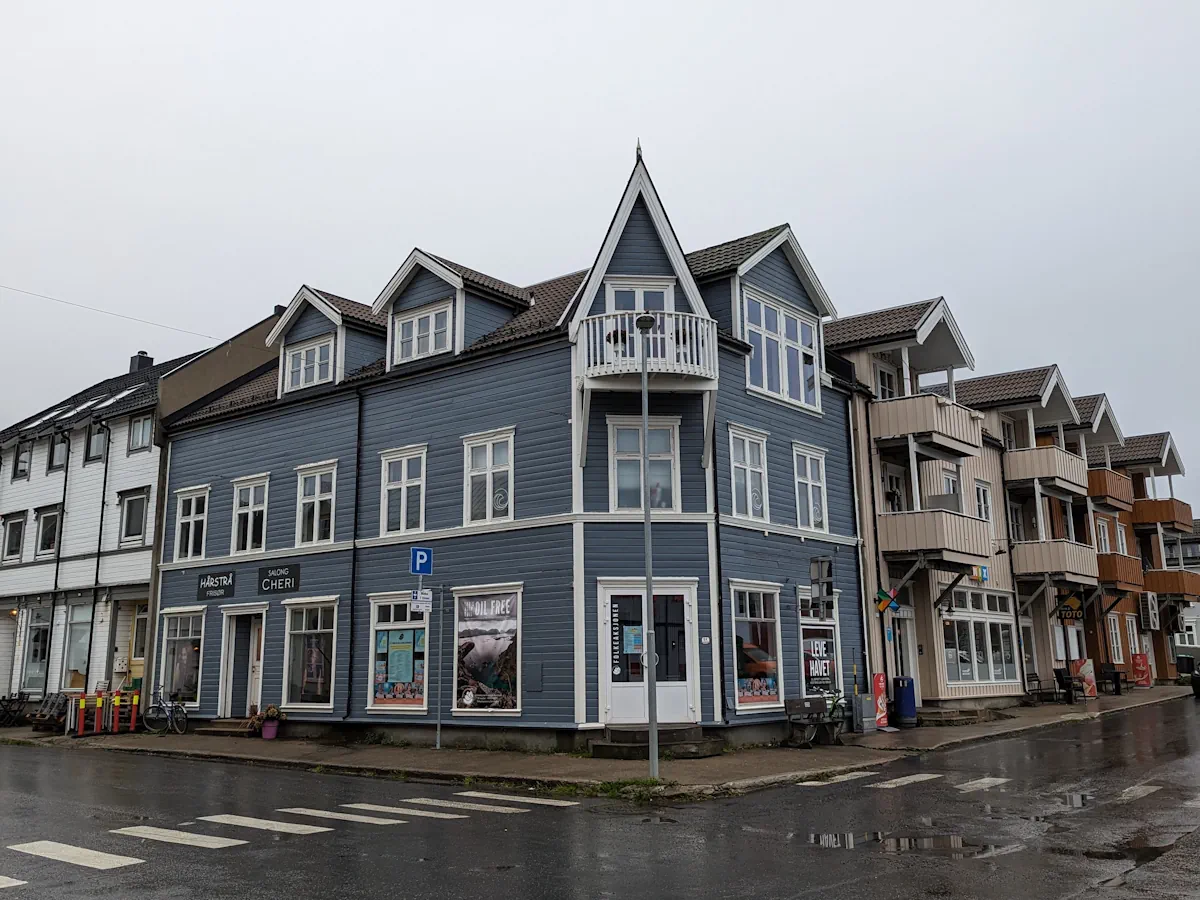
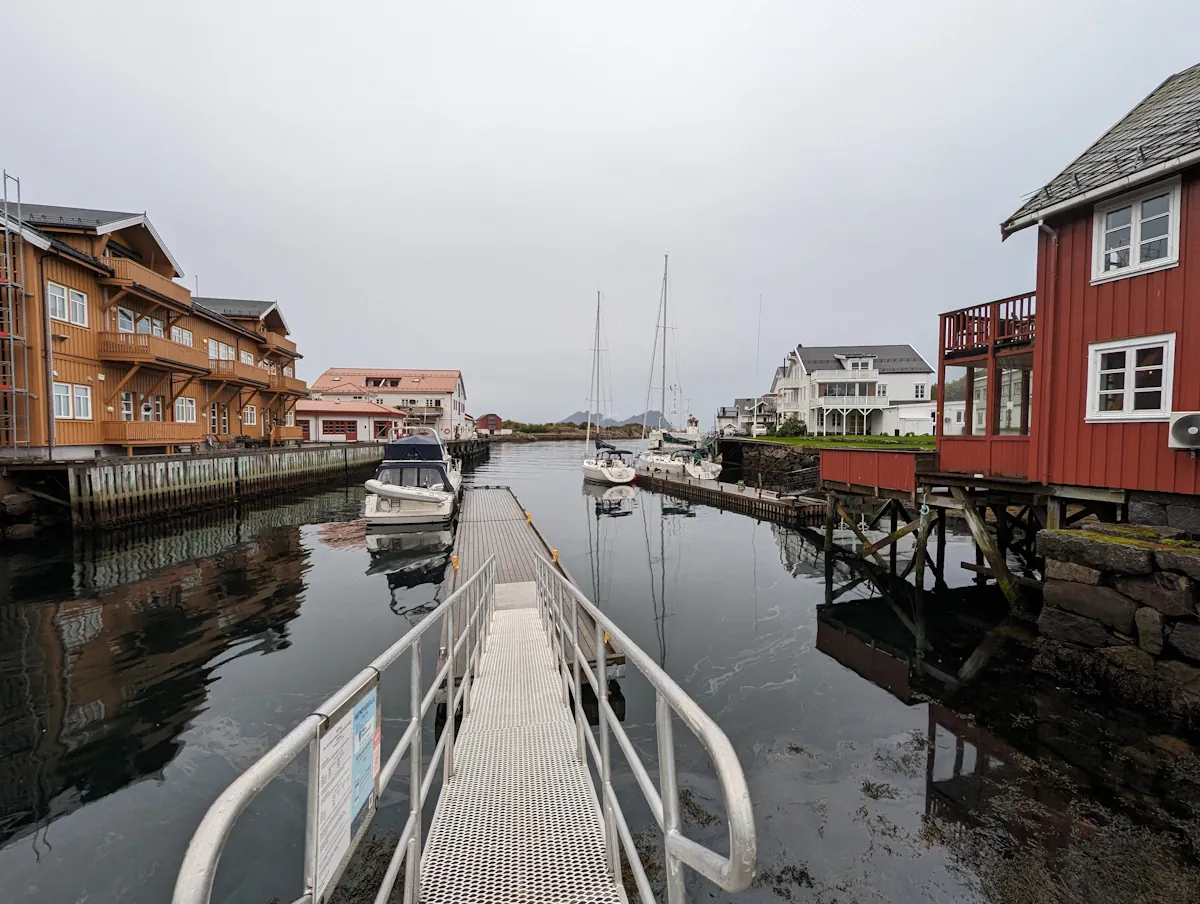
A change of mood here: Kabelvåg isn’t a fishing hamlet but one of the oldest towns in northern Norway, built on the medieval site of Vågar. Its small wooden centre around the main square can be explored on foot, between cafés, a glassblowers’ shop and a handful of restaurants: perfect for taking a breather for half a day, especially if the weather is playing up.
Originally I hadn’t planned to mention it here at all, but after discovering the pretty town centre and its architecture, I figured it could earn its place. Especially as it’s right next to Svolvær.
Just above the village stands the Lofotkatedralen (the church of Vågan), the largest wooden church north of Trondheim, with its 1,200 seats. And 5 minutes away, the Storvågan district brings together three fine visits: the Lofoten Museum (Lofotmuseet, on the site of the former town of Vågar), the Espolin Gallery, and above all the Lofotakvariet, the Lofoten aquarium, where you understand all about the “skrei” cod that comes to spawn here every winter. An ideal family visit, and a combined ticket lets you do the sites together.
How to get there and how long: Kabelvåg is on the E10, about ten minutes from Svolvær and very close to Henningsvær: you’re bound to pass through if you explore northern Lofoten. Allow half a day for the town, the cathedral and the aquarium (which closes in December–January and cuts its hours off-season, check before you go in winter).
RENTING A CAR IN NORWAY
Roam around Norway by renting with Discover Cars

- Rent a car from many airports or in town
- Small model, SUV or electric for the adventure
- Car supplied with the Autopass tag
- Prices from €30
Hamnøy, the postcard village
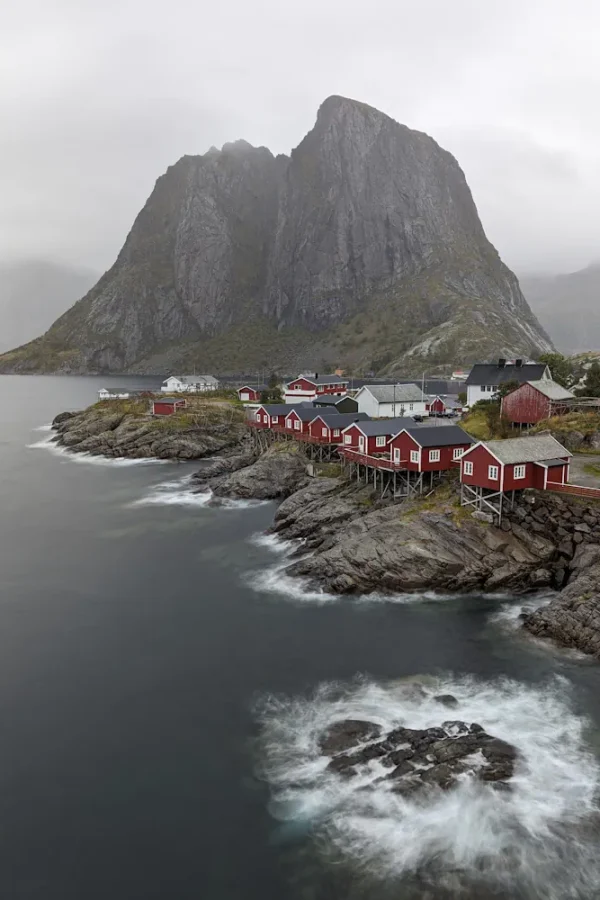
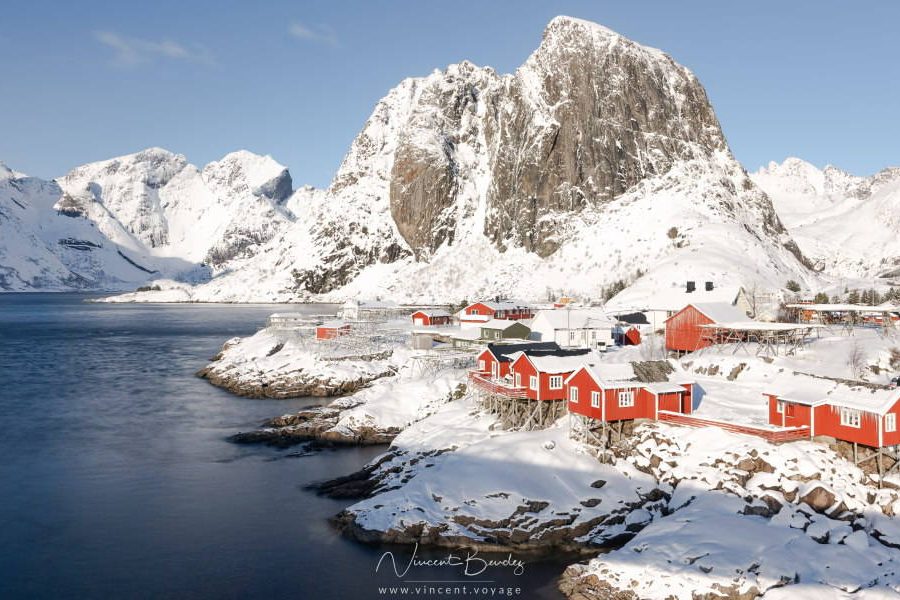
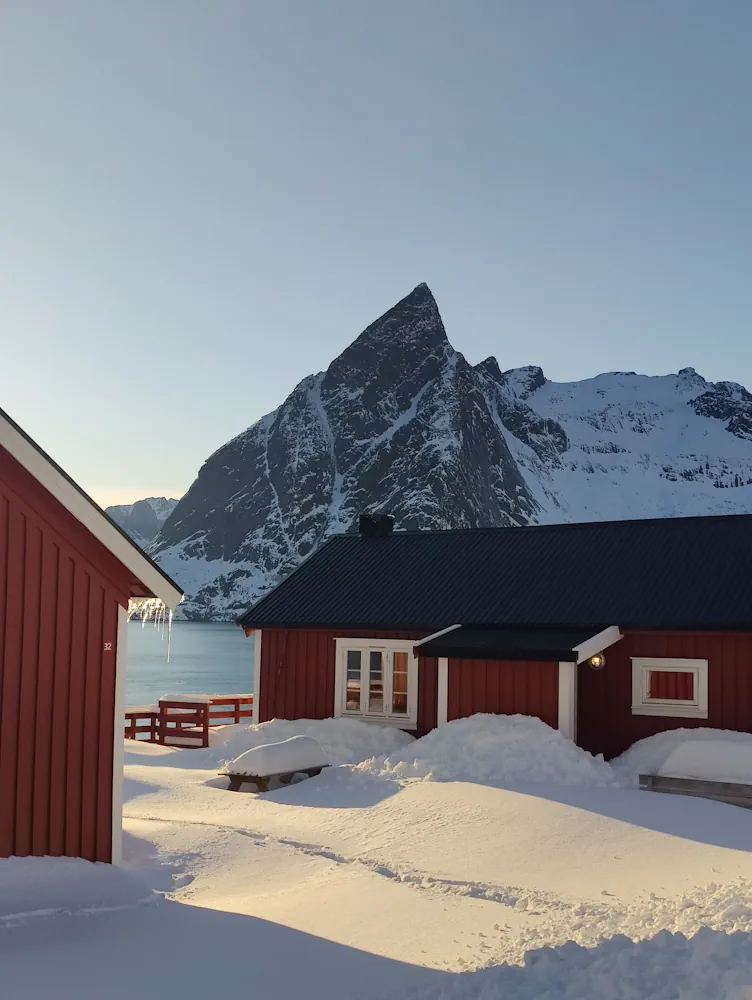
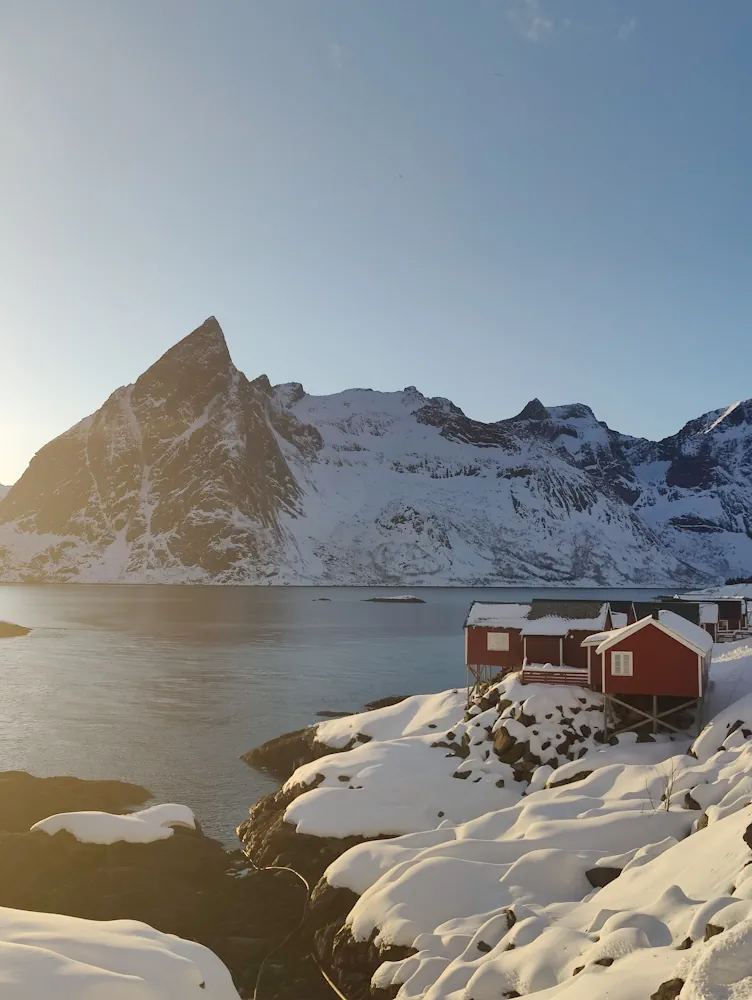
And I’m not joking. The view of Hamnøy from the bridge is ultra famous. It’s a little village of red houses just before Sakrisøy and Reine (a mere 5 kilometres away), which is generally used to illustrate every guidebook on the Lofoten Islands. It has to be said it stands in front of superb mountains, at the water’s edge. Ok, a village with mountains and water, in Lofoten, is fairly common. But here, it’s even more beautiful.
The water surrounding the village is, as is often the case in Lofoten, superbly turquoise, the setting is paradise-like. But that’s not all. It’s still an active harbour, you’ll see several fishing boats and several stalls of fish drying.
Hamnøy isn’t just the bridge and the tour of the little red houses. Before all that, there’s a real mini harbour where absolutely nobody goes, it’s as lovely (and small) as can be.
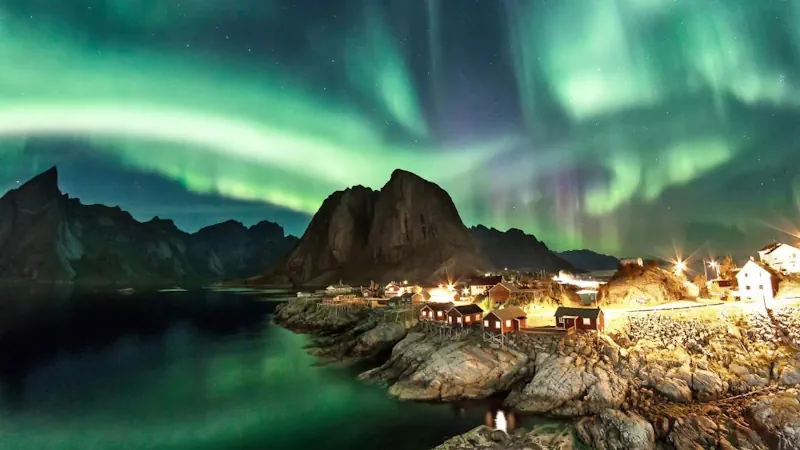
Right, it gently takes an hour to do the tour of the village and the various viewpoints. The night views here are also prized for the northern lights, if you can get away from the lights. In particular on the bridge (with quite a few other people) but also in the heart of the village.
Concretely, what is there to do in Hamnøy? It’s above all a photo stop and a quiet interlude. The postcard view is taken from the E10 bridge: the red rorbu in the foreground, the peaks bursting out of the water behind. The cabins you’re photographing are largely those of Eliassen Rorbuer, one of the most iconic stays in Lofoten: sleeping there means waking up inside the photo. Take the time to head down into the village, beyond the bridge: the little harbour is still active, with its boats and its stalls of cod drying.
How to get there and how long: Hamnøy is on the E10, 5 km before Reine. Allow about an hour to do the tour, and park properly (not on the private accesses or in the middle of the bridge): use the designated spaces.
Funny thing, the bridge is REALLY popular. You can’t miss it because there should already be people on it, all in the same spot. A little less so for the northern lights. But it’s a good spot!


Sakrisøy, the miniature village
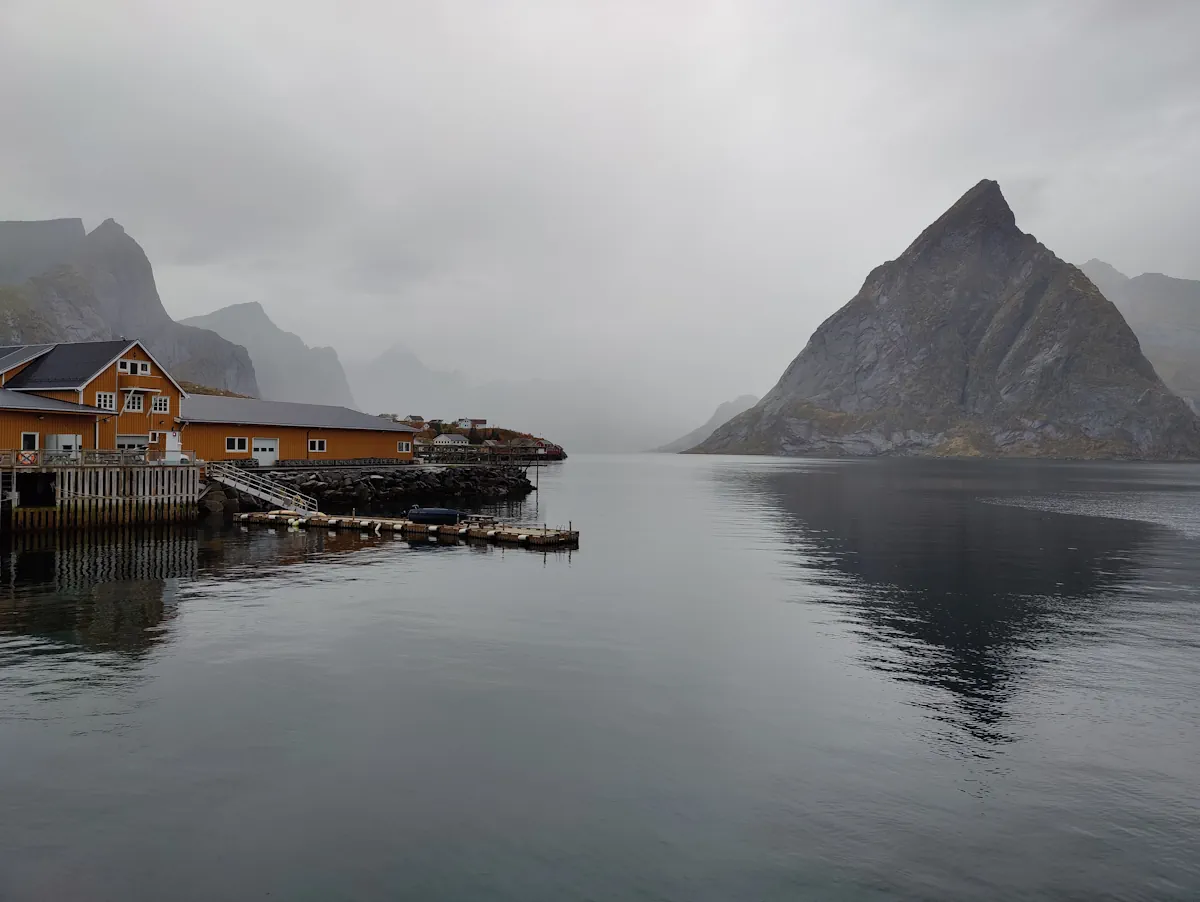
Watch out, teeny-tiny village! This one is a village of orange houses. Right next to Hamnøy (but really, it’s on the other side of the bridge) and Reine (on the other side of the other bridge!), it’s a pretty little village that’s ultra photogenic. Because mountains, little islands, super cute houses. And a restaurant with a superb view, where I recommend the salmon!
The village, founded in 1889, is also a good spot for the northern lights, because it faces some seriously beautiful mountains and at night the road lights are switched off, which is rather handy!
What is there to do in Sakrisøy? You can do the tour in 20 minutes, but you’ll happily stop there, especially at sunrise and sunset. On the foodie side, the village’s little seafood counter (Anita’s Seafood) is an institution: fish burger, prawns, soup, perfect for a break with your feet in the water. And as the road lighting goes off at night, it’s a very good northern-lights spot, quieter than the Hamnøy bridge. Sakrisøy combines with Hamnøy and Reine in the same little loop.
Each mini village around here has its iconic photo. Here, it’s the famous orange house with the mountain behind.


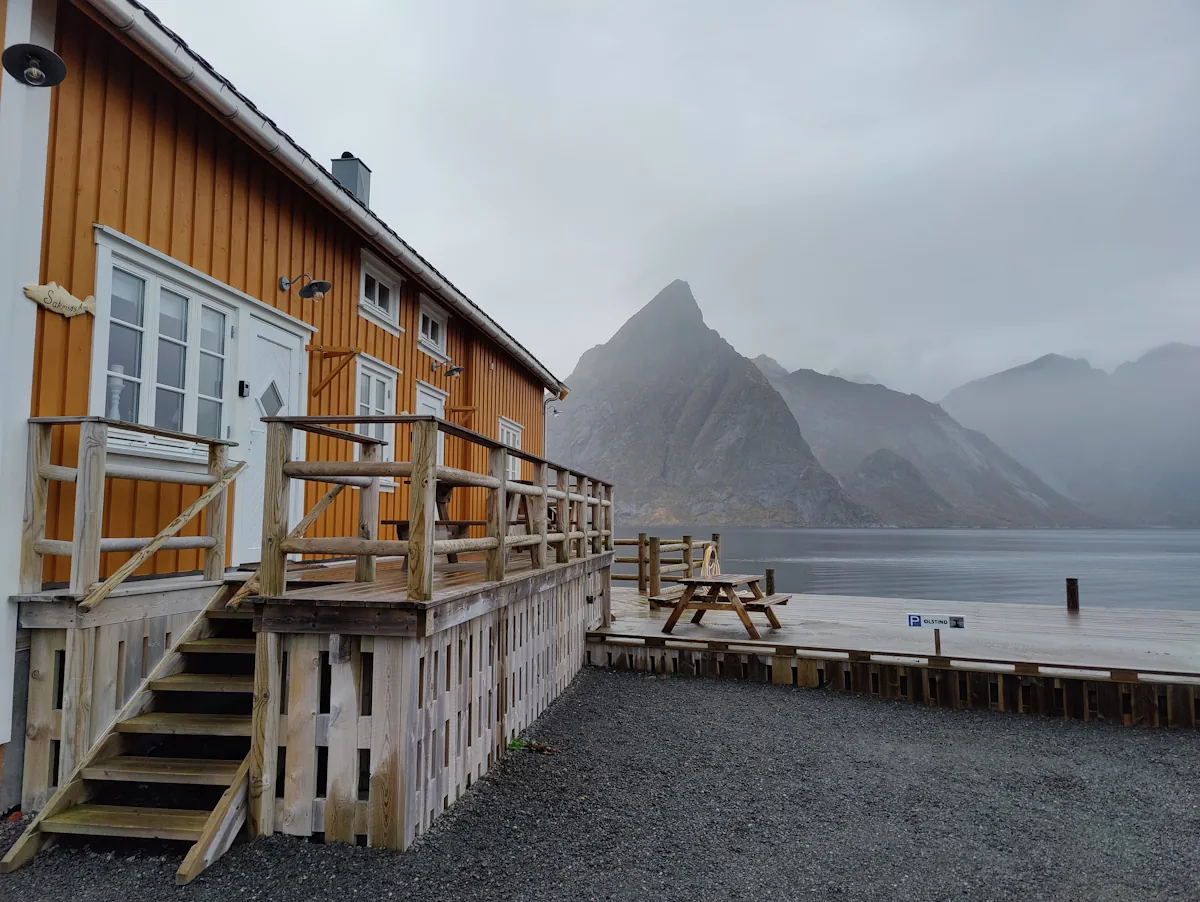
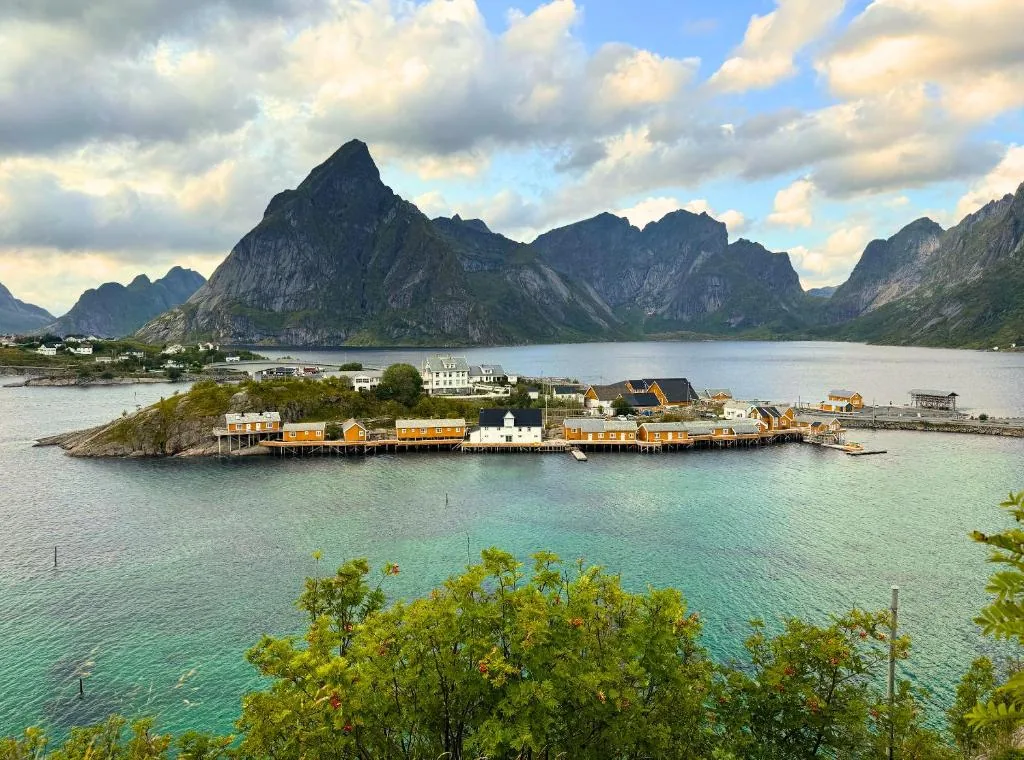
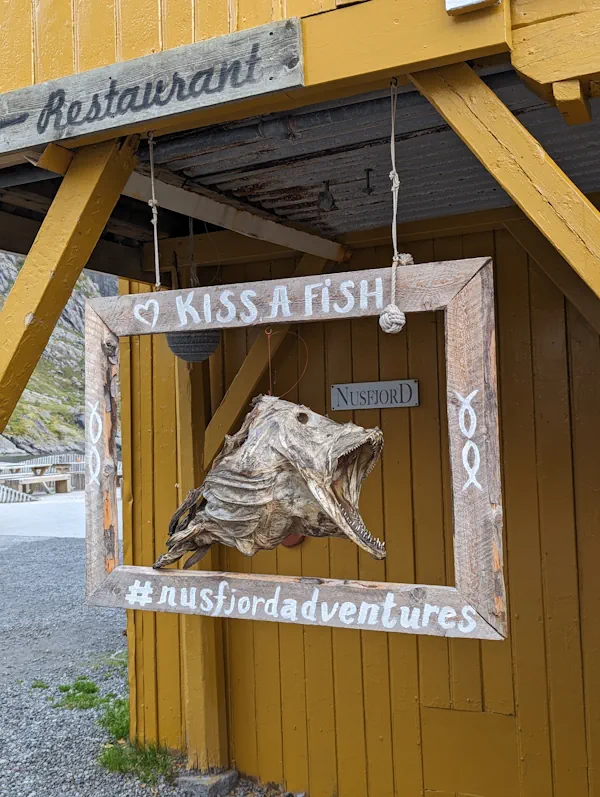
So Nusfjord, unlike the others, I don’t have any photos under the snow, I don’t know why. It’s far less known than the others and, unlike them, it isn’t on the main road. So to see it, you have to go looking a little!
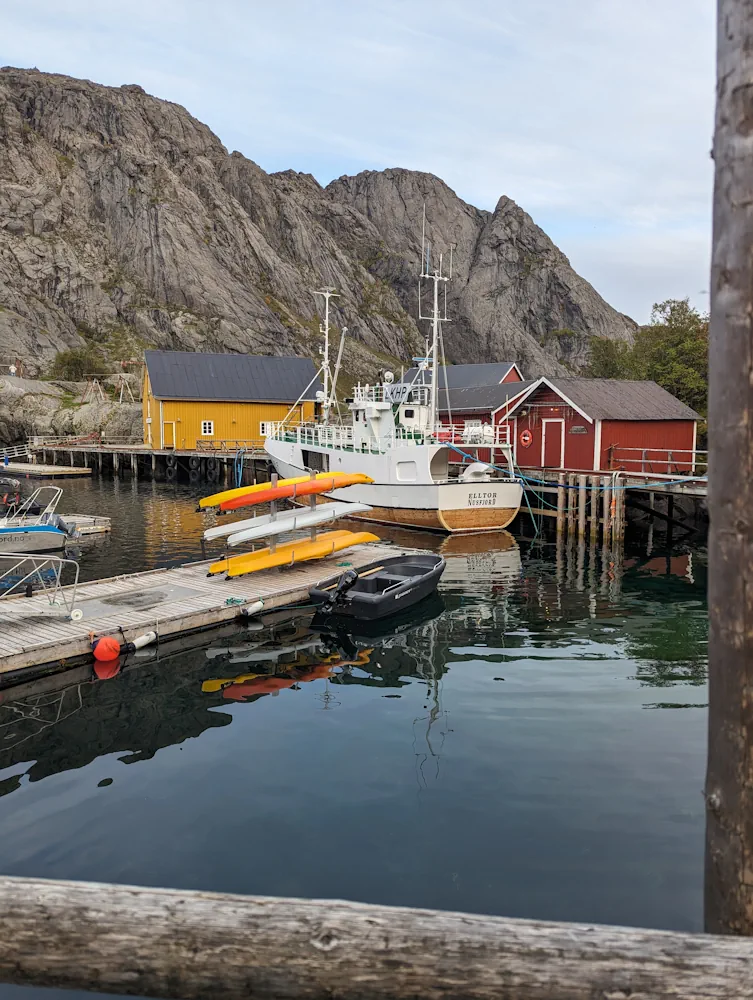
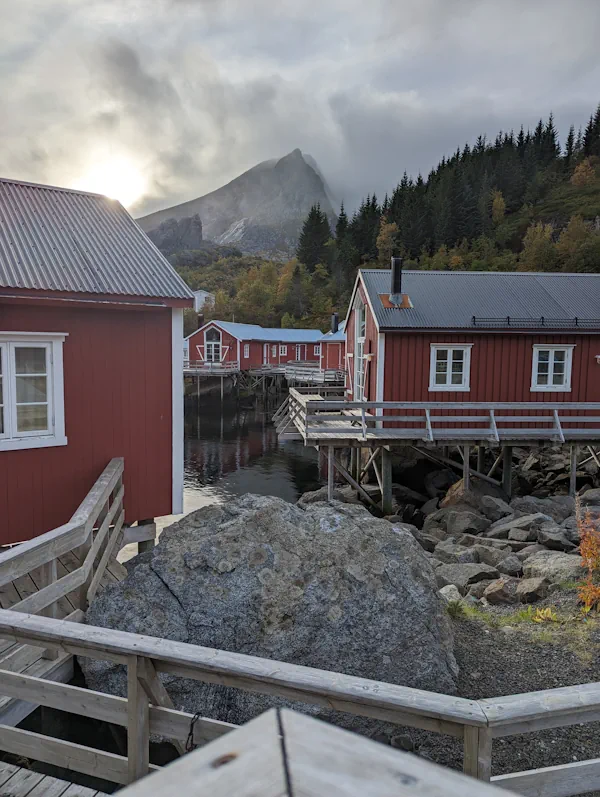
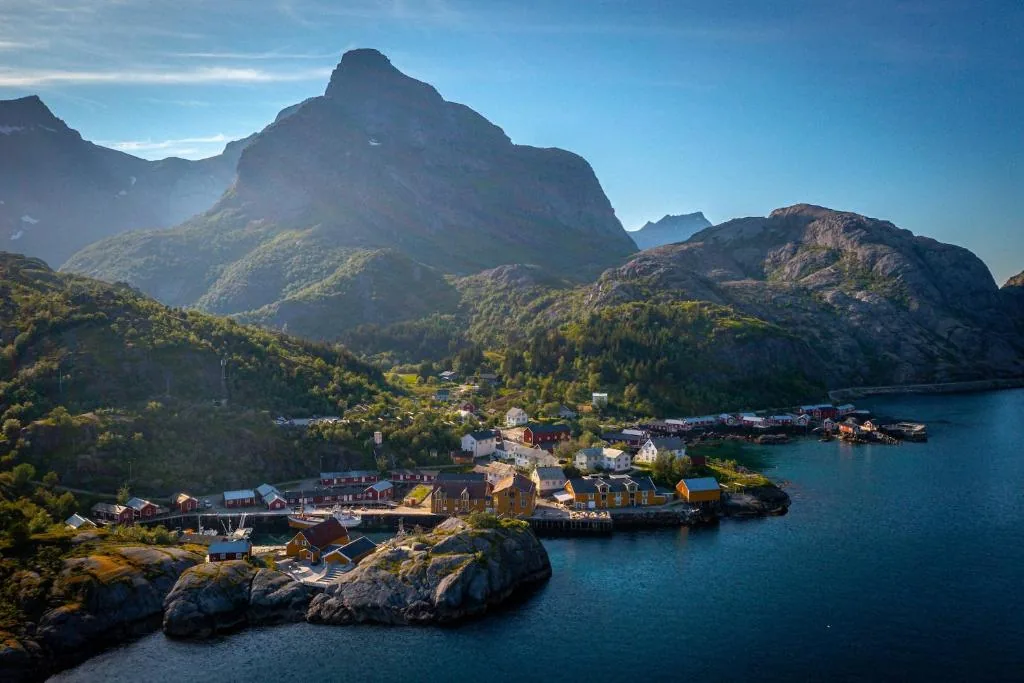
Nusfjord is a very pretty fishing village, and a typical one. It’s completely lost in its fjord, also surrounded by mountains, almost oppressively so. You’ll find a few rare rorbu but the tourist activity is lower here than elsewhere, especially in winter. By the way, the road to get there is really lovely, you’ll pass in front of the Batman mountains (you’ll quickly see why!).
The site is listed by UNESCO among the sites to preserve, and you can understand why.
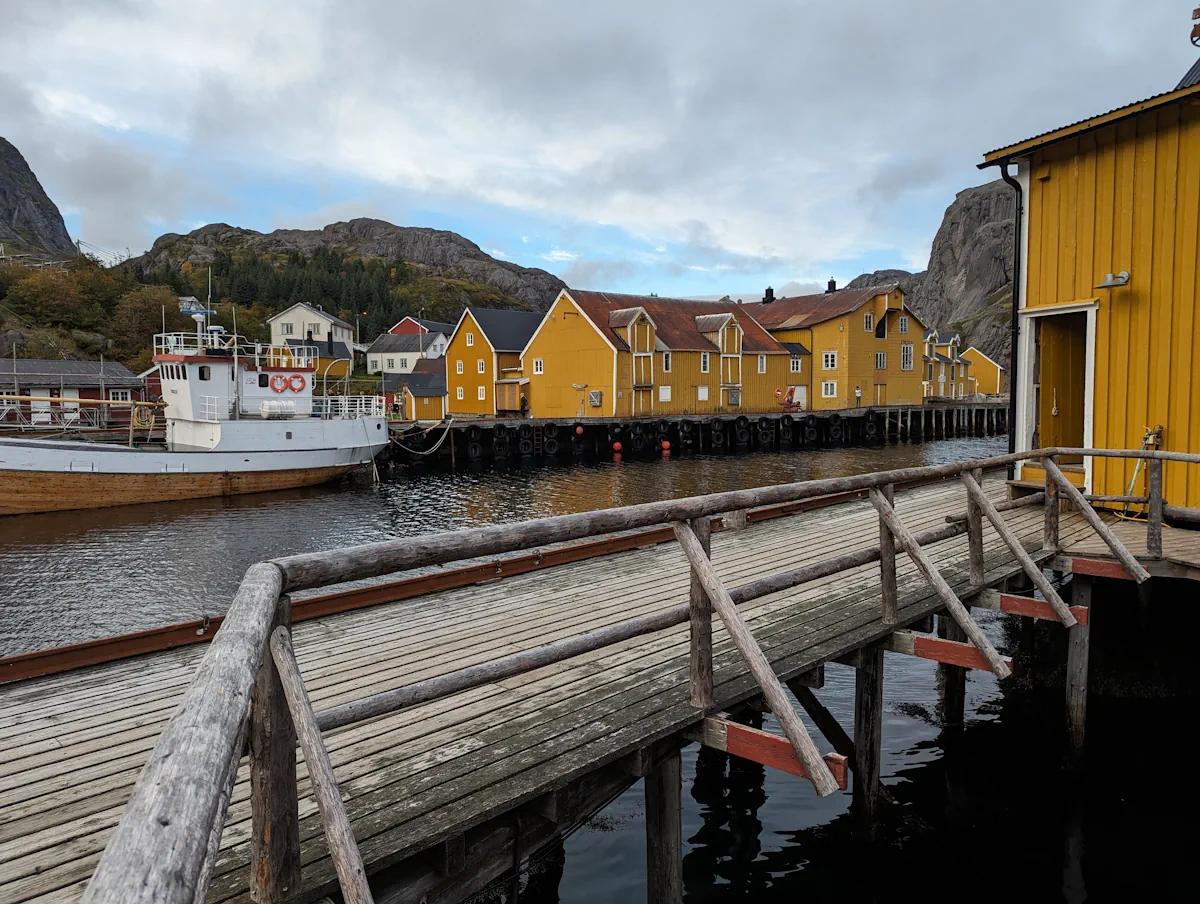
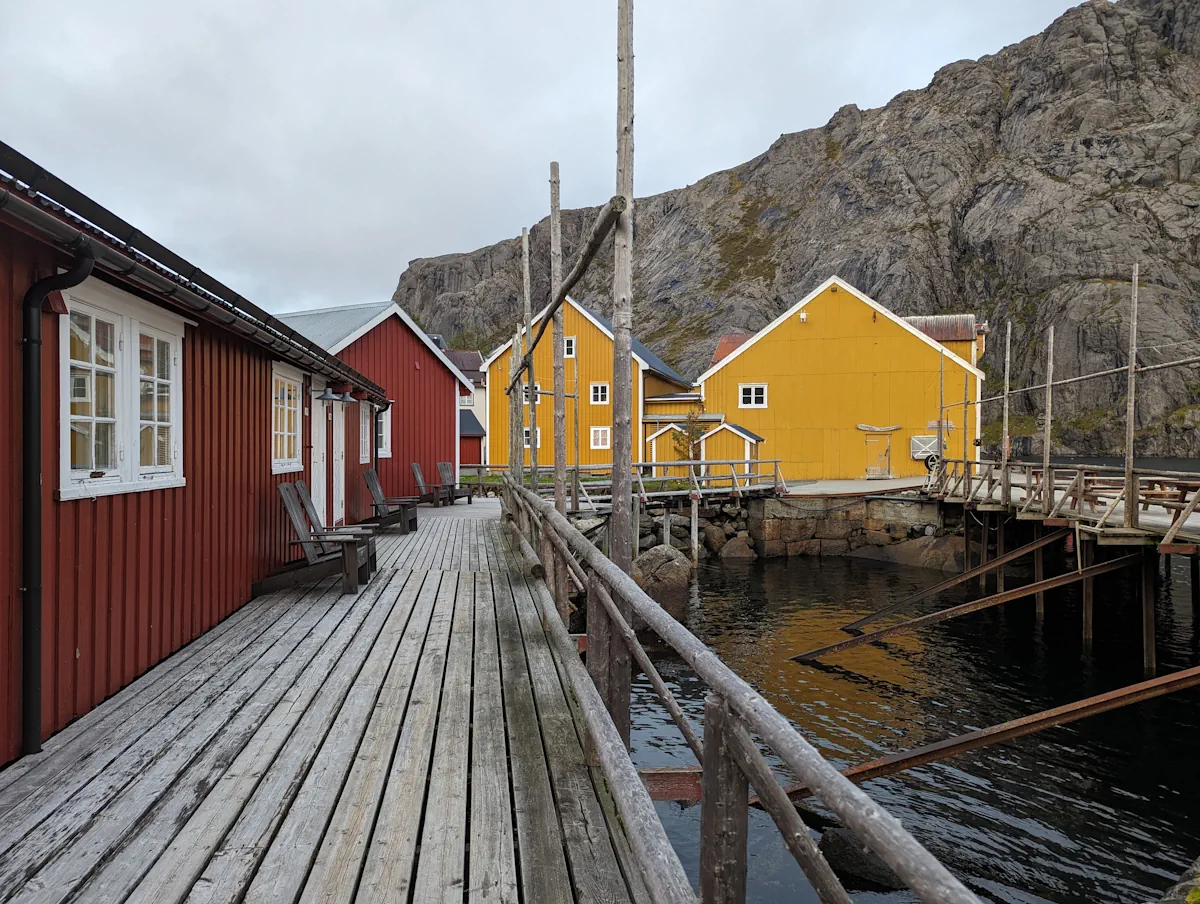
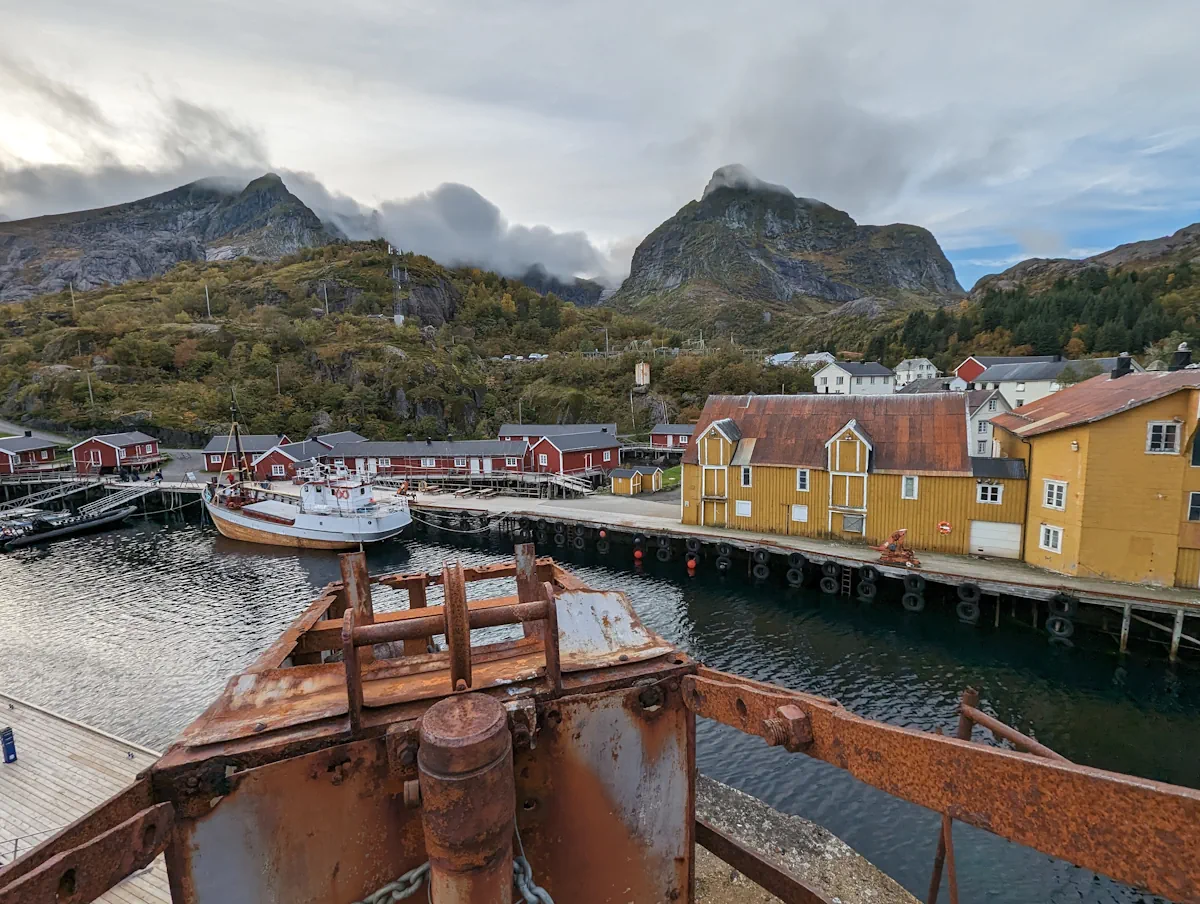
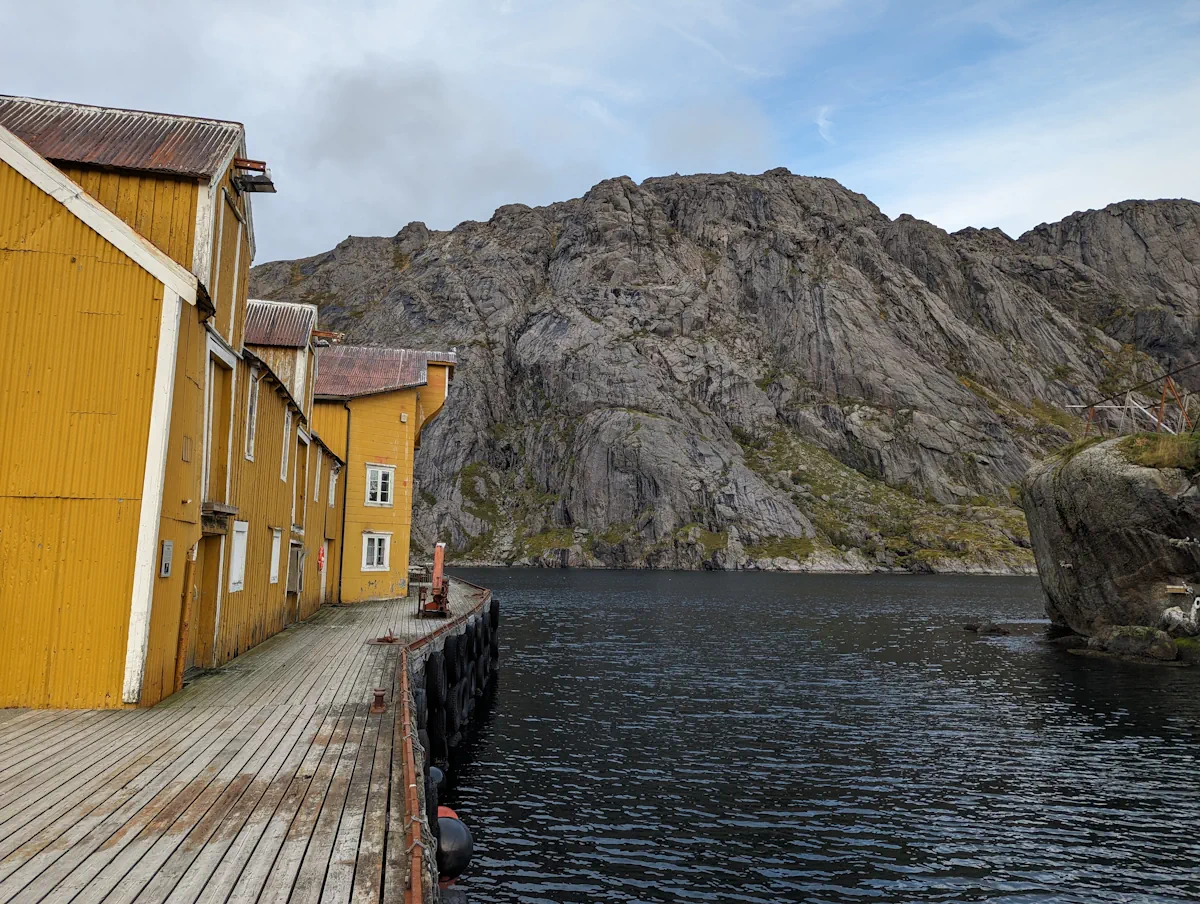
Important to know before you go: Nusfjord is now run as an open-air museum village, and entry is paid during the day (on the order of 100 to 150 NOK per person depending on the season). In practice, a booth takes the money during opening hours (roughly during the day, until around 5pm in season): if you arrive early in the morning or at the end of the day, when it’s not staffed, it’s often free. And if you sleep in one of the rorbu of Nusfjord, access is included — a good reason to spend the night.
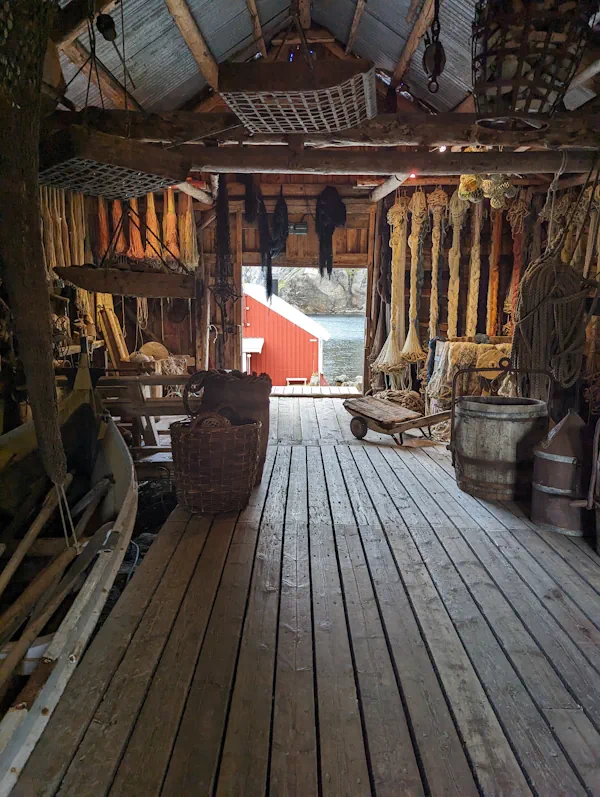
What to see here: stroll along the quay, take a look at the old historic grocery, the former cod liver oil factory and the rorbu clustered at the bottom of the fjord. You really feel like you’re going back in time, and in the evening, once the buses have left, the village is almost all to yourself. Allow 2 to 3 hours here. Nusfjord isn’t on the E10: you have to head down a small road to the end of the fjord, and it combines well with Ramberg, Flakstad and Skagsanden beach.
- Café: you can grab a little treat at the Landhandleriet Café
- Restaurant: there’s the Karoline restaurant, good but pricey
- Hotel: the ideal place to sleep is the Nusfjord Arctic Resort to be in the heart of the village, and the fishermen’s houses Lofoten Cottages which are top-notch.
Where to stay to visit the villages of the Lofoten Islands?
Clearly, visiting these villages MUST be part of your stay in the Lofoten Islands. And, luckily, they’re roughly all in the same place, that is to say in the far south. Reine is a very good base because it lets you get very easily to Å, Hamnøy, Sakrisøy.
But in each of these little villages, especially Hamnøy and Å, there are some really lovely little rorbu. Generally they’re not exactly cheap, but they’re rather spacious and typical.
Nusfjord is a bit further north, about 45 minutes away, so it can be doable while also going to Ramberg, Flakstad and Myrland. But there are also a few nice places to stay on site. Few, but it does the job perfectly well.
On the other hand Henningsvær is much further north, near Svolvær. So there, clearly, Reine isn’t the right base, but since it’s in the north, you’ll almost inevitably pass nearby, especially if you stay around Svolvær. But also, why not in Henningsvær. It has all the amenities, it’s as cute as can be, it can be lovely! Kabelvåg, right next door, is also a very good base to explore the north.

📍 Olenilsøy · Next to Reine (1,142 reviews)
Rorbuer renovated in a retro spirit facing the Reine mountains, each with a fully equipped kitchen.
- Direct views over the mountains and the sea
- Warm retro interiors, carefully finished
- Full kitchen to cook your own meals
From €137 / night Free cancellation

📍 Lamholmen · Peninsula on Svolvær harbour (1,625 reviews)
Red rorbuer on a peninsula in the harbour, a few steps from Svolvær's main square and restaurants.
- Sea and quay views from the rooms
- Varied breakfast with local specialities
- Staff who handle bookings and activities
From €137 / night Free cancellation
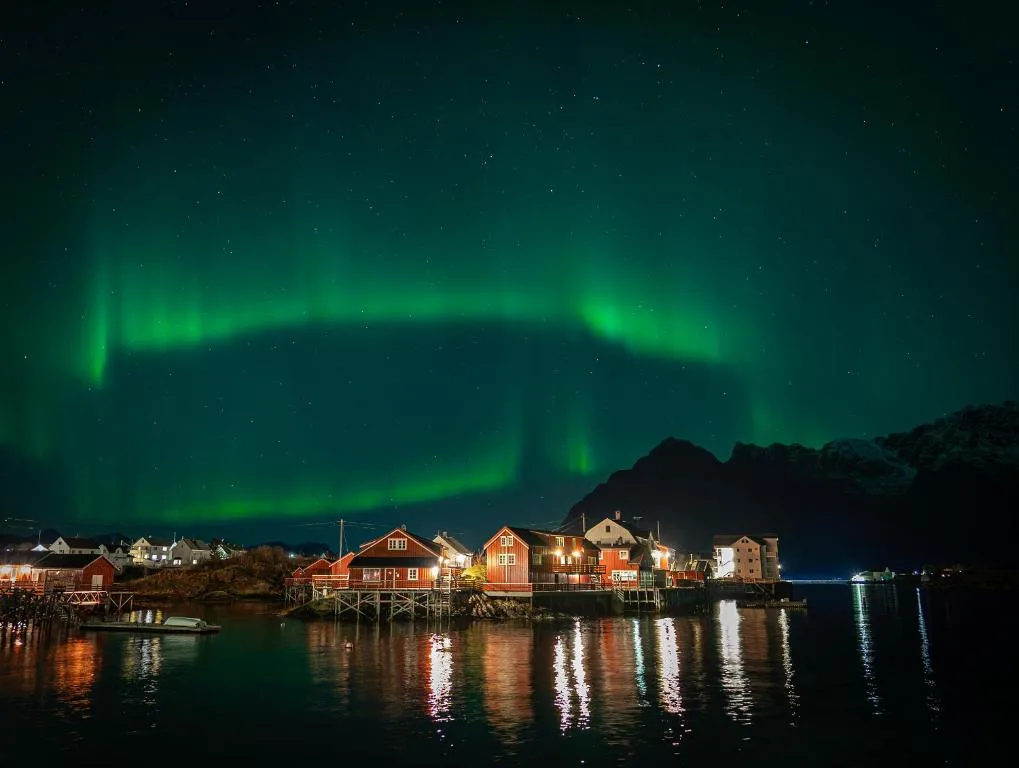
📍 Banhammeren 53 · At the end of Henningsvær village (1,360 reviews)
Fishermen's cabins at the end of the most photogenic village in Lofoten, facing the sea and the islets.
- Sea and islet views, aurora visible from the terrace
- Cosy, well-equipped interiors, sauna available
- Village centre 15 min on foot — ask for a fjord-side rorbu
From €165 / night Free cancellation
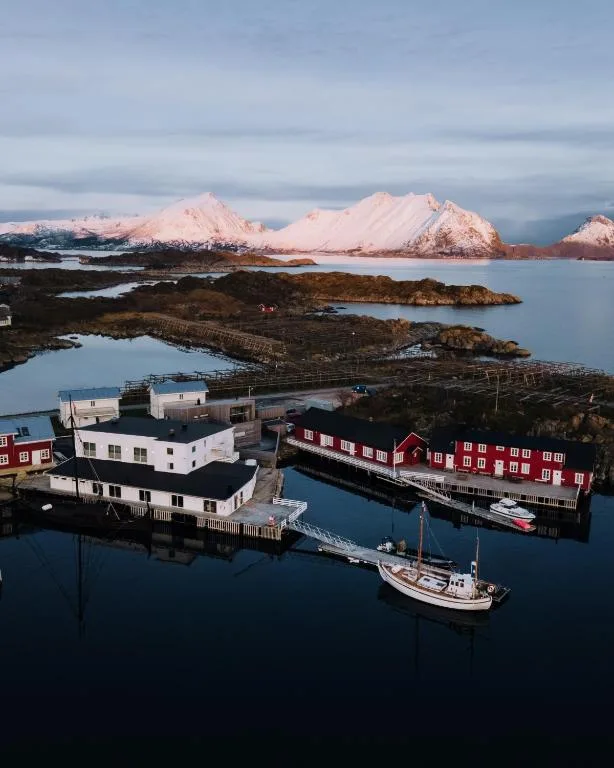
📍 Moloveien 41 · On Ballstad harbour (1,095 reviews)
Rorbuer on Ballstad harbour, with a seafood restaurant that nearly every review recommends.
- Water and mountain views from the rorbuer
- Restaurant known for its seafood
- Sauna, hot tub and excursion desk on site
From €208 / night Free cancellation
Your questions about the Lofoten villages
How long to visit the Lofoten villages? For the south (Reine, Å, Hamnøy, Sakrisøy, Nusfjord), some do it in a single rushed day, but two days would be more suitable; add a good half-day for Henningsvær and Kabelvåg in the north.
Which village to choose to sleep in? Reine to roam around the south, Henningsvær (or Svolvær / Kabelvåg) for the north. For the iconic rorbu experience: Hamnøy or Nusfjord. But if you want somewhere central for the whole stay, I loved staying in Ballstad.
What is the most beautiful village in Lofoten? Hard to decide! Reine for the view, Hamnøy for the postcard, Å for the authenticity, Henningsvær for the atmosphere. The best is still to discover them for yourselves, but I maybe prefer Å and its edge-of-the-world feel.
Do you need a car? Yes, clearly: it all plays out along the E10 and public transport is rare. Here’s my article on renting a car in the Lofoten Islands.
How to visit these villages if you don’t have a car
Well, they’re nearly all reachable by bus (except Nusfjord), but there aren’t many buses a day (4 or 5) so you’ll need to be patient, very patient 😀
To get to Henningsvær from Svolvær, it’s the 743 bus which takes 45 min. Otherwise, to reach the southern villages (Reine, Hamnøy…), it’s the 300 line or the combined 741+742 and that takes 2hr 30.
The most important thing: use the journey planner, with all the bus timetables, online payments and everything: entur.no, it’s essential the moment you use public transport!
Otherwise the simplest would be to take a guide who shows you around these villages and the most beautiful spots in Lofoten over a day. It’s not especially expensive and it means you don’t spend too much time on the bus.
Conclusion and other resources on the Lofoten Islands
What’s really nice about these villages is that they’re all different. Ok, some do look alike, or could even be lumped together since they’re so close — but try telling the locals that Hamnoy and Sakrisoy are the same thing, not sure they’d be too pleased about it!
They’re not very big, so take the time to visit them, especially since they’re the most beautiful fishing villages in all of Norway — it would be a shame not to make the most of them. And since you explore the Lofoten Islands lengthwise, you really can’t miss them 🙂
Other articles on the Lofoten Islands
- Visiting the Lofoten Islands – all the useful info to plan your stay
- Sleeping in a fisherman’s cabin – here are all the nicest places to stay for your holiday
- The best activities to do – see the northern lights, go hiking, horse riding or kayaking, discover it all!
- How to get to the Lofoten Islands – which airport is best, the different ferries, I tell you everything
- Renting a car in the Lofoten Islands – which is the best option
- Taking the ferry between Bodo and Moskenes – the most convenient ferry to reach the Lofoten Islands