Last updated on
Right, I might as well come clean straight away: out of the thirteen ferry routes in the Canary Islands, I’ve taken one. Just one, the smallest, of course. The La Graciosa shuttle, twenty-five minutes, not even a car on board. Hardly enough to fancy myself an old sea dog! Well, not here anyway. It’s not that I didn’t want to, it’s that my trips didn’t lend themselves to it. Lanzarote and La Palma are at completely opposite ends, for instance.
Except that ferries and boat trips have gradually become a bit of an obsession of mine in other destinations. I spent months poring over the Norwegian crossings, to the point of building an entire website about them, and I eventually worked something out: on those routes, the published information is almost always wrong or out of date. The Canary Islands are no exception. So I started again from scratch, route by route, with the companies themselves: Fred. Olsen, Baleària, Líneas Romero.
A word to set the scene: this article is written above all for those who drive. If you have a hire car and you want to keep it from one island to the next, the ferry isn’t one option among several, it’s the only one. If you’re travelling on foot, you’ll get plenty out of this too, the plane will be more relevant to you, but you’ll still find all the information you need.

The ferry routes connecting the Canary Islands
⛴️ Ferry crossings between the Canary Islands
Click a line on the map — or a name below the map — for the crossing time, the operators, the fare and the booking. Zoom with the +/− buttons or the scroll wheel after clicking on the map.
Crossing times, frequencies and operators recorded in August 2026 from the shipping companies. Headline non-resident fares, per person and per trip: the 75% discount reserved for Canary Islands residents does not apply to visitors. Car fares are recorded one by one in the companies' booking engines, as none publishes a vehicle price list.
The 13 routes at a glance
The map is good at answering ‘I want to get from this island to that one’. It’s less good at ‘show me everything, quickly’. So here’s the whole network, on one page, grouped by hub.
A quick note on reading it: the crossings are only shown in one direction, but they obviously run both ways. Listing them twice would have given twenty-six routes for thirteen boats.
Western star — everything leaves from Los Cristianos (Tenerife)
None of these three islands is connected to the others: everything goes back through Tenerife.
| Crossing | Duration | Departures | Operators | Car + 1 person | |
|---|---|---|---|---|---|
| Tenerife → La GomeraLos Cristianos → San Sebastián | 50 min | 5/day | Fred. Olsen · Baleària | from £60 | Compare |
| Tenerife → La PalmaLos Cristianos → Santa Cruz de La Palma | 2 h 30 | 4/day | Fred. Olsen · Baleària | from £62 | Compare |
| Tenerife → El HierroLos Cristianos → Puerto de La Estaca | 2 h 20 | daily | Fred. Olsen · Baleària | from £77 | Compare |
The hinge — the only link between the two halves of the archipelago
Two operators, two different ports, sixteen euros apart.
| Crossing | Duration | Departures | Operators | Car + 1 person | |
|---|---|---|---|---|---|
| Gran Canaria → TenerifeAgaete → Santa Cruz | 1 h 20 | 8/day | Fred. Olsen | from £54 | Compare |
| Gran Canaria → TenerifeLas Palmas → Santa Cruz | 1 h 40 | 8/day | Baleària | from £70 | Compare |
Eastern star — around Las Palmas (Gran Canaria)
The network's long crossings, two of them overnight with cabins.
| Crossing | Duration | Departures | Operators | Car + 1 person | |
|---|---|---|---|---|---|
| Fuerteventura → Gran CanariaMorro Jable → Las Palmas | 2 h | 4/day | Fred. Olsen · Baleària | from £72 | Compare |
| Fuerteventura → Gran CanariaPuerto del Rosario → Las Palmas · overnight | 6 h 15 | 1/day | Baleària | from £77 | Compare |
| Lanzarote → Gran CanariaArrecife → Las Palmas · overnight | 6 to 10 h | daily | Baleària | from £126 | Compare |
| Fuerteventura → LanzarotePuerto del Rosario → Arrecife · 3 am | 2 h | 1/week | Baleària | from £47 | Compare |
The local shuttles — without going via a capital
Short, frequent, and for two of them without cars on board.
| Crossing | Duration | Departures | Operators | Car + 1 person | |
|---|---|---|---|---|---|
| Lanzarote → FuerteventuraPlaya Blanca → Corralejo | 25-35 min | 12/day | Fred. Olsen · Baleària · Romero | from £43.70 | Compare |
| Lanzarote → La GraciosaÓrzola → Caleta de Sebo | 25 min | 9/day | Romero · Biosfera | no cars | Compare |
| Fuerteventura → LobosCorralejo → Isla de Lobos · permit | 15 min | several/day | Romero | no cars | Compare |
| La Gomera, the south coastSan Sebastián · Playa Santiago · Valle Gran Rey | 30-70 min | 3/day | Fred. Olsen | no cars | Compare |
Car + 1 person prices, one way, non-resident visitor fare, recorded in August 2026 in the companies' booking engines. These are ballpark figures: the actual amount on the day depends on the date and appears at booking.
Two networks, not one archipelago
Now this is THE thing to grasp before building an itinerary. And it’s not necessarily obvious at first glance.
We picture the Canary Islands as a chain of islands linked to one another step by step. Well, not at all. They’re two separate hubs, with a single point of contact.
In the west, everything revolves around Tenerife, Los Cristianos, in the south of the island. La Gomera, La Palma and El Hierro are connected to it — and to nothing else. No direct boat links La Gomera to La Palma. None links La Palma to El Hierro. None links La Gomera to El Hierro. You’ll still see the companies selling these journeys: they’re tickets with a connection, not crossings. To get from one to another, you have to go back through Tenerife. Every single time.
In the east, everything revolves around Las Palmas, with the added Corralejo – Playa Blanca shuttle linking Fuerteventura directly to Lanzarote — the most useful crossing in the archipelago if you’re doing the two islands back to back.
And between the two halves: a single hinge, Tenerife – Gran Canaria.
So if you were dreaming of a Lanzarote – La Palma trip by boat: that’s three crossings and two days of your holiday. Honestly, take the plane — and if you’re absolutely set on keeping the car, you’re better off rethinking the itinerary than putting yourself through that.
The practical side: which port, which island?
Canarian port names are a breeding ground for booking mistakes. Santa Cruz de Tenerife and Santa Cruz de La Palma are two different ports, on two different islands, and the booking engines often list them one below the other. Keep this table handy:
| The port | The island |
|---|---|
| Las Palmas, Agaete | Gran Canaria |
| Santa Cruz de Tenerife, Los Cristianos | Tenerife |
| Santa Cruz de La Palma | La Palma |
| San Sebastián, Playa Santiago, Valle Gran Rey | La Gomera |
| Puerto de La Estaca | El Hierro |
| Arrecife, Playa Blanca, Órzola | Lanzarote |
| Corralejo, Puerto del Rosario, Morro Jable | Fuerteventura |
| Caleta de Sebo | La Graciosa |
| Huelva, Cádiz | Andalusia, on the mainland |
Two traps to remember. Las Palmas is on Gran Canaria, not on La Palma — they’re two islands 300 km apart. And Puerto del Rosario is the main town of Fuerteventura, not to be confused with Puerto de La Estaca, which is on El Hierro.

The various ferry companies in the Canary Islands
Three families of companies share the archipelago.
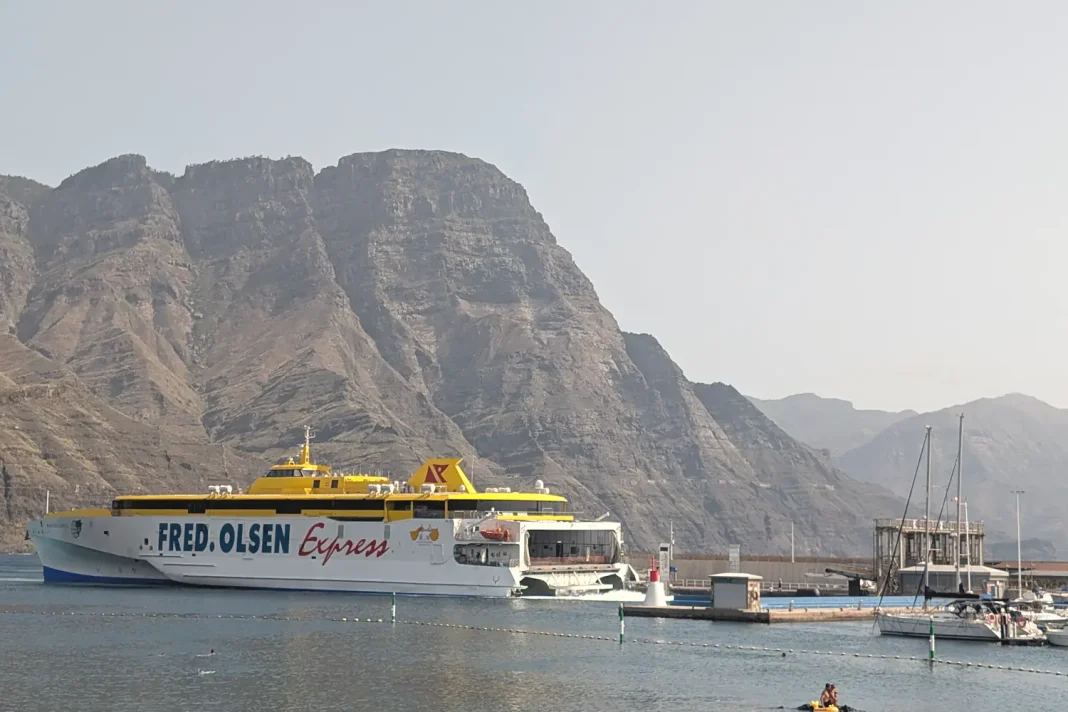
Fred. Olsen Express is the old hand. A family of Norwegian shipowners based in Tenerife for decades, fast trimarans that hit up to 38 knots. Seven routes. They’re the ones running Tenerife – Gran Canaria in 1h20, and it’s the fastest fleet in the Canary Islands.
Baleària Canarias, and here’s where you need to pay attention, because it’s brand new: on 18 May 2026, Baleària took over Armas Trasmediterránea’s Canarian operations. The two brands still coexist during the transition, but there are no longer two competing networks, there’s only one. Nine routes, daytime fast ferries on the short hops and proper cabin ships for the overnight crossings. If you go to their site, yes you’ll find the Canary Islands routes, but you’ll be quietly redirected to the Balearia site
Líneas Romero and Biosfera Express, finally, are the little ones from the north of Lanzarote. La Graciosa from Órzola, Lobos from Corralejo, and Líneas Romero is also on Corralejo – Playa Blanca.
Where it really gets competitive is on just five routes: the three out of Los Cristianos, Corralejo – Playa Blanca, and Morro Jable – Las Palmas. Everywhere else, it’s a monopoly. And you can feel it in the fares.
The funniest case is Tenerife – Gran Canaria: the two companies go head to head from different ports. Fred. Olsen arrives at Agaete, in the north-west, and saves twenty minutes on the water. Baleària arrives at Las Palmas, right in the city. Except that Agaete is about thirty kilometres from the capital — Fred. Olsen lays on a free shuttle bus to make up for it.
So if you’re heading to Las Palmas, the advantage disappears. If you’re heading to the north of the island, it’s real. Which port to choose therefore depends mostly on where you’re staying. I’ve actually detailed the neighbourhoods in where to stay in Gran Canaria and where to stay in Lanzarote.
How much does a ferry trip in the Canary Islands cost
Here’s what I found, for a one-way trip, non-resident visitor fare. The column you’ll care about is probably the last one: it’s the real price of a car with its driver. But I’ve also included foot passengers.
I note in brackets where I found each price, because — as you’ll see — on some routes, the cheapest company isn’t the same one. Each crossing links to its comparison site for your own dates:
| Crossing | Duration | On foot | Car + 1 person |
|---|---|---|---|
| Órzola – La Graciosa | 25 min | 16 € | — no car |
| Playa Blanca – Corralejo | 25 to 35 min | 31 € | 43,70 € (Bal.) · 46 € (F.O.) |
| Puerto del Rosario – Arrecife | 2h15, once a week | — | 47 € (Bal.) |
| Agaete – Santa Cruz de Tenerife | 1h20 | 48 € | 54 € (F.O.) |
| Los Cristianos – San Sebastián de La Gomera | 50 min | 40 € | 60 € (F.O.) · 61 € (Bal.) |
| Los Cristianos – Santa Cruz de La Palma | 2h30 | 49 € | 62 € (F.O.) · 62,50 € (Bal.) |
| Las Palmas – Santa Cruz de Tenerife | 1h40 | 60 € | 70 € (Bal.) |
| Morro Jable – Las Palmas | 2h | 55 € | 72 € (F.O.) · 77 € (Bal.) |
| Los Cristianos – Puerto de La Estaca | 2h20 | — | 77 € (F.O.) |
| Puerto del Rosario – Las Palmas | 6h15, overnight | 62 € | 77 € (Bal.) |
| Arrecife – Las Palmas | 6 to 10h, overnight | 112 € | 126 € (Bal.) |
F.O. = Fred. Olsen Express, Bal. = Baleària Canarias. Where two figures appear, it means both companies run the route and I noted both.
So take a close look at that right-hand column, because there are several things going on in it.
First, the good surprise: on Agaete – Santa Cruz, the car costs only six euros more than the foot-passenger ticket. Elsewhere the supplement runs between ten and twenty euros. In other words: taking your car between Gran Canaria and Tenerife costs roughly the price of a sandwich. Compare that with returning the vehicle, taking the plane and hiring another one on arrival…
Next, the comparison between companies, which I’ve seen nowhere else. On Gran Canaria – Tenerife, the two companies don’t leave from the same port, and the gap is huge: 54 € via Agaete with Fred. Olsen, 70 € via Las Palmas with Baleària. Sixteen euros to connect the very same two islands. If you’re not specifically staying in Las Palmas, go via Agaete — the shuttle bus is included, and you save the price of a good meal.
On Fuerteventura – Gran Canaria, same logic: 72 € from Morro Jable with Fred. Olsen versus 77 € with Baleària leaving from the same port. But Baleària holds a card Fred. Olsen doesn’t — the overnight route from Puerto del Rosario, also at 77 €. If you’re staying in the centre or north of Fuerteventura, the two hours of driving saved to Morro Jable are well worth the five-euro difference.
And on Corralejo – Playa Blanca, it’s the other way round: Baleària is cheaper, at 43,70 € against 46 € with Fred. Olsen. The gap is slim, and on that route it’s mainly the timetable that matters — each company leaves roughly every two hours, which adds up to as many as twelve crossings a day once all three are combined.
On the two routes out of Los Cristianos, on the other hand, the prices are almost identical. To La Gomera, 60 € with Fred. Olsen against 61 € with Baleària. To La Palma, 62 € against 62,50 €. A one-euro gap, which is to say none: on these two crossings, simply take whichever leaves when it suits you. And there’s plenty of choice — up to five departures a day to La Gomera, from morning to early evening.
One last route deserves a mention: Arrecife – Las Palmas at 126 € with the car, it’s by far the most expensive in the archipelago, and that makes sense — six to ten hours at sea, overnight, on a proper cabin ship. If you have to get Lanzarote to Gran Canaria by car, it’s the only direct boat. And no, cutting through Fuerteventura won’t save you anything: 47 € for Puerto del Rosario – Arrecife plus 77 € for Puerto del Rosario – Las Palmas comes to 124 €, just two euros less than the direct one. As good as nothing.
All the more so since that Puerto del Rosario – Arrecife route, which I put in the table for the sake of honesty, isn’t really an option: a single departure a week, Monday at 3 a.m., arriving at 5.15 a.m. To get from Fuerteventura to Lanzarote, you take Corralejo – Playa Blanca, full stop. I’m flagging it mainly so you don’t stumble on it thinking you’ve found a bargain.
If you really want to link Lanzarote to Gran Canaria by breaking it up, do it in three stages via Corralejo then Morro Jable, and plan to sleep along the way. It’s a holiday itinerary, not a shortcut.
And now the catch, because there’s a big one. As you search you’ll come across fares of 11 €, 13 €, 15 €, splashed in huge type across the companies’ websites. You’ll think, great, that’s a steal! Well, no. Those are resident fares, and you’re not entitled to them.
Canarians get a 75% discount on inter-island crossings. It’s not a special offer, it’s a public scheme: 50% paid by the Spanish state, plus 25% added by the Canary Islands government. And the condition isn’t nationality — it’s genuine residence in the Canary Islands, checked at the counter. A Brit living in the UK isn’t entitled to it. A Brit settled in Tenerife is.
Basically: on those sites, the cheap price is never for you.
A note on the table: the two columns weren’t recorded at the same moment, and the foot-passenger fare and the car fare don’t always belong to the same ticket class. The gap between the two therefore gives a ballpark figure for the vehicle supplement — reliable enough to decide, not enough to be quoted to the exact euro.
When you book, do take real care to tick ‘non-resident’

Taking your car on the ferry
As you’ve gathered, this is the heart of the matter. And it’s also the point on which the companies are most tight-lipped.
Before even thinking about loading it on board, you first have to have chosen it: I compared the agencies and prices in hiring a car in Gran Canaria. but also in Lanzarote, where it really doesn’t cost much at all.
Next, vehicles are classed by size bracket, not by the metre. With Fred. Olsen, a ‘turismo’ is under 1.90 m tall and under 5 m long. Cross just one of the two thresholds and you tip over into ‘large vehicle’, which is markedly dearer. Motorbikes and scooters have their own separate fare. So if you’ve got a roof box or a van: measure before booking, not at the counter.
And here I have to be honest with you: no company publishes a ready-made car price grid. The fares shown on the home pages are resident prices or one-off promotions. The eleven figures in the table above, I went and dug them out one by one in Fred. Olsen’s and Baleària’s booking engines, ticking ‘non-resident’ every time — it’s the only place where the real price appears.
Good news along the way: the vehicle supplement is far gentler than you’d fear. Between ten and twenty euros on most routes, just six euros between Agaete and Santa Cruz. We always imagine the car doubles the bill; in reality it adds about a quarter.
Three habits to get into before loading a car:
Book the vehicle space in advance, it’s capped and it goes fast in summer. Turn up 40 minutes before departure, against 20 minutes for a foot passenger — and being late loses you the booking, no argument.
And above all, check your rental contract: taking a hire car to another island isn’t always allowed, and when it is it can sting. I tried the trick of picking up a car on one island and dropping it on another in my article on car hire in Lanzarote: bang, 380 €! That needs sorting out beforehand.
One last point everyone always forgets: with a vehicle, luggage is no longer limited. On foot, it’s 20 kg per person.


Ferry or plane: it mostly comes down to your car
Seven of the eight islands have an airport. Binter serves all of them, Canaryfly doubles up on eight routes but doesn’t open a single new one. On paper, the plane wins hands down: 40 minutes in the air against 2 hours 30 at sea.
Except that’s not the real question. The real question is whether you’re driving.
You’re travelling with a car: the boat, full stop
If you’ve hired a car and you’re planning to drive on the next island, there’s no comparison to be had. Flying would force you to hand the vehicle back, fly, and hire another one on arrival. That means two contracts instead of one, two trips to the counter, two condition checks, two excess deposits — and often a hefty surcharge if you return the vehicle somewhere other than the pick-up branch. I’d given it a go: bang, 380 €!
The ferry, on the other hand, takes you on board with your loaded car, your bags inside it, your child seats already fitted. You drive down the ramp and off you go.
So if you’re driving, the only thing to look at is whether there’s a direct boat. When there is, take it:
| You want to go from… | …to | The boat | Your car + you |
|---|---|---|---|
| Lanzarote | Fuerteventura | 25 min, up to 12/day | from 43.70 € |
| Gran Canaria | Tenerife | 1h20, up to 8/day | from 54 € |
| Fuerteventura | Gran Canaria | 2h, up to 4/day | from 72 € |
| Lanzarote | Gran Canaria | overnight, cabins | from 126 € |
| Tenerife | La Gomera | 50 min, up to 5/day | from 60 € |
| Tenerife | La Palma | 2h30, up to 4/day | from 62 € |
| Tenerife | El Hierro | 2h20, every day | from 77 € |
Look at those figures for a second: six of the seven routes carry you and your car for under 80 €. A round trip to the hire branch to drop off one vehicle and pick up another costs more than that in admin fees alone, never mind the time.
Yes, Tenerife – La Palma takes 2 hours 30 against a 40-minute flight. But with your car on board, those 2 hours 30 replace half a day of paperwork and a second hire contract. The maths isn’t the same at all.
You’re not driving: now the plane makes more sense
If you’re island-hopping on foot, by bus or on organised excursions, you don’t have much reason to put yourself through 2 hours 30 at sea to reach La Palma or El Hierro. Take the plane on those long diagonals, and save the boat for the short hops, where it’s the better option anyway.
Then again, it also depends on where you’re staying: if your ferry drops you right by your accommodation, then it’s worth it rather than taking the plane.
Bear in mind that flights are super quick and, at the outset, not expensive, but if you leave it to the last minute the price can climb fast.
Taking the ferry as a foot passenger makes sense if you’re going at an easy pace and you like taking your time.
Your two islands have no direct boat: the plane, no question
This is the most common trap, and it affects 14 island pairs out of 21. No boat links Lanzarote directly to Tenerife, Fuerteventura to Tenerife, Gran Canaria to La Palma, La Gomera to La Palma, or El Hierro to anything other than Tenerife.
On those routes, the ferry would force two or three crossings with connections — reckon on the whole day. The plane does it in an hour. Even with a hire car, it’s often better to return it and pick up another.
One case is worth flagging: La Gomera – La Palma has neither a direct boat nor a direct flight. You have to go back via Tenerife either way.
Three cases where the boat is still the best option
La Graciosa. No airport, no runway, nothing. The boat is the only way in that exists. Full stop.
Lanzarote – Fuerteventura. Two neighbouring islands, eleven kilometres of water between them — and no direct flight. None! Flying forces a detour via Gran Canaria or Tenerife, which is half a day gone. The ferry takes twenty-five minutes and leaves up to twelve times a day. Here, honestly, it’s not even a question.
La Gomera. The island’s airport is 34 km from San Sebastián, tucked away in the south. The port, though, is right in town. Fifty minutes by boat from Los Cristianos and you’re in the centre. The plane, by contrast, dumps you up in the mountains.
Two details that change the maths
Check-in is surprisingly light on domestic flights: Binter closes boarding 30 minutes before, which narrows the gap. But the airports aren’t in town — 18 km at Gran Canaria, 10 km at Tenerife North — whereas the ports of Las Palmas, Santa Cruz or San Sebastián are bang in the centre. And on baggage, Binter only includes 8 kg in the cabin on its basic fare, no hold luggage, while the ferry gives you 20 — and unlimited if you’ve got the car.
A word on flight prices, because I’m not going to sell you a phoney comparison: Binter publishes no one-way fare between islands, just an Airpass deal at 40 € per leg with a minimum of three legs. Canaryfly shows calendars between 13 and 24 € without ever specifying whether it’s the resident fare or yours. So every priced comparison you’ll read elsewhere is built on sand. The only real test is your own dates in both search engines.

Can you do the round trip in a day
A question I get asked a lot! And the answer depends entirely on the route.
One tip before the list: for a day trip, leave the car at the port and go on foot. You save the vehicle fare both ways, and on islands like La Graciosa you wouldn’t be allowed to land with it anyway. It’s actually perfectly doable to visit Lanzarote without a car, relying on buses and excursions.
With children, the question plays out differently — the short crossings are absolutely fine, the six-hour overnight ones much less so. I talk about it in Lanzarote with the family.
Yes, easily: Lanzarote → Fuerteventura (25 min, up to 12 departures a day, you leave in the morning and you’re back for dinner without a second thought), Lanzarote → La Graciosa (25 min, 9 departures, the day round trip is actually the standard way to do it), Tenerife → La Gomera (50 min, up to 5 departures, a fine, full day).
Yes, but tight: Gran Canaria ↔ Tenerife (1h20 to 1h40, up to 8 departures). Doable, but you spend three hours on the water. Best kept for people with something specific to do on the other side.
No, forget it: Tenerife → La Palma and Tenerife → El Hierro (2h20 to 2h30 each way, and only a handful of departures). You’d spend five hours on the boat for three hours on the ground. Those islands are ones you sleep over on, full stop.
And absolutely not: anything done overnight with a cabin, Arrecife – Las Palmas and Puerto del Rosario – Las Palmas. These aren’t day trips, they’re stages of a journey.

The two crossings that are worth the journey in themselves
La Graciosa, the only one I’ve done
Right, it’s the only one I’ve actually done, so I might as well tell you about it properly.
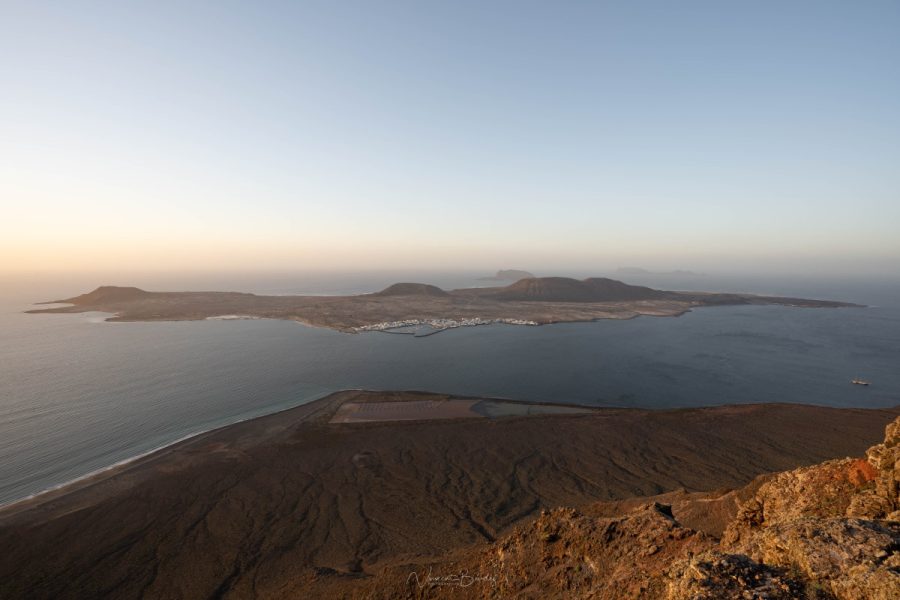
I hadn’t planned to go. It was the view from the Mirador del Rio that made me change my plans mid-trip — you can see the whole island from up there, sitting in turquoise water, and you tell yourself you have to go. I ended up spending two nights there, in January.
The crossing leaves from Órzola, right at the north of Lanzarote. Twenty-five minutes according to Líneas Romero — reckon on more like half an hour quay to quay, boarding included, which is the time you’ll see on the ticketing sites. Nine departures a day, 16 € one way and 29 € return. The boat runs along the cliff of the Risco de Famara — six hundred metres of basalt dropping straight into the water — and that’s already a spectacle in its own right!
And on arrival, no cars. Not yours, not anyone’s: motor traffic is capped by the Teguise town council, the streets aren’t even surfaced. You land on foot or by bike, and that’s exactly what makes the place so charming! I’ve written a full article about it here if the island tempts you, and it obviously features on my map of Lanzarote with the rest of my favourites.
Lobos, and its compulsory permit
This one I haven’t done, but it takes some preparation that a lot of people discover too late.
The islet of Lobos, opposite Corralejo, is protected and access is capped. You need a free permit from the Cabildo de Fuerteventura, to be requested at least three days in advance on the Lobos Pass platform. The quota is 200 visitors at any one time, over two four-hour slots, so 400 people a day maximum.
Without a permit, they won’t let you board. Full stop. It’s restrictive, and that’s precisely why the island has stayed as it is.
I’ll also mention the coastal route on La Gomera, a mini-ferry linking San Sebastián, Playa Santiago and Valle Gran Rey along the south coast. It doesn’t take cars — eight scooters at the very most — but it spares you a fairly gruelling mountain road. 15 € per leg.

Getting to the Canary Islands by ferry from Spain
Here’s the nice scenario, and yet it’s the finest gift the ferry can give a traveller with a car: you can reach the Canary Islands by sea from mainland Spain, with your own vehicle.
No more hire, no more contract, no more excess. You load your car at home, you drive down to Andalusia, you board, and you land in Tenerife with your things, your bikes on the roof and your child seats in place. For a three-week trip or a winter stay, the maths quickly starts to add up.
You catch it at Huelva, in western Andalusia, between Seville and the Portuguese border. Fred. Olsen Express and Baleària run the line together, with two vessels, the Marie Curie and the Buenavista Express. The latter gives you a sense of the scale of the thing: 172 metres, 1,250 passengers, 390 vehicles and over 200 cabins.
Two destinations from Huelva: Santa Cruz de Tenerife in 33 hours direct, and Las Palmas in 40 hours, with a four-hour stopover. Reckon on three sailings a week, and four in summer.
On board, you choose your level of comfort: standard seat, premium seat, “sleep lounge”, or inside, outside and superior cabin. The cabin isn’t compulsory — but over thirty-three hours at sea, I’ll let you guess which one I’d take. And the best part: no baggage limit, since everything stays in the car.
A note of honesty, because the two companies don’t tell quite the same story. Fred. Olsen only mentions Huelva, but Baleària’s routes page announces departures from Cádiz to Tenerife, Gran Canaria, Lanzarote and La Palma — without mentioning Huelva. Both ports therefore seem to be active, probably a legacy of the Trasmediterranea then Balearia network on the Cádiz side. Check the port of departure when you book rather than relying on an article, this one included.
- Find the various crossings between Huelva (Spain) and Gran Canaria
- Here are the crossings between Cádiz (Spain) and Tenerife
One last practical point: these crossings need booking well in advance in summer. Three sailings a week and 390 vehicle spaces go quickly when everyone leaves at the same time.
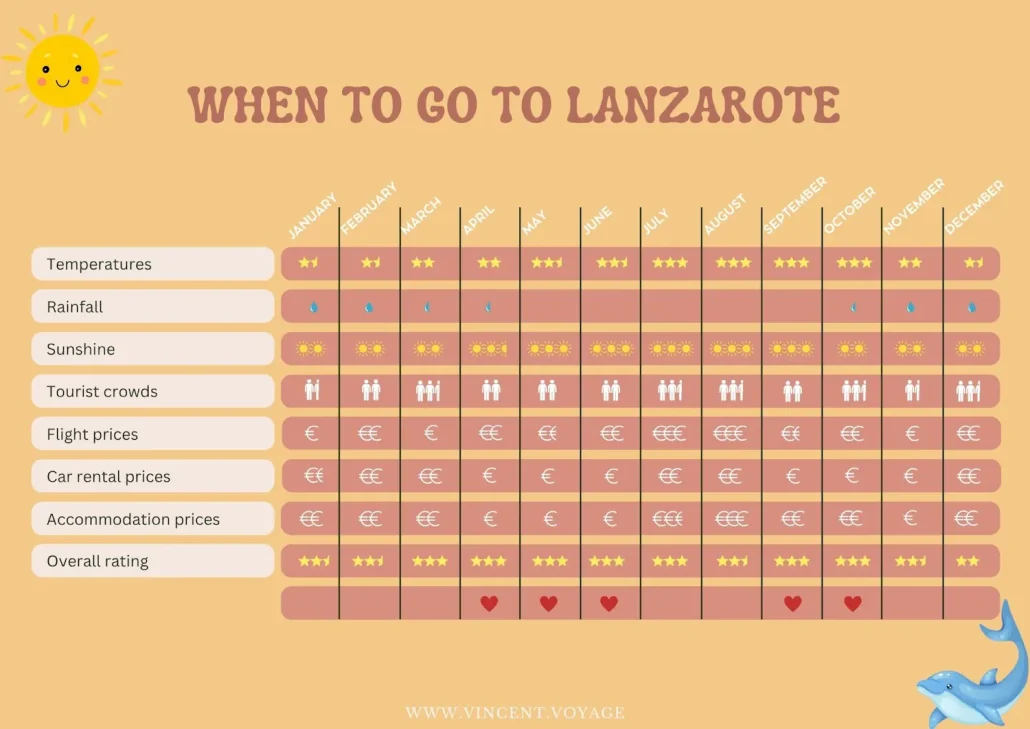
Which is a good argument for shifting your trip. The Canary Islands are pleasant all year round — I’ve broken it down month by month in when to go to Lanzarote — and they rank high among my destinations for a September getaway as well as for the autumn half-term holidays. Outside July and August, the boats are less full and the fares gentler.

FAQ – The most important questions
Do you need to book your ferry in advance in the Canary Islands?
For a foot passenger out of season, not essential. For a car, or for any crossing in July and August: yes, without hesitation. Vehicle spaces are capped and go well before the day itself. For a car out of season, don’t take the risk because… well, there’s no off season in the Canary Islands, in fact! It’s fairly touristy all the time. So book as soon as you know.
How much does a ferry cost in the Canary Islands with a car?
Between 43.70 € and 126 € one way for the car plus its driver, non-resident visitor fare. The cheapest is Corralejo – Playa Blanca, the dearest Arrecife – Las Palmas, which is also the longest. On most short routes, reckon on between 50 and 80 €.
Is it better to bring your own car or hire another one there?
If you’re changing island for more than two or three days and there’s a direct boat, bring it. You avoid a second contract, a second condition check, a second excess, and the one-way surcharge if you return the vehicle elsewhere. On top of that, hiring a car for a long stretch costs less than two short hires. For a day round trip, it’s the reverse: leave it at the port and travel on foot.
Can you take a hire car to another island?
It depends entirely on your contract, and it isn’t always allowed. When it is, a one-way with drop-off on another island can cost a great deal — I tried it, 380 € in my case. To be sorted before booking the boat, never at the boarding desk. But ideally it’s better to return it to the same place you picked it up. That avoids some fairly hefty fees.
Can you get to the Canary Islands by ferry from France?
Not directly. You have to drive down to Andalusia and board at Huelva — or at Cádiz depending on the company. Reckon on 33 hours at sea to Tenerife, with your car on board and no baggage limit.
Which islands aren’t linked by any direct ferry?
La Gomera, La Palma and El Hierro aren’t linked to each other by any boat: everything goes back via Tenerife. And there’s no direct connection between the western group (Tenerife, La Gomera, La Palma, El Hierro) and the eastern group (Gran Canaria, Fuerteventura, Lanzarote) other than through the Tenerife – Gran Canaria hinge.
Does the ferry pitch about a lot in the Canary Islands?
You’re in the middle of the Atlantic, so yes, it can get choppy — especially on the stretch of sea between Tenerife and Gran Canaria, which is known for it. If you’re sensitive, take a fast ferry rather than a conventional one, or take a little travel-sickness remedy. Settle yourself in the middle of the boat, and take something before boarding.
That said, the crossings are never super super long, so you’ll be fine 🙂
How long before departure do you need to be at the port?
20 minutes before departure on foot, 40 minutes with a vehicle. Beyond that, the booking is forfeited.
Is there a discount for tourists?
No. The 75% you’ll see advertised is reserved for Canary Islands residents, on proof. No discount exists for visitors, whatever their nationality.
Can you get to La Graciosa by plane?
No, the island has no airport. The boat from Órzola is the only way in.
In conclusion
It all comes down to two questions:
- are you driving
- what’s your itinerary
If you’re driving and the islands you want to visit have direct links, then there’s no hesitation to be had, take the ferry.
If, like me, your itinerary takes you to Lanzarote and La Palma, that is, the two most opposite islands (clever me), then the plane is essential, obviously.
If you’re not driving, then the boat holds on to three territories where it’s unbeatable: La Graciosa, which has no airport, Lanzarote – Fuerteventura, which has no direct flight, and La Gomera, whose port is in town when the airport is 34 km away. Everywhere else, take the plane and don’t feel guilty about it. Unless you like taking your time, because watching the islands draw closer is genuinely a beautiful thing.
And in every case, compare on your real dates. The prices shown on the companies’ home pages are resident fares that don’t apply to you.
Once your crossings are sorted, the nicest bit remains: deciding what to see on the other side. My two maps are made for that — the one for Lanzarote and the one for Gran Canaria.
Safe travels, and if you only do one: Órzola – La Graciosa. Twenty-five minutes, and the feeling of having gone much further!
Durations, frequencies, ports and companies noted in August 2026 from Fred. Olsen Express, Baleària Canarias, Líneas Romero and Biosfera Express, plus Aena and the Cabildo de Fuerteventura for the airports and access to Lobos. Timetables shift with the seasons: always check for your own dates before booking.
A few extra resources for planning your trip to the Canary Islands
I’ve written quite a bit about the Canary Islands, especially Lanzarote and Gran Canaria, so here are the main articles that will help you plan the rest of the trip — the part that begins once you’re off the boat.
- Everything you need to know about Lanzarote – the island I know best, and by far the most surprising in the archipelago
- What to see and do in Gran Canaria – dunes in the south, mountains in the centre and a proper city in the north
- Spending a day on La Graciosa – twenty-five minutes by boat from Órzola, and not a single surfaced road left
- My map of Lanzarote, spot by spot – to pinpoint at a glance what’s worth the detour before plotting your route
- The map of Gran Canaria and its points of interest – same idea, on an island where distances are deceptive
- Hiring a car in Lanzarote – what it cost me, and what to look at before you sign
- Hiring a car in Gran Canaria – handy if you’d rather pick up a vehicle there than take your own across
- Visiting Lanzarote without a car – it’s doable, and the crossing costs you much less
- Where to stay in Lanzarote – the resorts compared, to choose your base before booking
- Choosing the right area in Gran Canaria – between Las Palmas and the south, it’s not at all the same kind of trip
- Lanzarote with the family – the island seen with children, the pace and the activities that hold up for a whole day
- When to go to Lanzarote – to aim for the right month, for weather and for crowds alike