Last updated on
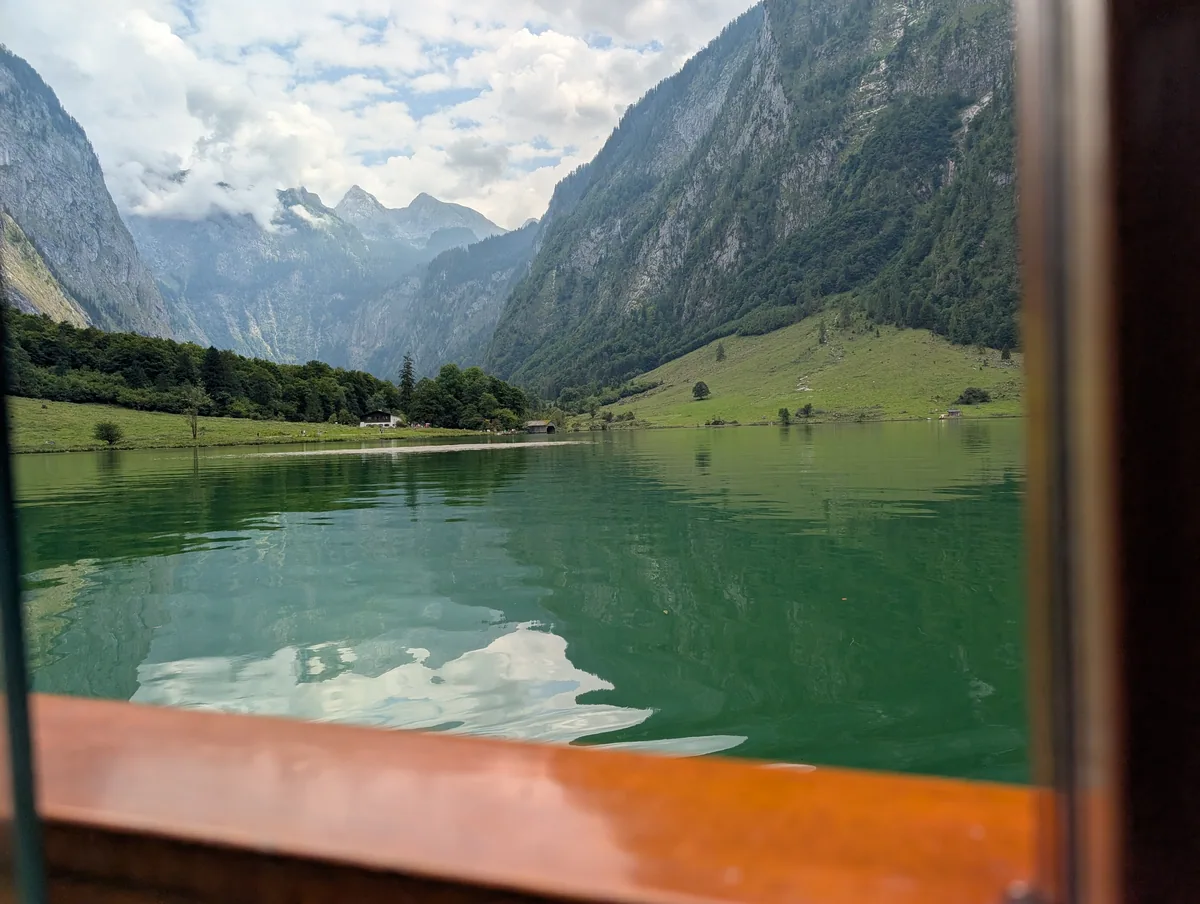
Right, brace yourselves, because we’re about to visit what is probably the most beautiful lake in the Bavarian Alps and in Germany. And that’s coming from someone who adores Norway!
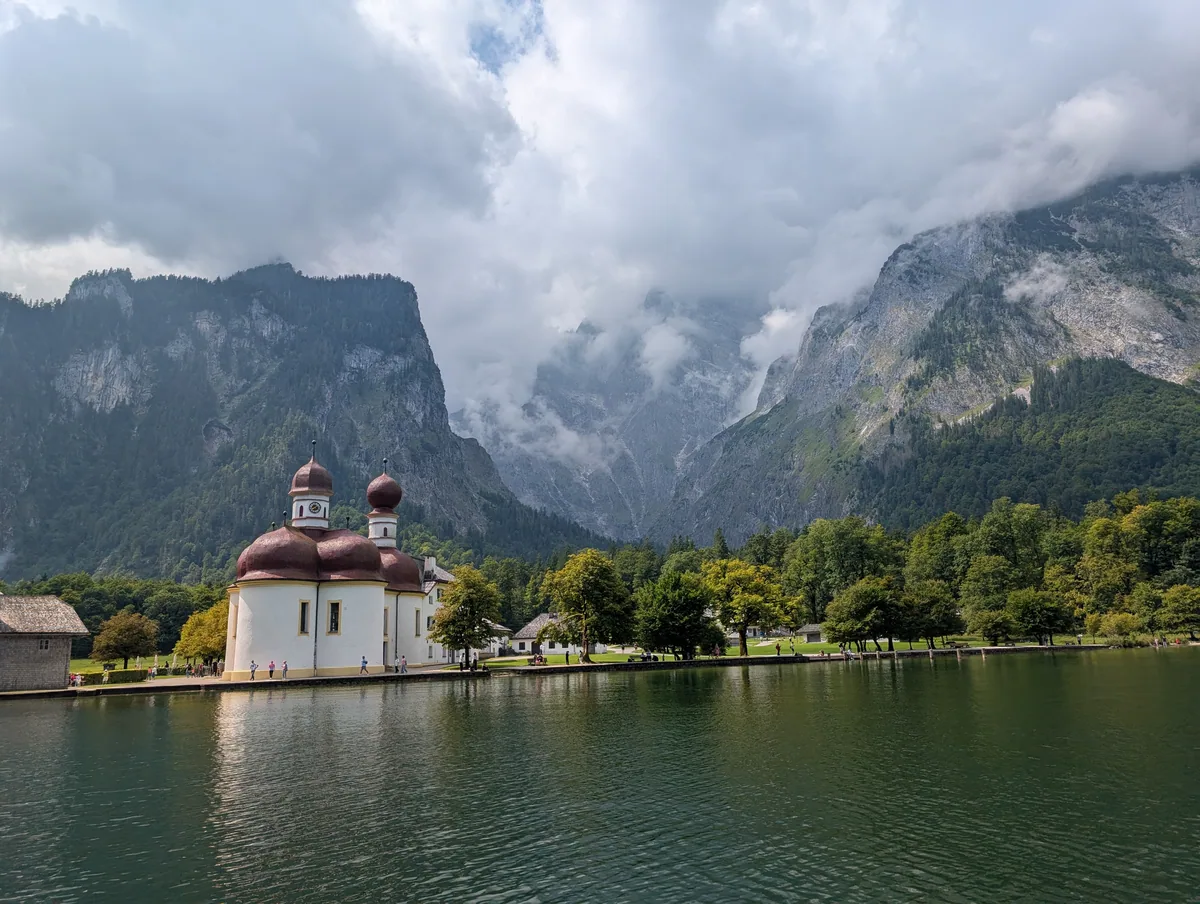
A tongue of emerald-green water wedged between sheer walls that plunge straight down for eight kilometres, a little church with red meringue domes perched on a peninsula, electric boats going back and forth without a sound. It’s the deepest lake in Bavaria, the cleanest in Germany, and surely the most photographed in the Alps.
We’ve been several times. Twice in summer, and once in the depths of winter, with the walls under snow and almost nobody on the lake. And each visit is completely different from the one before.
Let’s get to it! You’ll find all the up-to-date facts, of course: the prices, the various routes…
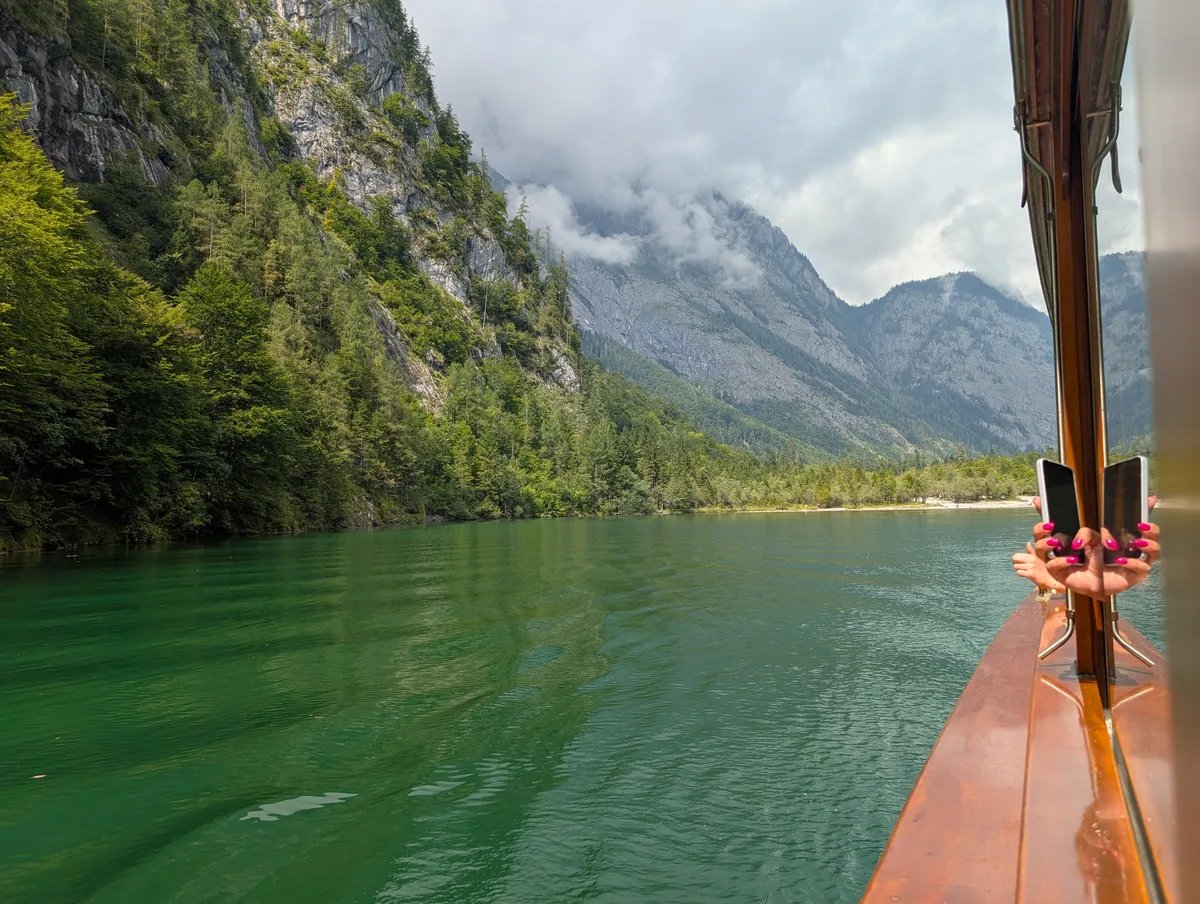
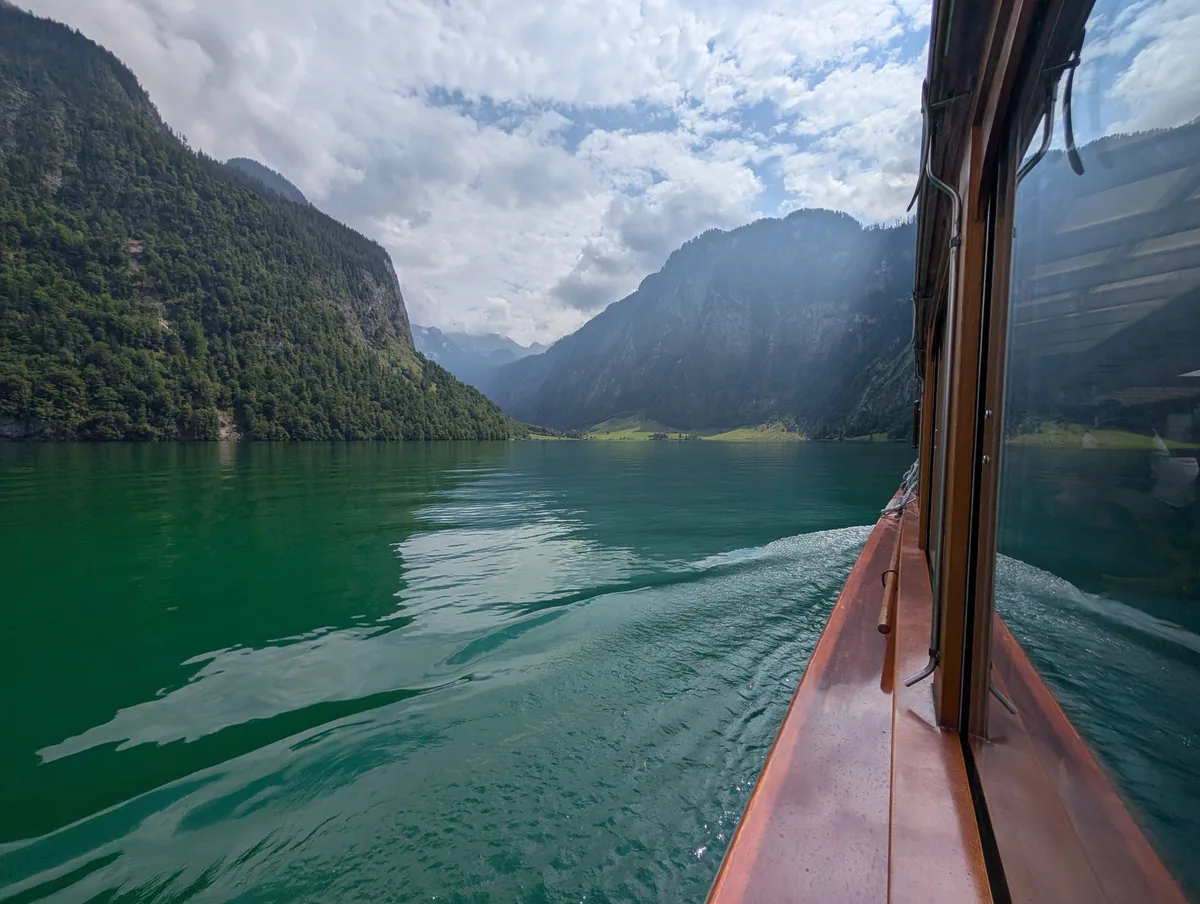
Königssee in brief
If you’ve only got thirty seconds, here’s the essence of it.
| The Königssee | The essentials at a glance |
|---|---|
| Recommended duration | A full day for Salet and the Obersee, half a day for St. Bartholomä alone |
| Budget per person | €23.40 (St. Bartholomä) or €29.80 (Salet), plus €9 parking per car |
| Booking | Online (official shop, departures from the Seelände) or at the ticket office, on the day |
| Best season | September, the best compromise. January if you want the lake to yourself |
| Best time of day | The first boat of the morning, without hesitation |
| Walking | 15 min on the flat to the Obersee, 45 min to the Fischunkelalm. Accessible to everyone |
| The catch | The last boat. Miss it and someone will come to fetch you, at your own expense |
And keep a close eye on the last line, the one about the last boat!
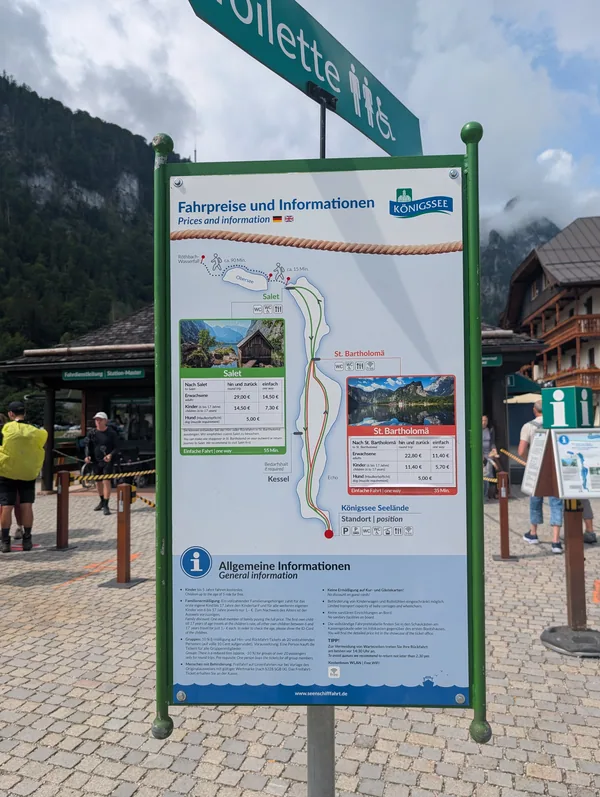
How much does Königssee cost? The 2026 boat fares
So let’s start with the fares, because choosing the ticket is where it’s easiest to get things wrong.
The prices below come from the official fare table of the Bayerische Seenschifffahrt, the public authority that operates the lake. They’re valid from 2026 onwards.
| Route | One way | Return |
|---|---|---|
| Schönau → St. Bartholomä | €11.70 | €23.40 |
| Schönau → Salet (for the Obersee) | €14.90 | €29.80 |
| Schönau → Kessel | €9.00 | — |
| St. Bartholomä → Salet | €5.00 | €9.00 |
Two remarks on these prices.
First, the ticket to Salet includes the stop at St. Bartholomä. You get off at the church, you catch a later boat, you carry on to the far end of the lake: it’s the same ticket. So whatever you do, don’t buy two separate return tickets, that’s the mistake that costs the most on this lake!
Second, I really do recommend going for Salet. The €6.40 difference gives you access to the Obersee, which is frankly the most beautiful part of the day. If you need to save money, save it elsewhere.
Children, families, dogs, wheelchairs
And I can tell you these rules make quite a difference to a family’s budget.
- Under 6s: free.
- 6 to 17 years: half price. That’s €11.70 return to St. Bartholomä, €14.90 to Salet.
- Family fare: one adult pays full price, the first child pays the reduced fare, and every subsequent child pays €1. Yes, one euro! For a family with four children, the saving is enormous.
- Dog: €5, muzzle compulsory. And there’s no arguing about that one, the staff check.
- Disabled passengers: free travel on presentation of a card with a valid sticker, and the carer travels free if the card is marked “B”.
- Groups: from 20 paying adults, 10% off and the 21st place free.
One trap to watch out for, though: the Gästekarte handed to you by your accommodation gives no discount on the boat. It’s excellent for the buses, we’ll come back to that further down, but not here.
The real cost of a day out
Because between the price of the boat and what you actually spend, there’s a world of difference.
For a couple arriving by car, going all the way up to Salet and having lunch there:
| Item | Amount |
|---|---|
| Parking 24h | €9.00 |
| Salet boat return × 2 | €59.60 |
| Lunch at St. Bartholomä (2 people) | €40 to €55 |
| Total | ≈ €110 to €125 |
For a family of two adults and two children aged 8 and 11, with a picnic: €9 for parking, €59.60 for the parents’ boat tickets, €14.90 for the first child and €1 for the second. That’s €84.50. You can see the family fare really does make the difference!
And a handy tip if you’re staying nearby: parking is free after 7pm. So an evening by the lake costs you nothing, and the late-afternoon light on the walls is genuinely worth the trip.

Where to buy your ticket
You have two options. The first is the Bayerische Seenschifffahrt’s official online shop: you buy your ticket in advance, for a departure from the Seelände (the Schönau jetty), and go straight to the pier without stopping at the ticket office. The second is the ticket office by the jetty, on the day.
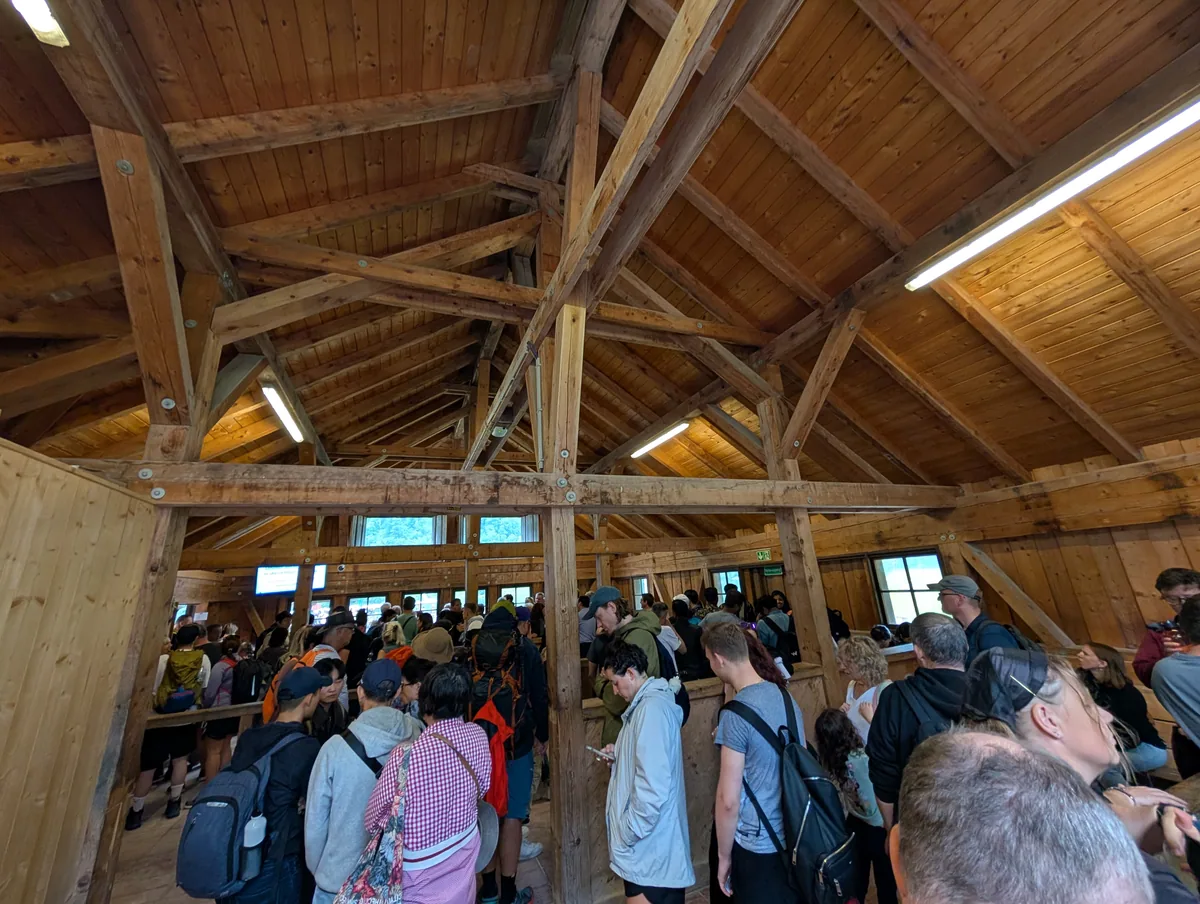
Be careful though: an online ticket saves you the ticket office queue, not the wait to board. In high season there can be a crowd at the pier, on the way out and on the way back. And on some summer days everything sells out by early afternoon, online and at the office. So check availability and the ticket conditions before you go.
You’ll come across “Königssee ticket” offers on the booking platforms. These are in fact organised excursions departing from Salzburg or Munich, with transport and a guide. They’re great if you don’t have a car, but they’re not the official boat ticket: everyone gets on the same boat.
In practice: Arrive early! In July and August, the queue at the ticket office can top an hour by around 10.30am. At 8am, there’s nobody. The company itself recommends setting off before 10am and taking the boat back before 2.30pm.
The boat timetables: the trap of the last return
The second key piece of information, and it’s the one that ruins the most days out.
Königssee runs all year round, with a summer timetable and a winter timetable. And the summer timetable itself changes four times over the season, which doesn’t help.
| Period | First departure | Last departure from Schönau | Last return from St. Bartholomä | Last return from Salet |
|---|---|---|---|---|
| 25 April – 22 May | 9:00 | 16:15 | 17:30 | 17:10 |
| 23 May – 26 June | 8:30 | 16:15 | 17:30 | 17:10 |
| 27 June – 14 Sept. | 8:00 | 16:45 | 18:00 | 17:40 |
| 15 Sept. – 11 Oct. | 8:30 | 16:15 | 17:30 | 17:10 |
A boat roughly every 30 minutes, with extra sailings when it’s busy.
Don’t miss the last boat
Take a good look at the last column. The final return from Salet leaves 20 to 30 minutes before the one from St. Bartholomä. It makes sense, it takes time to sail back up the lake, but on the day it’s easy to forget.
And the scenario is always the same. You push on to Salet, you walk to the Obersee, you carry on to the Fischunkelalm because it’s just too beautiful, you sit down, you have a coffee. And you head back at your leisure thinking you’ve got until 6pm.
So my rule: be at the Salet jetty an hour before the last departure. There’s no plan B, no road or usable path links Salet to Schönau. And the park regulations are very clear on this: if you’re still there after the service ends, a special boat comes to fetch you, at your own expense, and the bill is steep!
When to visit Königssee?
The lake runs all year round, but you won’t see remotely the same thing depending on the month. Here’s how I’d break it down.
Spring (late April to June): the waterfall at full flow
The boat starts again on 25 April. It’s the snowmelt season, so the Röthbachfall really flows, whereas in dry August it dwindles to a rather sad trickle. The peaks are still white, the meadows already green, and there are far fewer people than in July.
The downside is that the water is freezing and the first boat doesn’t leave until 9.00am early in the season.
Summer (July and August): everything’s open, and everyone’s there
It’s the only time when absolutely everything is running. First boat at 8.00am, last return from Salet at 5.40pm, swimming possible, all the mountain huts open.
But it’s also the moment when the car park is full by 10am, when the queue at the ticket office tops an hour, and when you share the Obersee boathouse with fifty other people. Coming in August is perfectly doable, provided you take the first boat. Otherwise you’ll be queuing, it’s as simple as that.
September and early October: my recommendation
If I had to pick a single moment, it would be this one. Everything’s still open until 11 October, the light is lower and warmer, the larches begin to turn, and the August crowds have gone. And the water is still swimmable in early September!
It’s genuinely the best compromise between “everything accessible” and “no crush”.
Winter (mid-October to April): nobody about, and it’s magical
And yes, you can visit Königssee in winter too: the boats run all year round.
We went in February, a few years before our summer visits. And it’s a completely different memory, almost another lake.
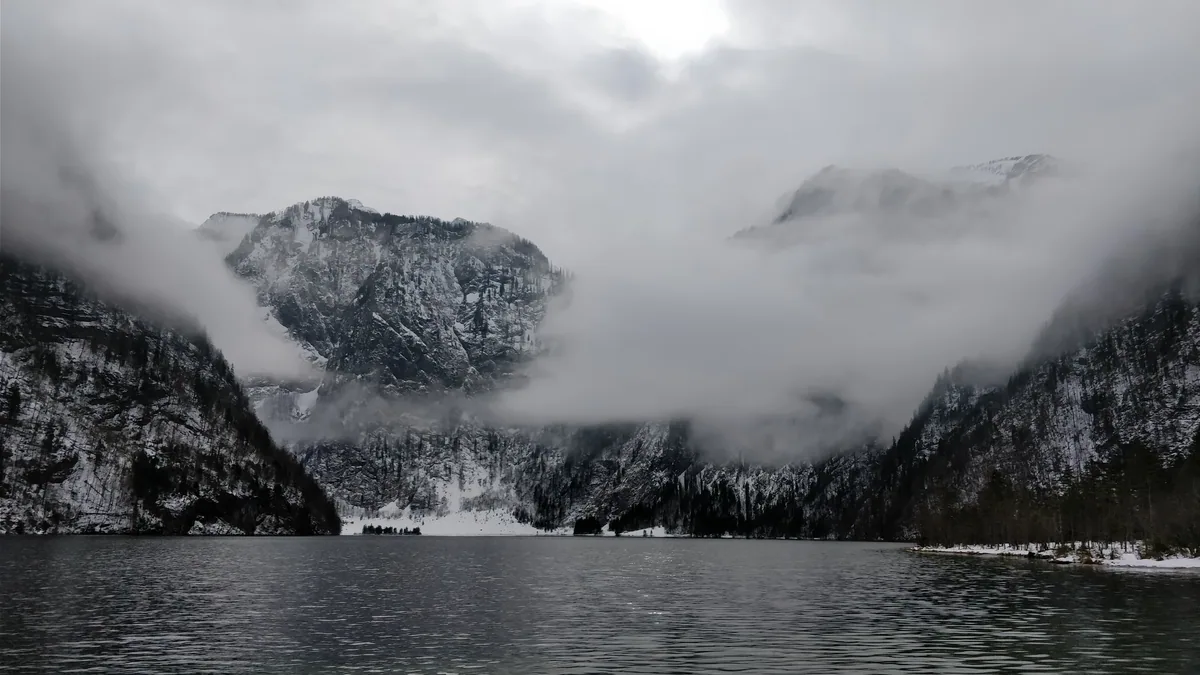
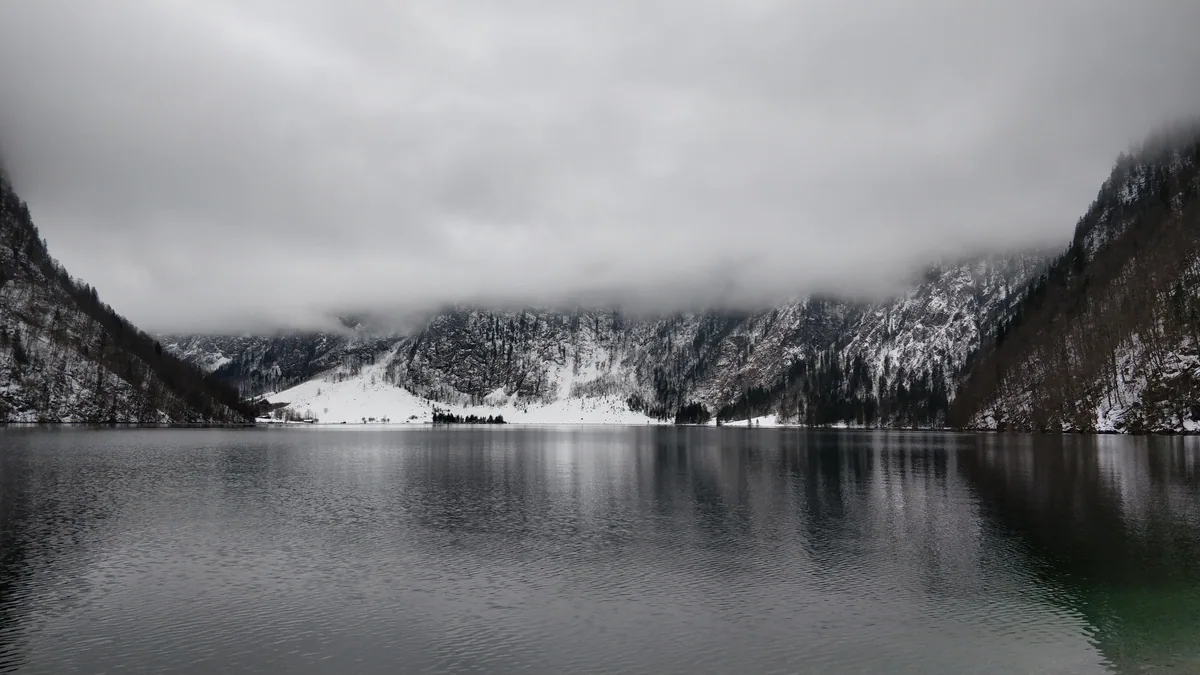
There was hardly anyone about. No queue at the ticket office, no crowd on the pontoon. The white walls plunging into black water, the clouds snagged halfway up, and a silence we never found again in summer. Where in August you share the scenery with three hundred people, in winter you have it to yourself!
But there’s a trade-off, and it’s a big one: the Obersee isn’t accessible. Salet is only served part of the year. In winter the boat stops at St. Bartholomä, that’s it. So no Obersee, no boathouse, no Fischunkelalm.
If the Obersee is your main motivation, don’t come in winter. If it’s the atmosphere of the lake, then on the contrary it’s the best time of year.
On the practical side, the winter timetable runs from 12 October 2026 to 23 April 2027. First departure at 9.45am, last departure from Schönau at 4.00pm, last return from St. Bartholomä at 4.50pm. No service on 24 December, and sailings suspended in the event of fog, storm or ice.
The restaurant at St. Bartholomä stays open from 10am to 5pm all year round, which settles the question of lunch. And the Jenner, right next door, becomes a ski area, enough to fill a proper day.
The only real drawback is the short days. First boat at 9.45am, dark by around 4.30pm, you only have one window. So take the first departure, don’t dawdle, and save the Malerwinkel for late afternoon: it’s superb under the snow.
No, you won’t be walking on the lake
That’s the question that comes up every single time. Königssee very rarely freezes over completely, and the last time was back in 2006, for 29 days, with 40 centimetres of ice.
So come for the snow on the walls and the empty lake, not in the hope of crossing on foot!

The boat crossing
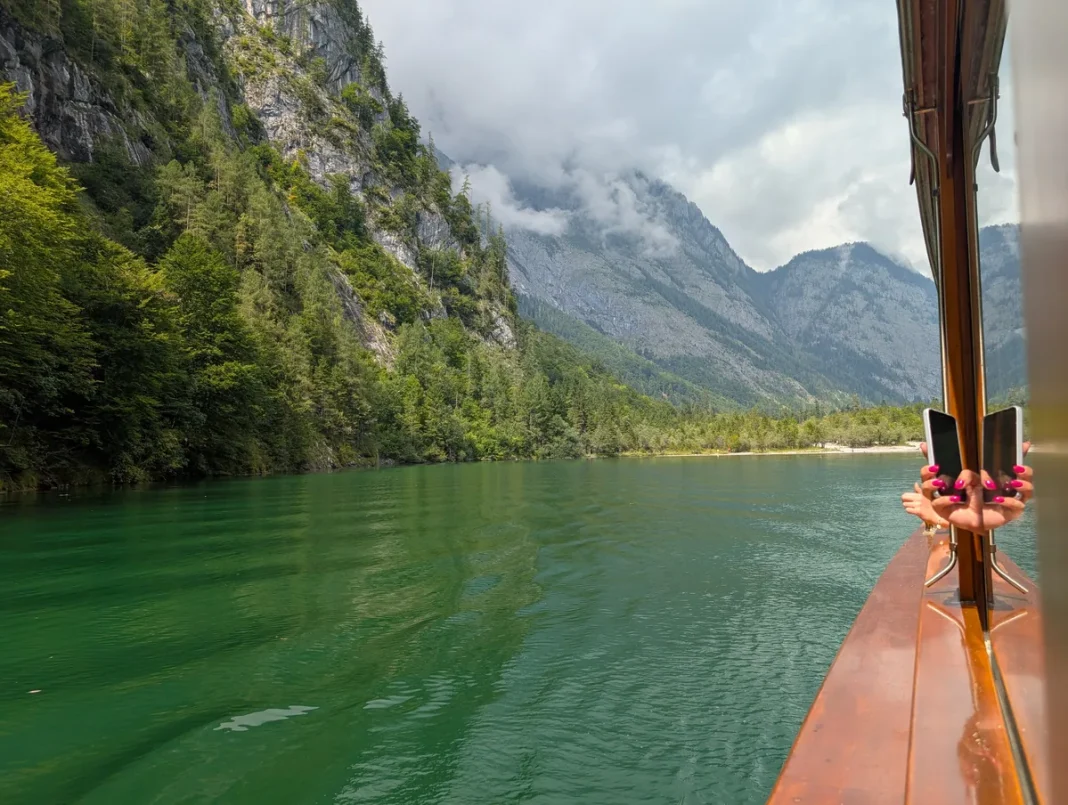
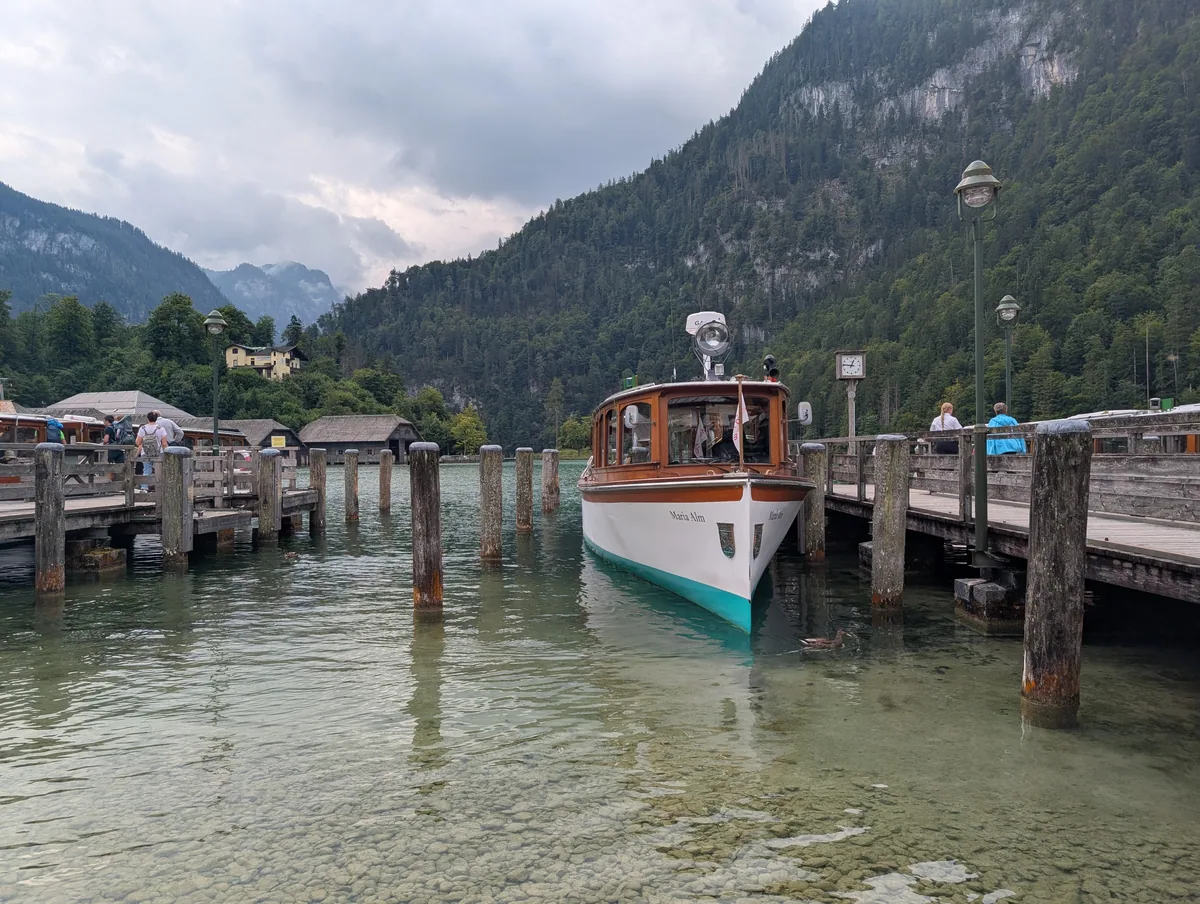
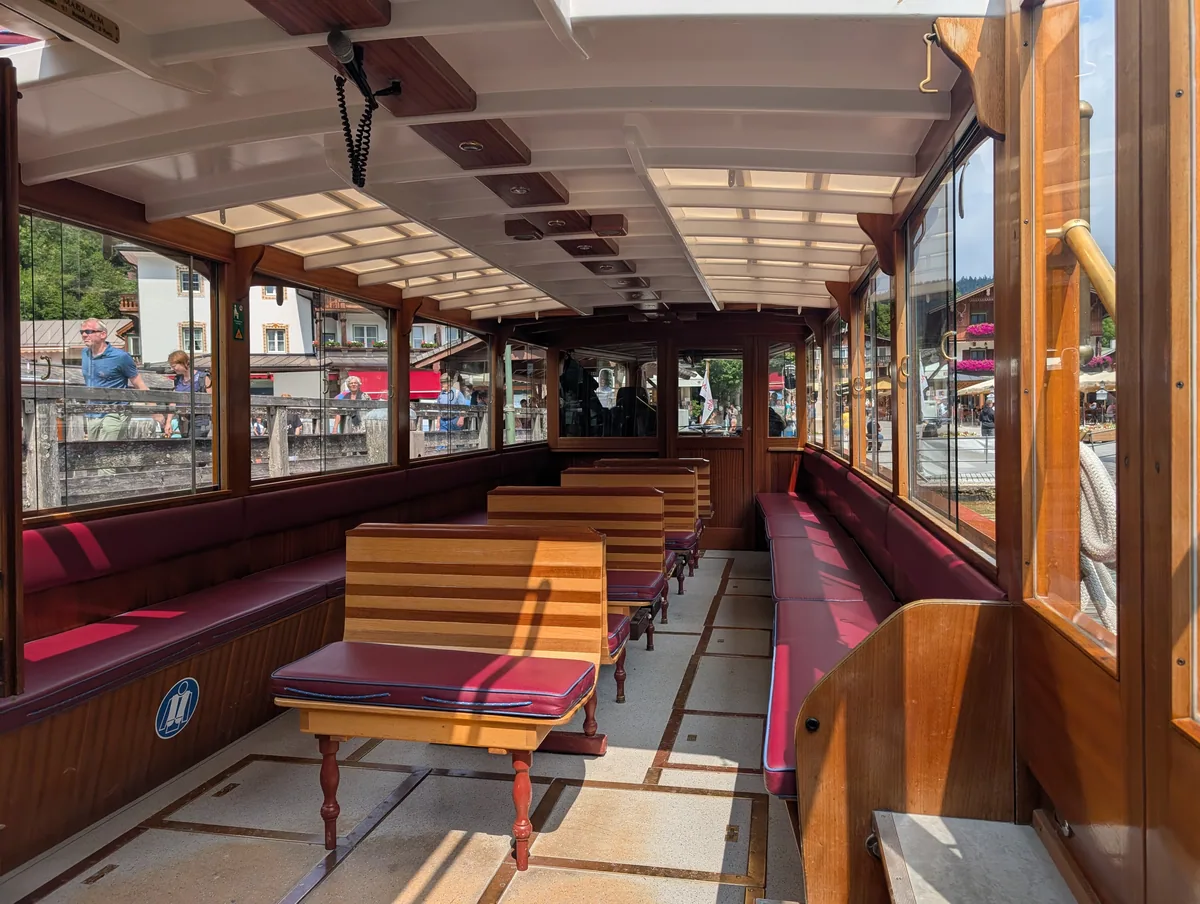
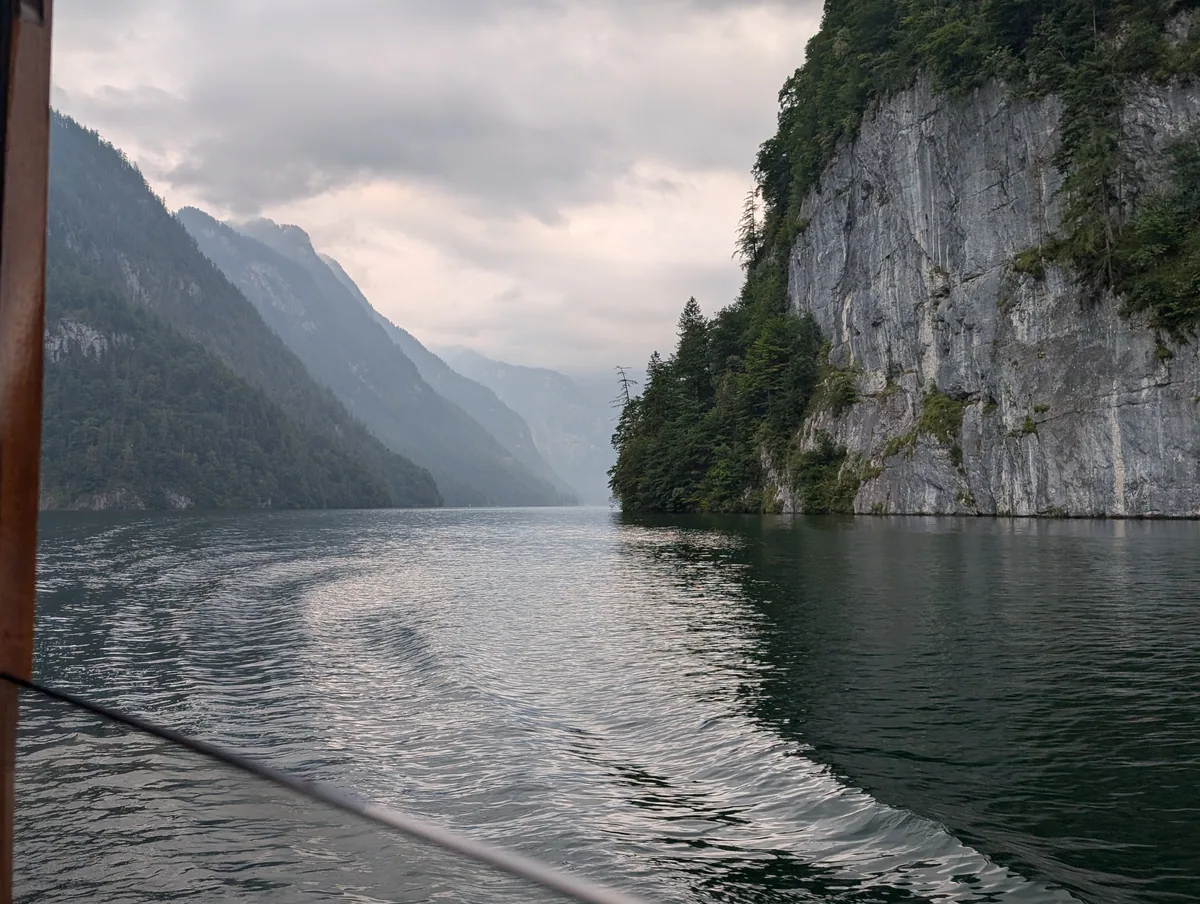
You board at Schönau, a five-minute walk from the car park, in a long, low boat with around a hundred seats. And the first thing that strikes you is the silence.
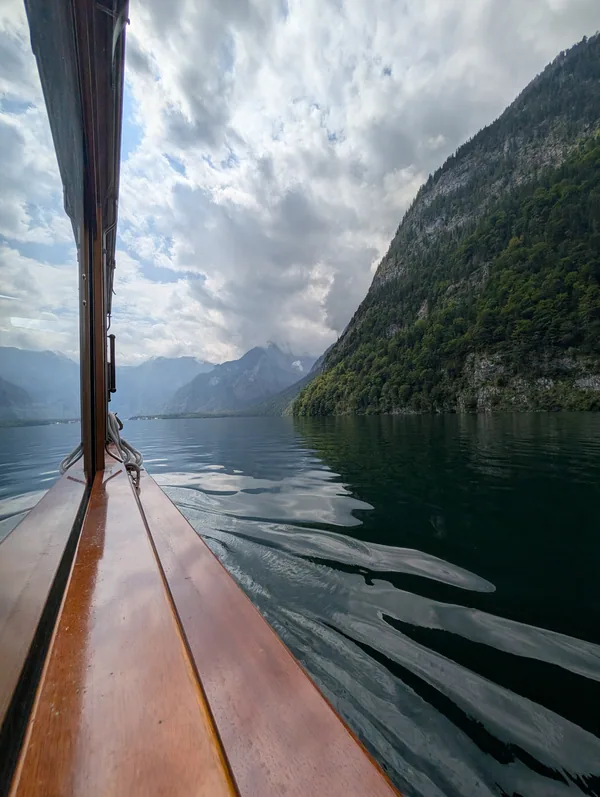
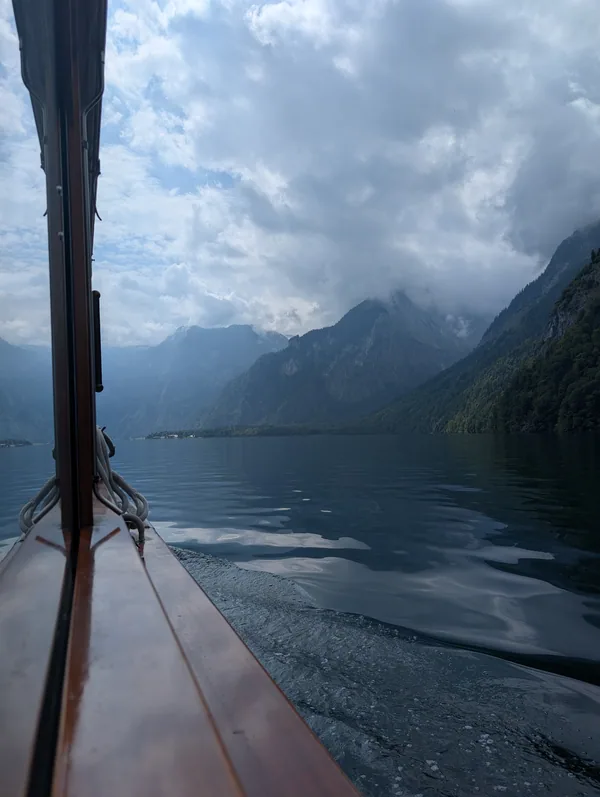
No engine, no vibration, no smell of diesel. Just the sound of the water. You catch yourself talking in hushed tones without having agreed to. The crossing to St. Bartholomä takes about thirty minutes, to Salet about fifty, and at no point are you bored: the walls close in as you go and the scenery changes every five hundred metres.
Electric boats since 1909
The first electric boat was launched on 15 July 1909, with Siemens-Schuckert motors. Today the Bayerische Seenschifffahrt runs only electric boats on the lake, and it’s become a major environmental selling point for the region.
Except that wasn’t the original intention at all! The reason was far more down to earth: back then, bringing coal to a hemmed-in lake with no road cost a fortune, whereas electricity was produced on site. So it was an economic choice. The ecology came afterwards, and just as well.
The trumpet echo
Halfway across, the boat slows down and stops. The pilot takes out a trumpet, opens a window, and plays a few notes towards the wall.
And the echo comes back. Once, twice, sometimes three times. It’s a bit kitsch, everyone gets their phone out, and yet it works every time: there’s a real hush in the boat as the notes come back. And the tradition goes back to the 19th century, when they used to fire a cannon to make the walls ring out!
A small tip is expected at the end. It’s not compulsory, but it’s the custom.
St. Bartholomä: the red church
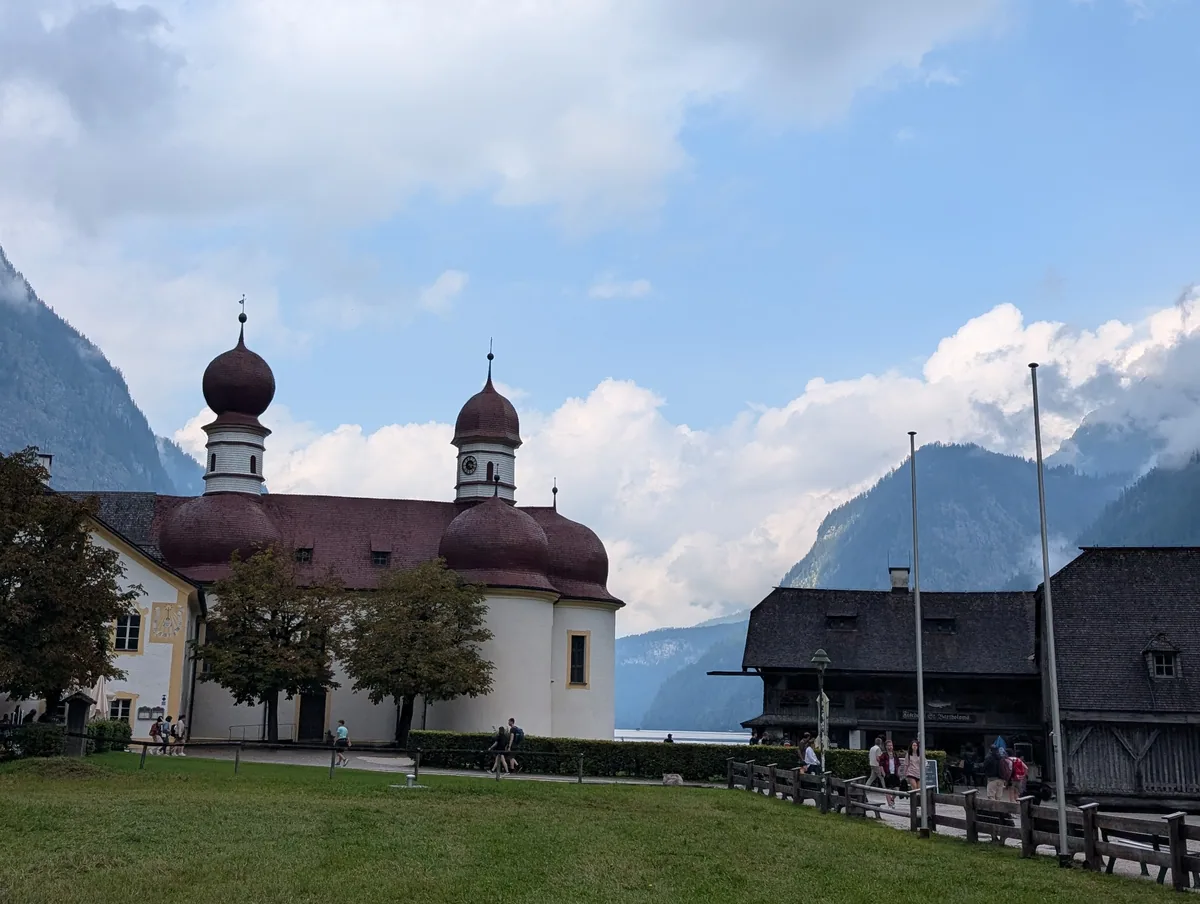
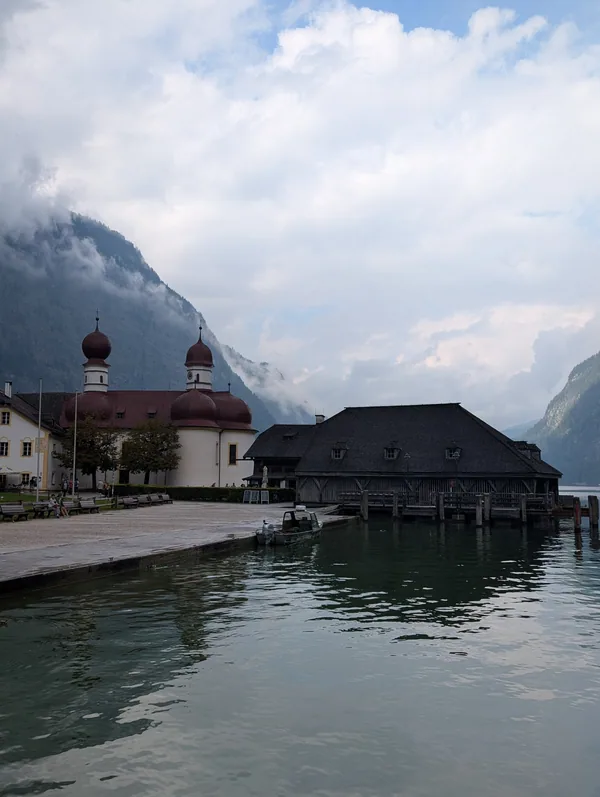
This is the image of Königssee. Three red onion domes on a peninsula, and the east face of the Watzmann rising 1,800 metres straight behind. The chapel dates from the 12th century, it was remodelled in the 17th, and it belongs to the Bavarian palace administration.
It’s tiny inside and you’ll spend five minutes there, timed. But it’s not for the church that you get off here! It’s for the peninsula, for the walk on foot that hugs the water, and for the view from the little pebble beach on the right, the one 90% of visitors miss because they stay in front of the church.
How long to stay
An hour and a half to two hours, that’s about right. Enough to walk around the peninsula, take your photos and catch your breath.
If you eat there, allow three hours. And if you’re carrying on to Salet, an hour is enough: you’ll come back to see the lake in a different light on the way back anyway.
Eating and sleeping at St. Bartholomä
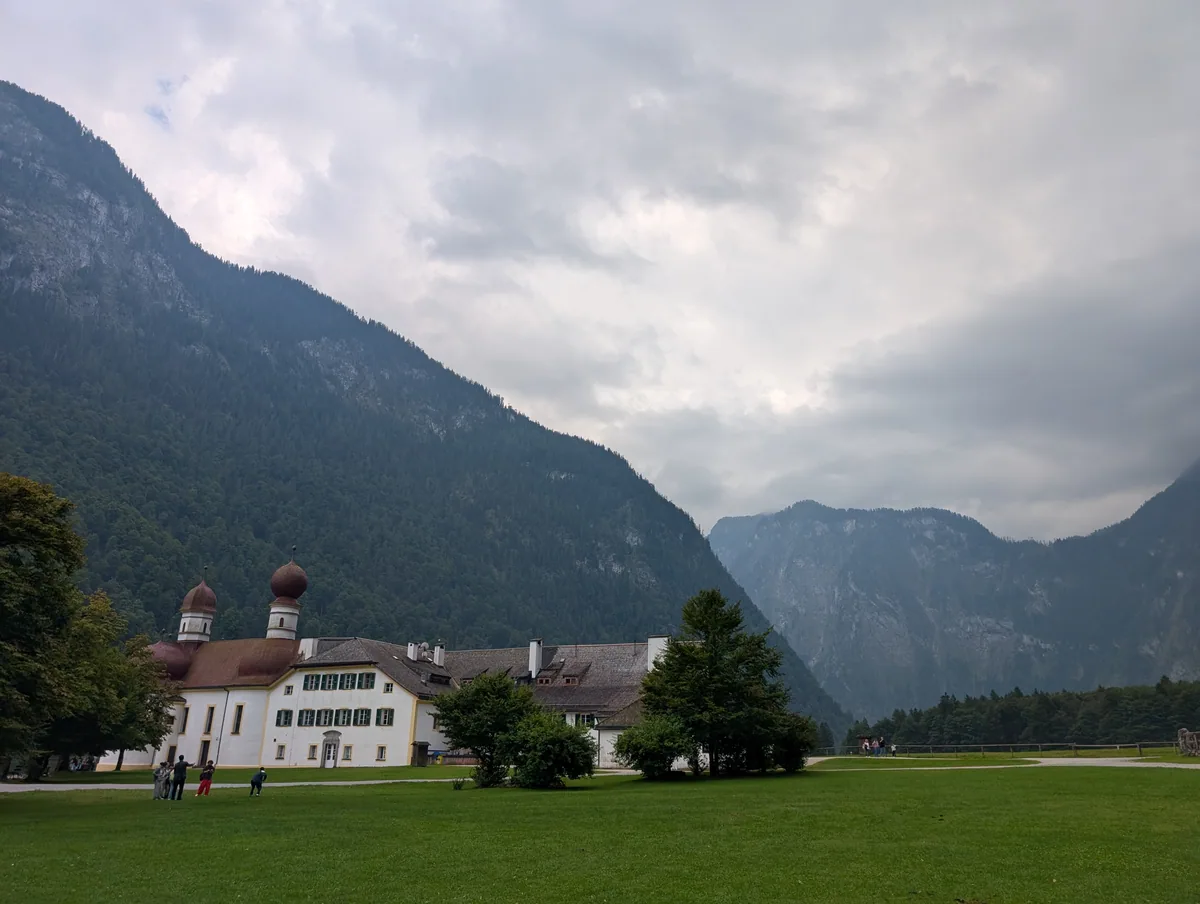
The Gasthaus St. Bartholomä is open from 10am to 5pm, all year round. Classic Bavarian cooking, lake trout smoked on site, terrace facing the water. It’s not cheap and it’s not haute cuisine, but the location is unbeatable.
And here’s a detail worth knowing: you can sleep there! The establishment has guest rooms. Spending the night on the peninsula after the last boat has left, with the lake completely empty, must be quite something. It’s an idea to keep in mind if you’re after a rather special memory.
Higher up, at 1,638 metres, the Kärlingerhaus refuge and its 160 beds welcome those heading up to the Funtensee, the coldest spot in Germany. But now we’re talking a proper mountain hike, not a stroll.
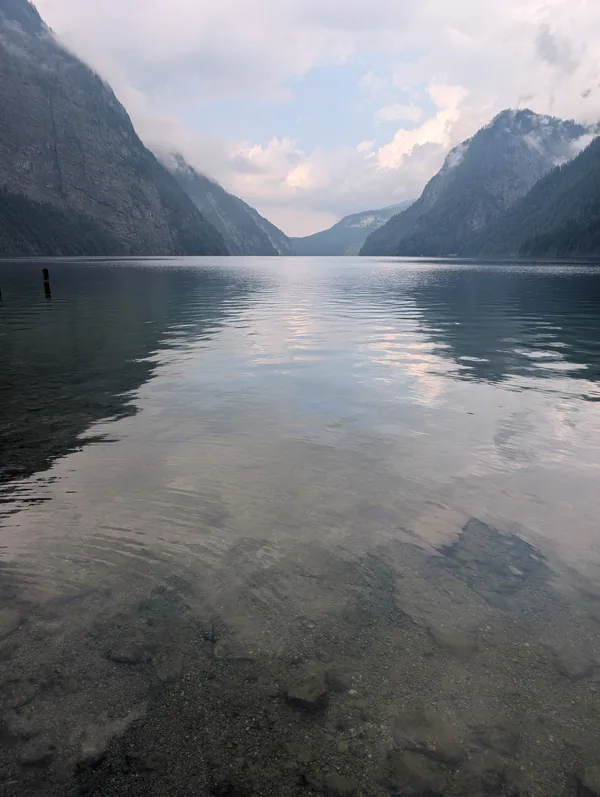
The Eiskapelle: the hike you should no longer do
Careful, this one is important.
The Eiskapelle was a permanent snowfield at the foot of the east face of the Watzmann, at 900 metres altitude, the lowest in the German Alps. You reached it in three hours’ walk from St. Bartholomä, and you could pass beneath a spectacular ice arch.
It collapsed in the summer of 2025. Around 575,000 m³ of ice have vanished since late 2019, under the effect of low-snow winters and very hot summers, and even the researchers were taken aback by the speed of the phenomenon.
The national park director is very clear: he strongly advises against approaching the remains of the Eiskapelle, where the danger of falling rocks is immediate across the whole area. All that’s left is a chaos of scree and unstable blocks of ice.
So the path still exists and the valley remains magnificent. But if you go, check the day’s conditions with the park, and don’t go near the remnants. This isn’t excessive caution on my part, it’s an official warning.
The Malerwinkel, seeing Königssee without paying for the boat
If your budget is tight, or if you arrive too late for the last boat, there’s still the Malerwinkel, the “painters’ corner”.
It’s a loop that starts from the car park, follows the shore and climbs to a promontory overlooking the whole northern end of the lake. It’s free, it’s shaded, and the viewpoint is the one the Romantic painters of the 19th century made famous!
Distance-wise, the loop is 3.4 to 5 kilometres, depending on whether you take the Rabenwand variant. So allow an hour for the short loop, an hour and fifty minutes with the Rabenwand. And the elevation gain is negligible either way.
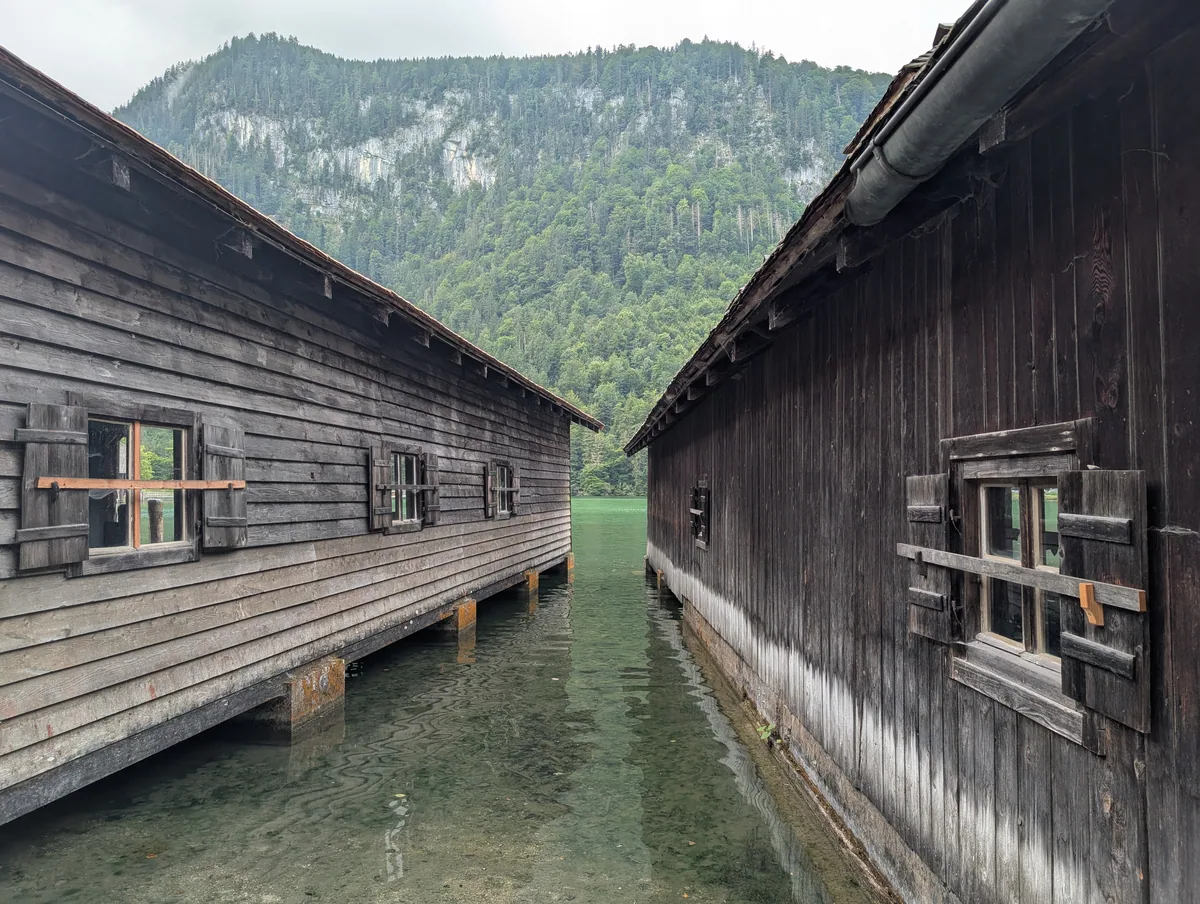
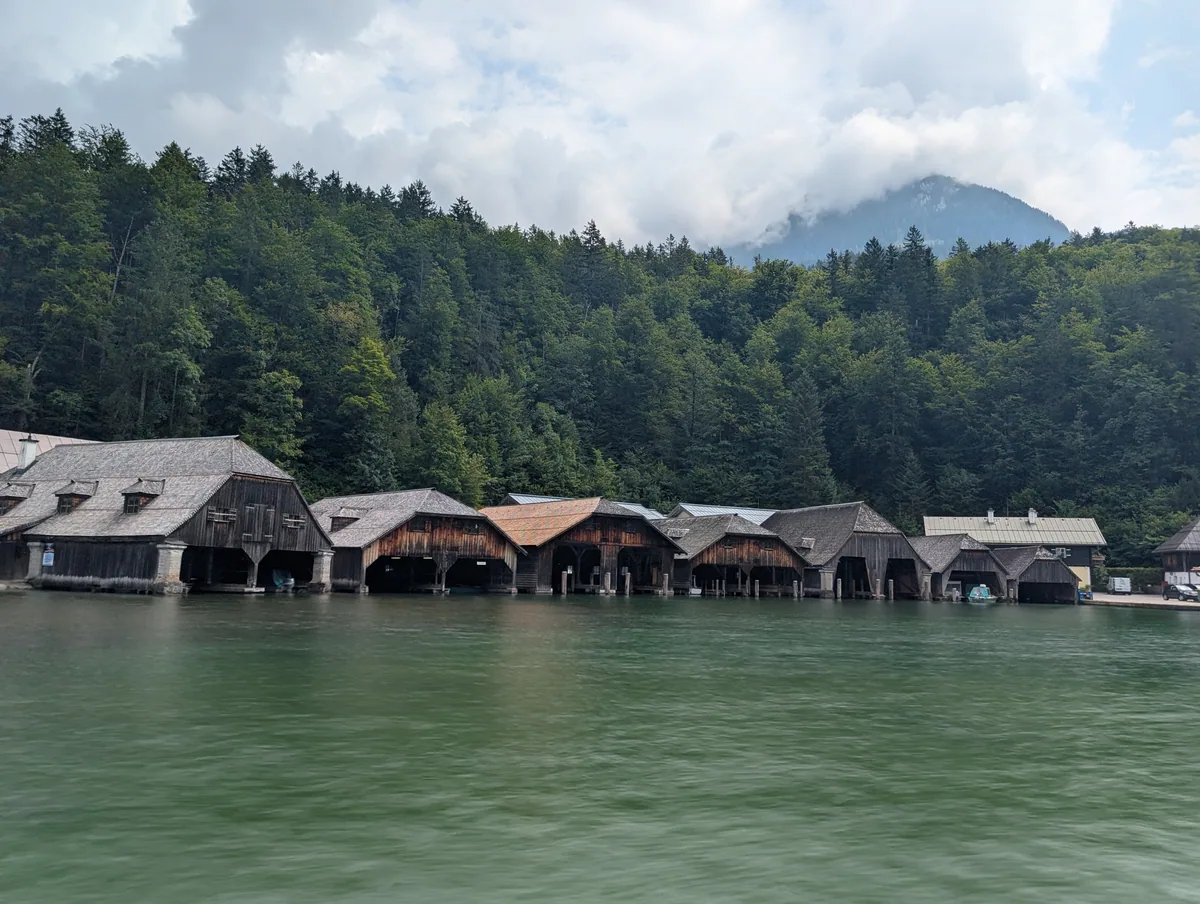
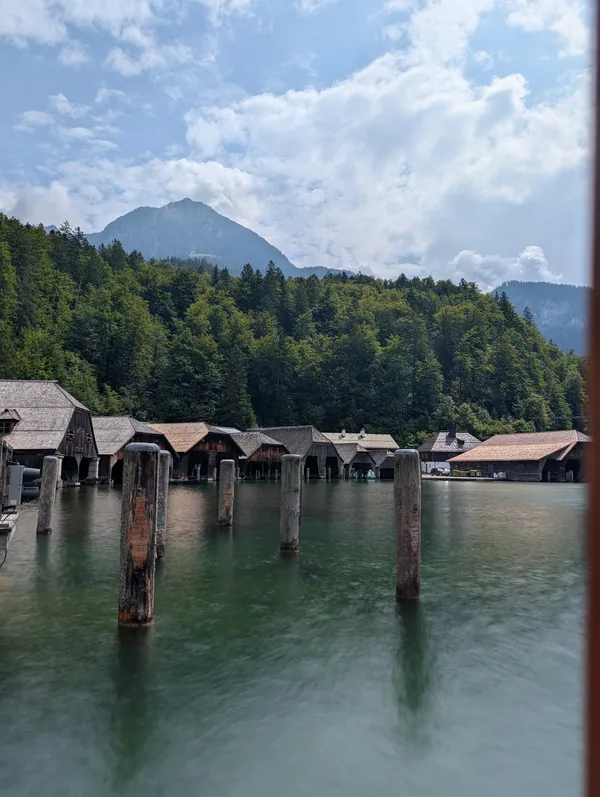
Along the way, you pass the old wooden boat sheds that line the shore. They’ve been there for generations, set on stilts above the green water, and I find them almost as photogenic as the lake itself!
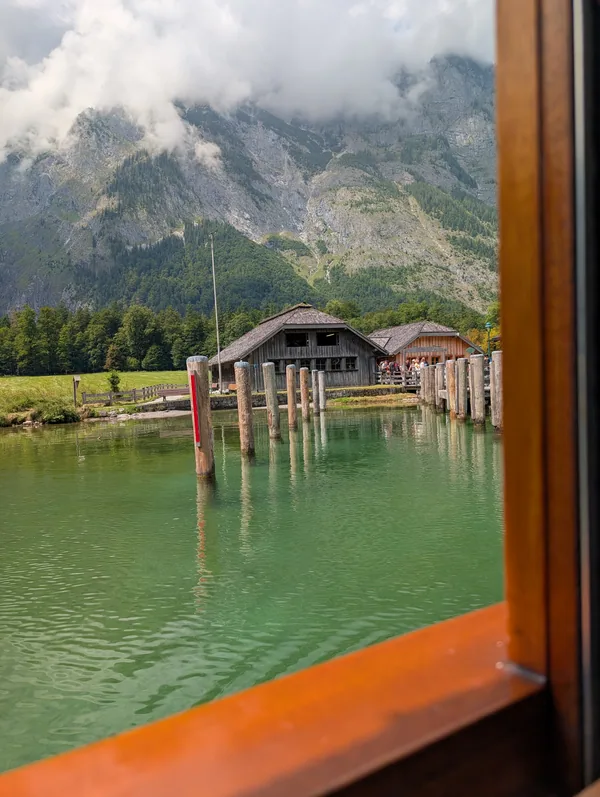
Walking to the lovely Obersee
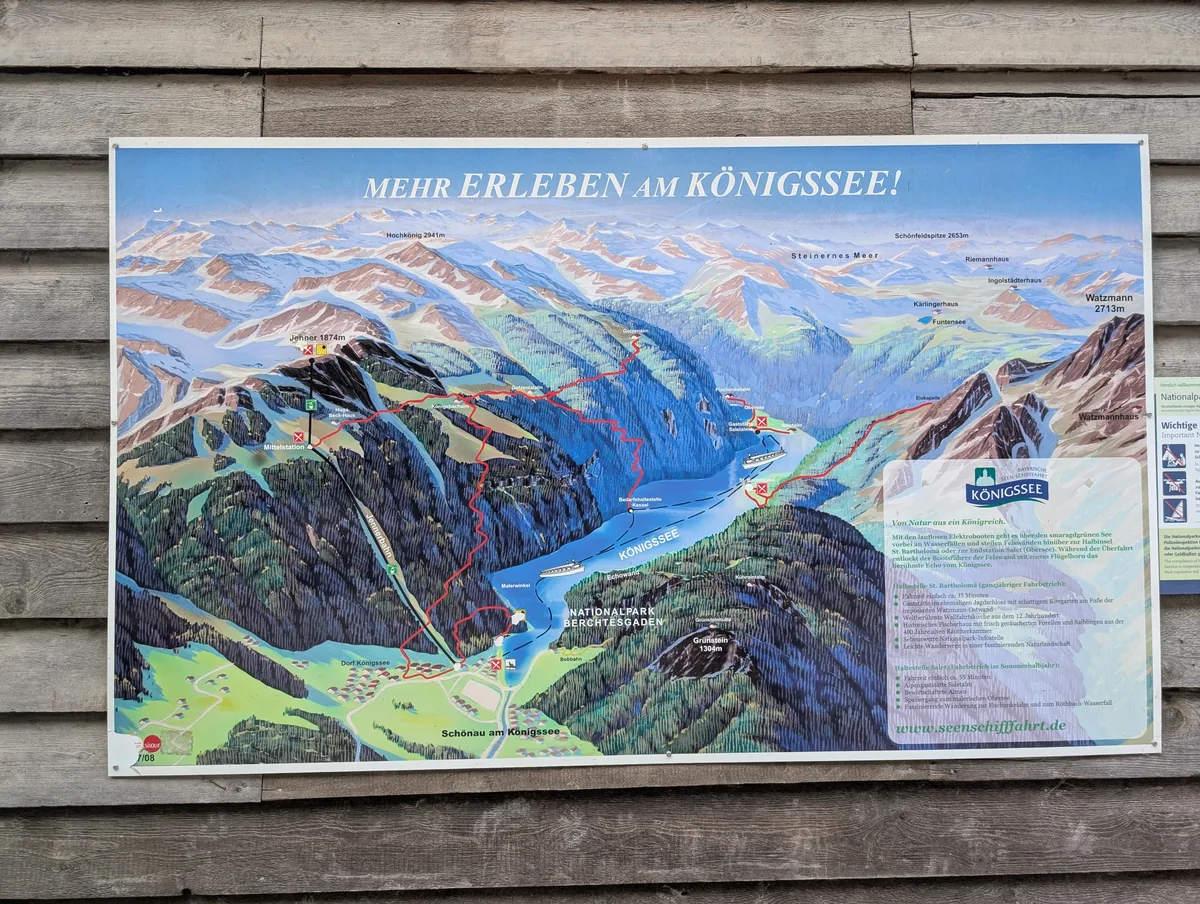
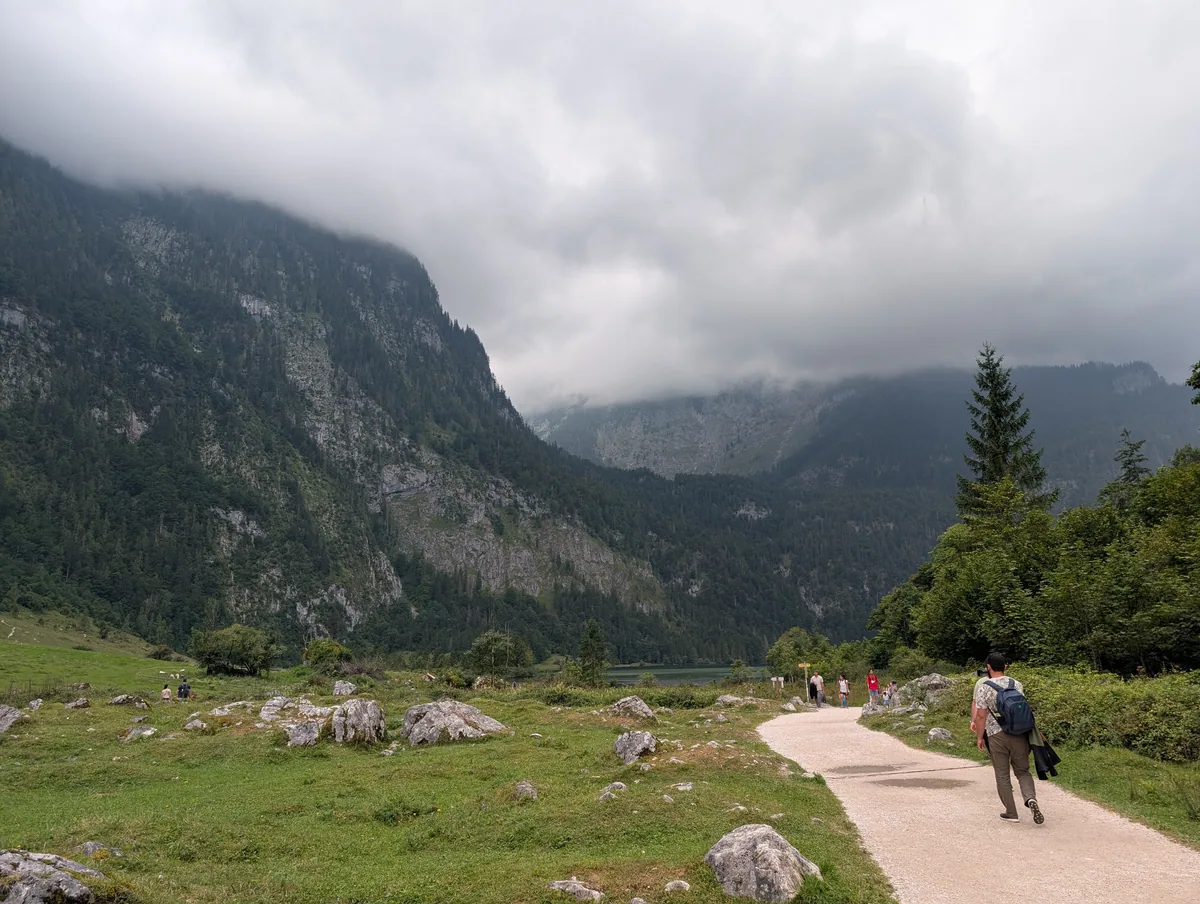
Many visitors stop at St. Bartholomä, take their photo and head off. So they miss the Obersee, the little lake tucked behind, a fifteen-minute walk from the Salet landing stage. A smaller, wilder lake, with water of an unreal transparency and walls that plunge straight into it.
The path from Salet is flat, wide and accessible to everyone, pushchairs included on the first section. So there’s really no reason to deny yourself. Especially as the price difference is minimal and the boat trip genuinely beautiful.
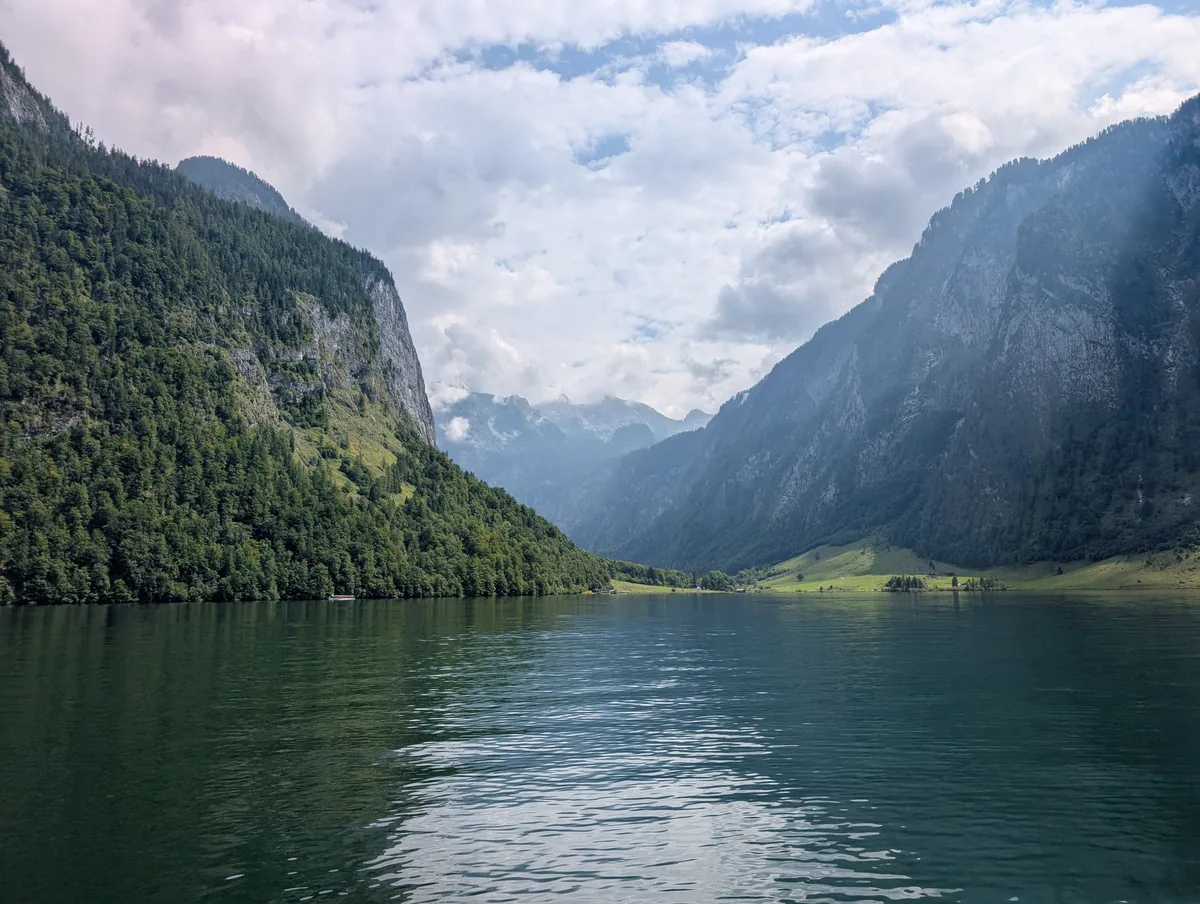
The boathouse, the Obersee photo spot
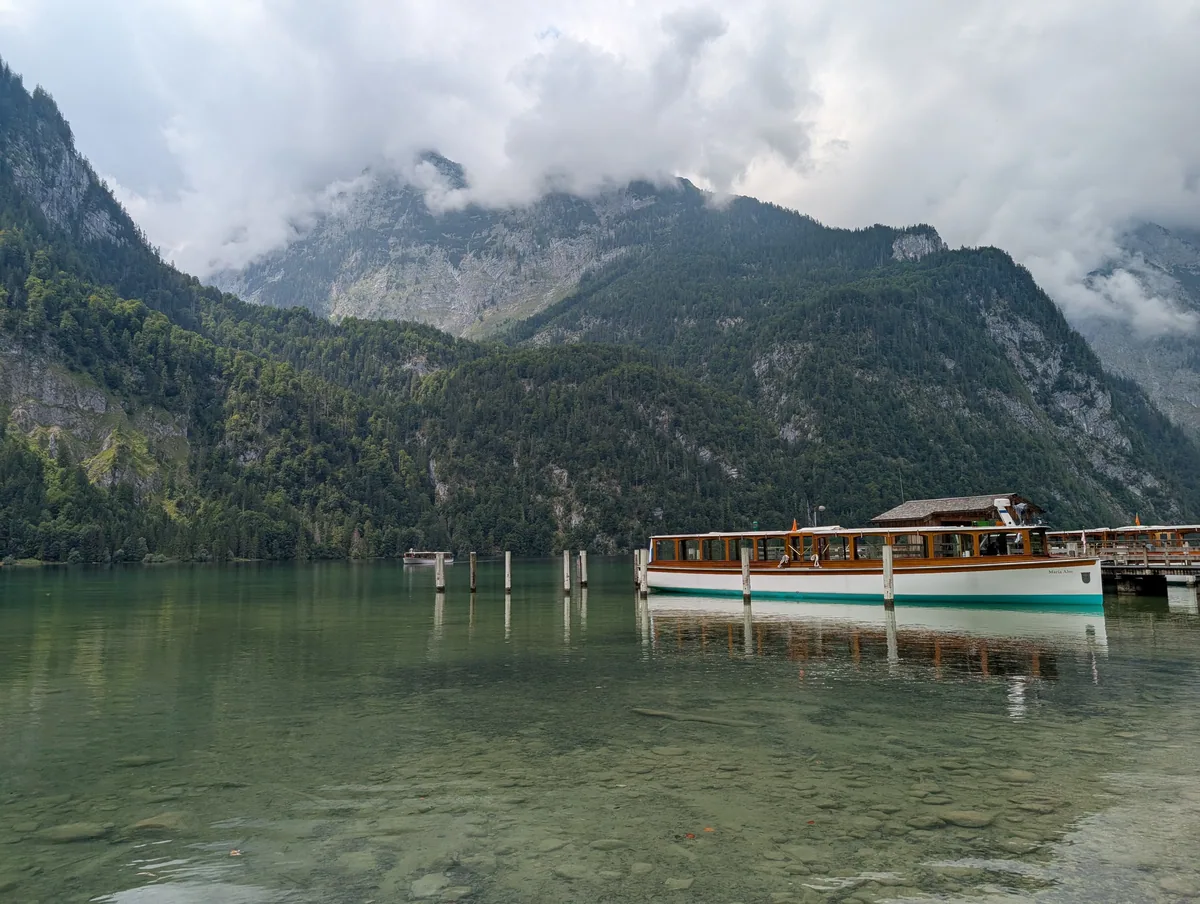
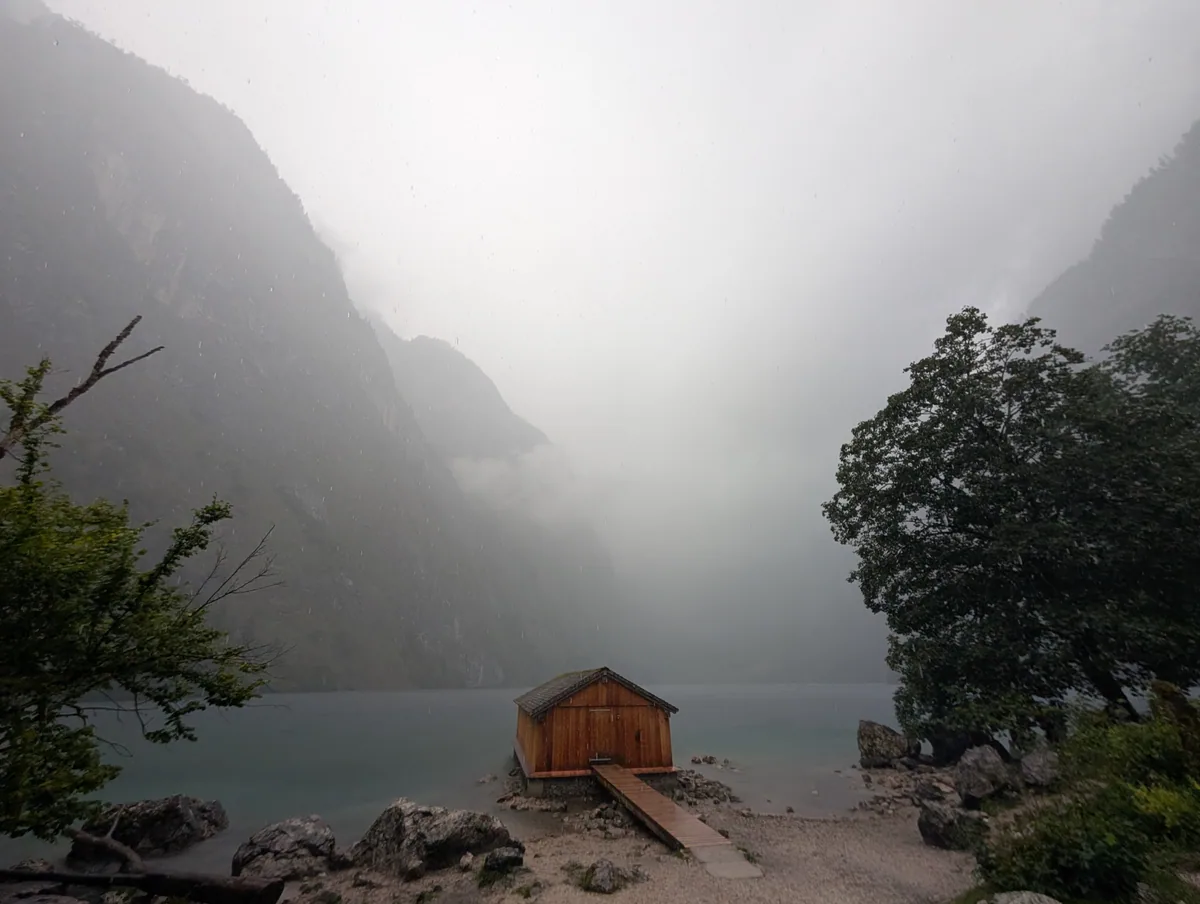
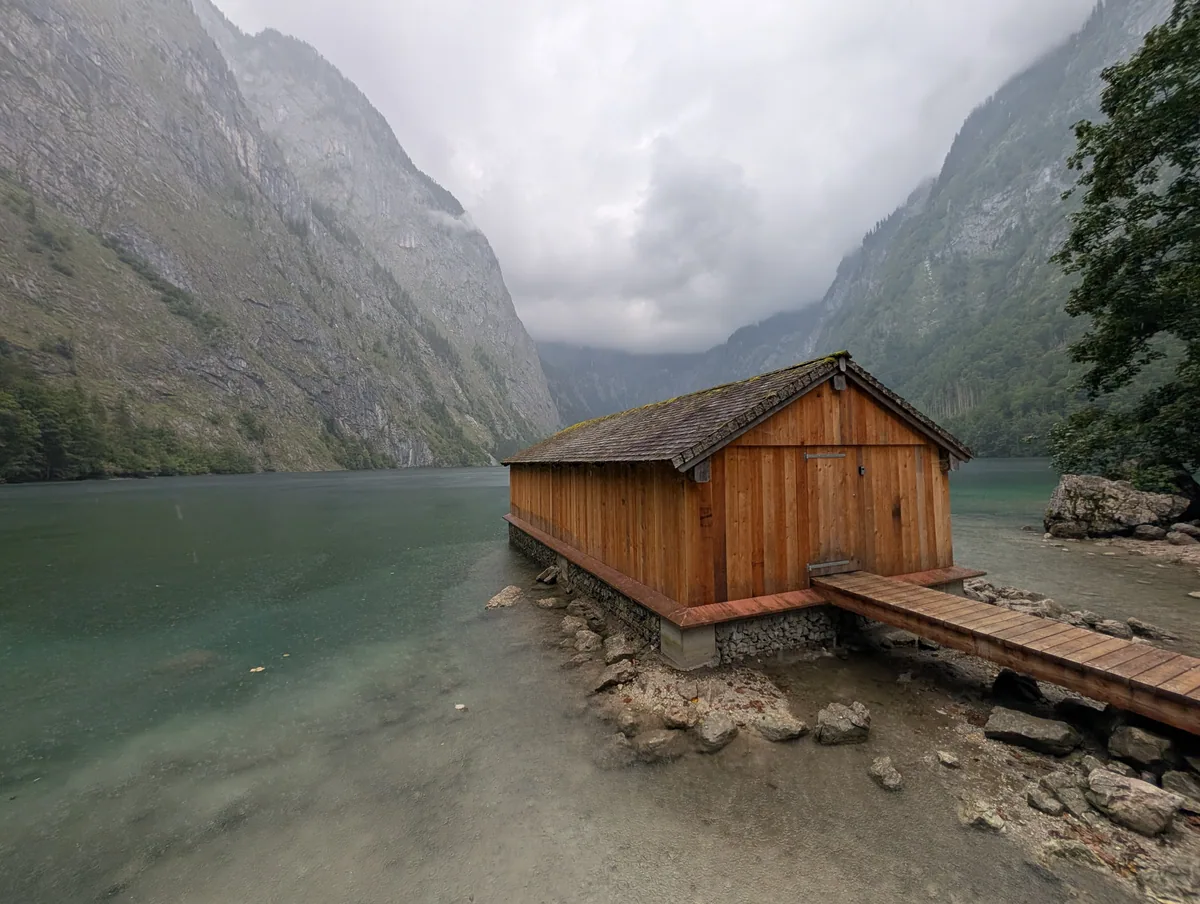
You’ll recognise it straight away: a wooden hut set on a stone base, half in the water, with a little jetty. It’s on the north shore, you come across it about fifteen minutes after Salet, impossible to miss.
A quick clarification while we’re at it, because it causes confusion: there are two of them. This one, and a second at the far end of the lake, about a hundred metres from the Fischunkelalm, which belongs to the national park administration. People often confuse the two photos and wonder why they didn’t find “the right one”.
And above all, it’s no longer grey! Every photo you’ll find searching for “Obersee” shows charcoal-grey wood, weathered by decades of damp. It has since been completely re-clad: the planks are pale, almost orange, and the jetty is new too. Only the shingled roof, still covered in moss, betrays the old hut. So if you turn up expecting to find the grey hut of the postcards, you may be in for a surprise.

The trail to the Fischunkelalm
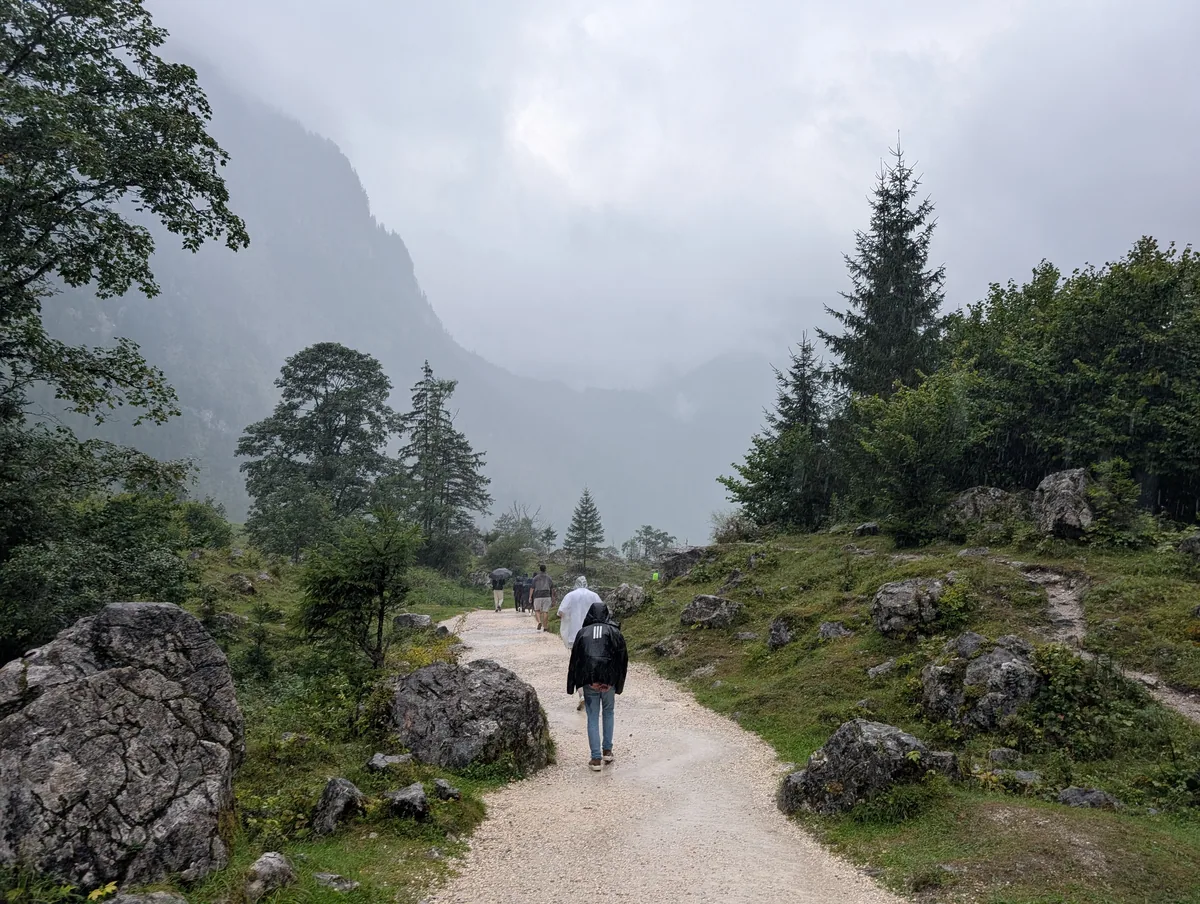
From the boathouse, allow another thirty minutes or so along the shore to reach the Fischunkelalm, a mountain pasture at the far end of the lake.
I would genuinely have loved to do it, but once we reached the Obersee we got caught in a proper downpour, so off we went, back to the boat!
The pasture itself, by reputation, I really do recommend. The chalet was rebuilt in 1840 in the style of the one that had burned down, cows graze there in summer, and fresh milk and alpine cheese are served. It is one of the few places in the park where you can still see mountain farming genuinely at work.
The Röthbach waterfall, the highest in Germany
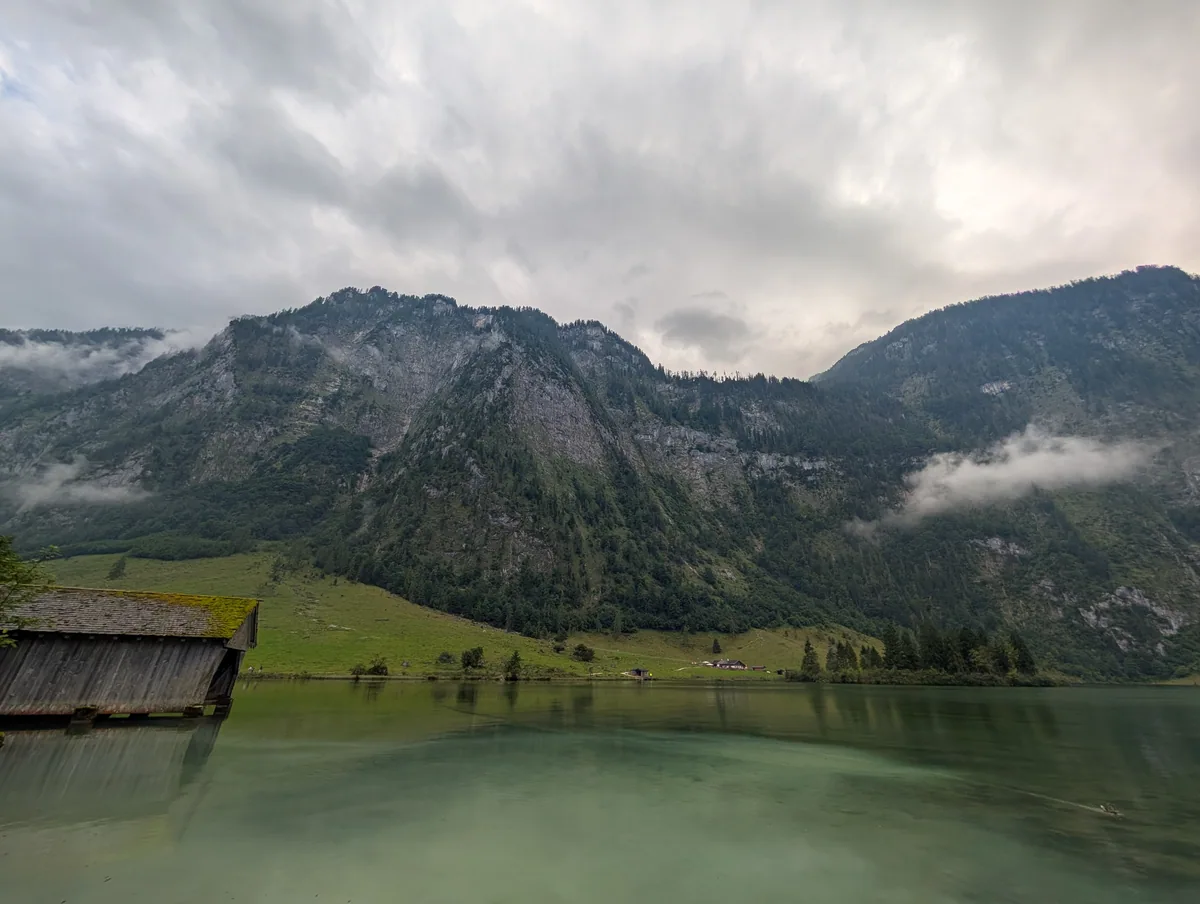
Another quarter of an hour beyond the Fischunkelalm and you are at the foot of the Röthbachfall: a drop of around 470 metres, the highest waterfall in Germany.
One word of advice all the same: come in spring or after a good spell of rain. In a dry August it shrinks to a rather disappointing trickle, whereas in June with the snowmelt it is an altogether different spectacle.
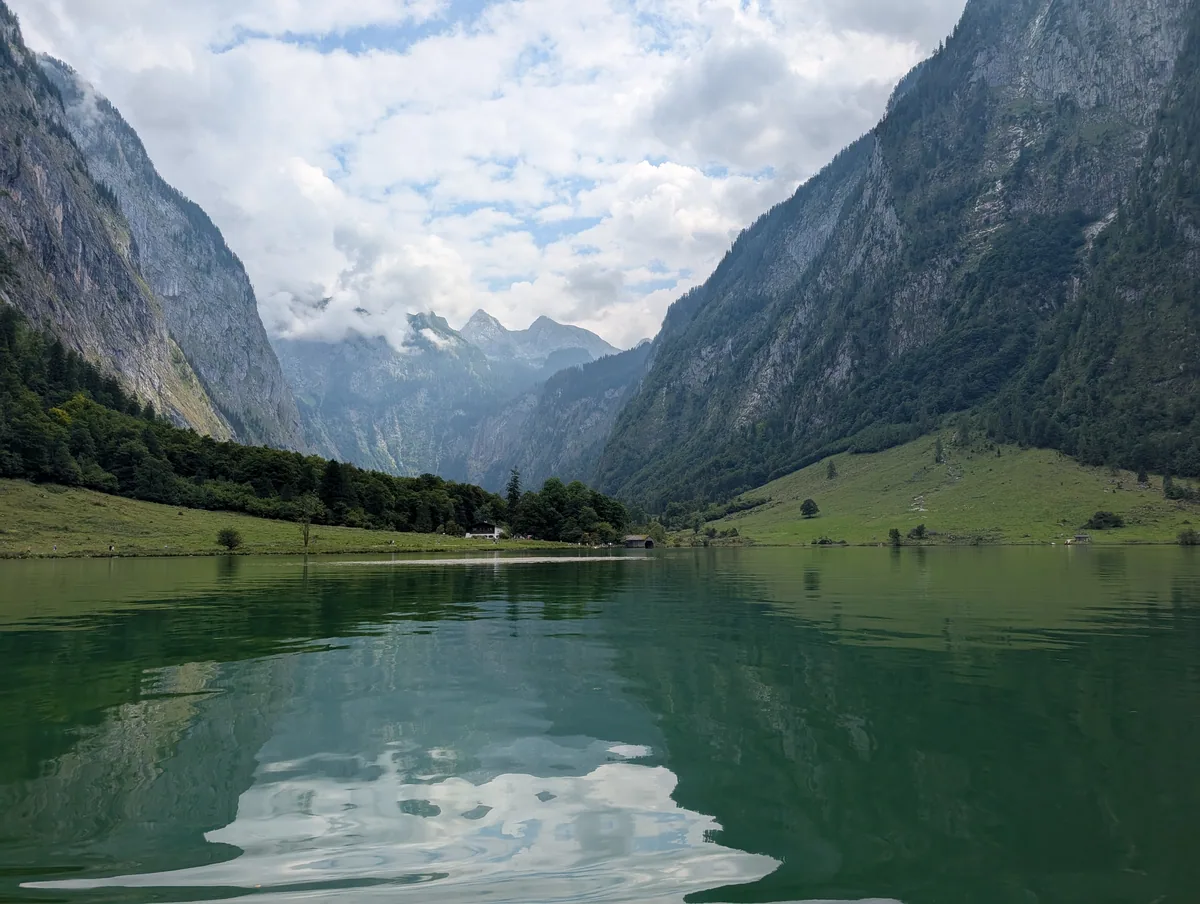
Going up the Jenner to see the lake from above
The Jenner is the mountain that towers over the boat landing, and its cable car drops you at 1,800 metres in about twenty minutes. From up there you see the lake along its whole length, with the Watzmann opposite. And I find it is by far the finest overall view of the Königssee.
| Adult | Aged 6-17 | |
|---|---|---|
| One-way up | 35.00 € | 22.00 € |
| Return | 47.00 € | 28.00 € |
The family return fare (2 adults and their children aged 6 to 17) is 109.00 €. First ascent at 8.30am, last ascent at 4.40pm.
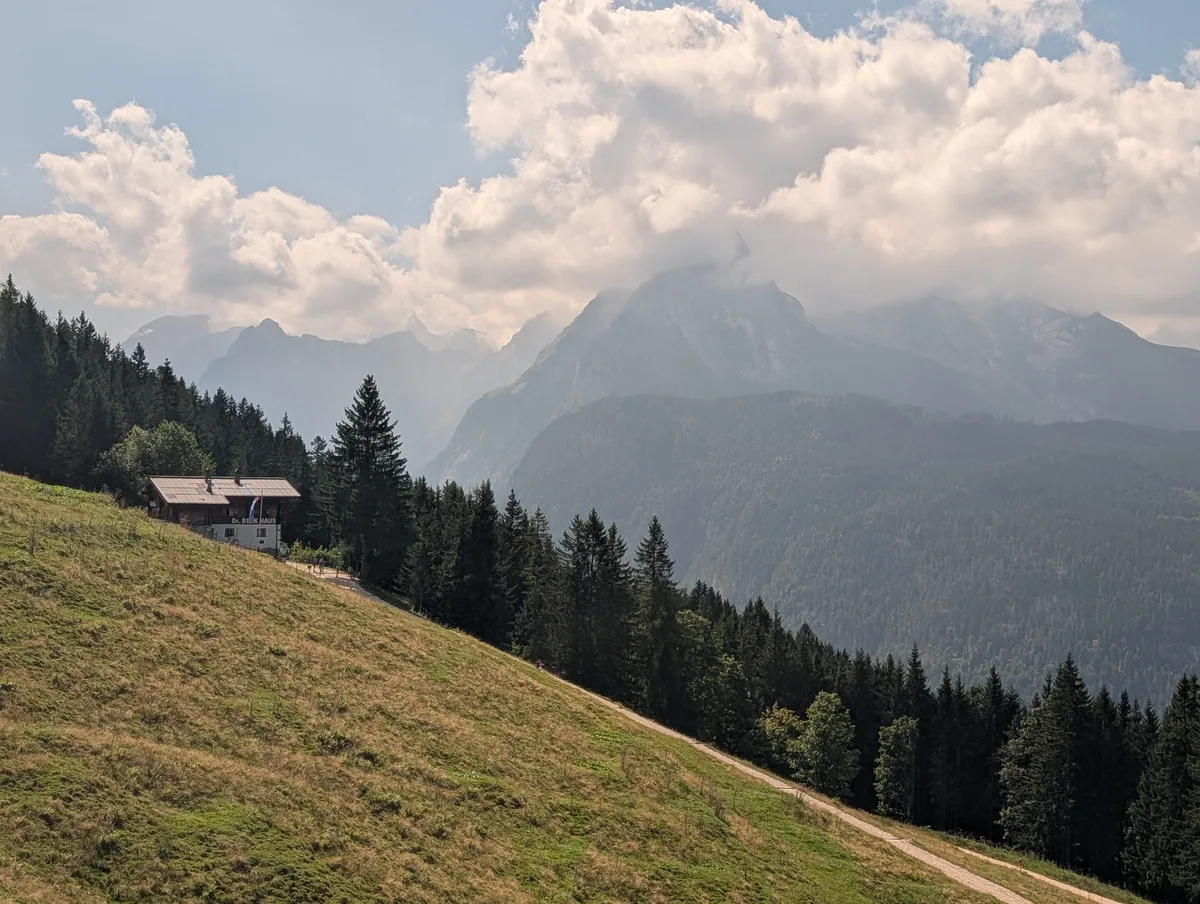
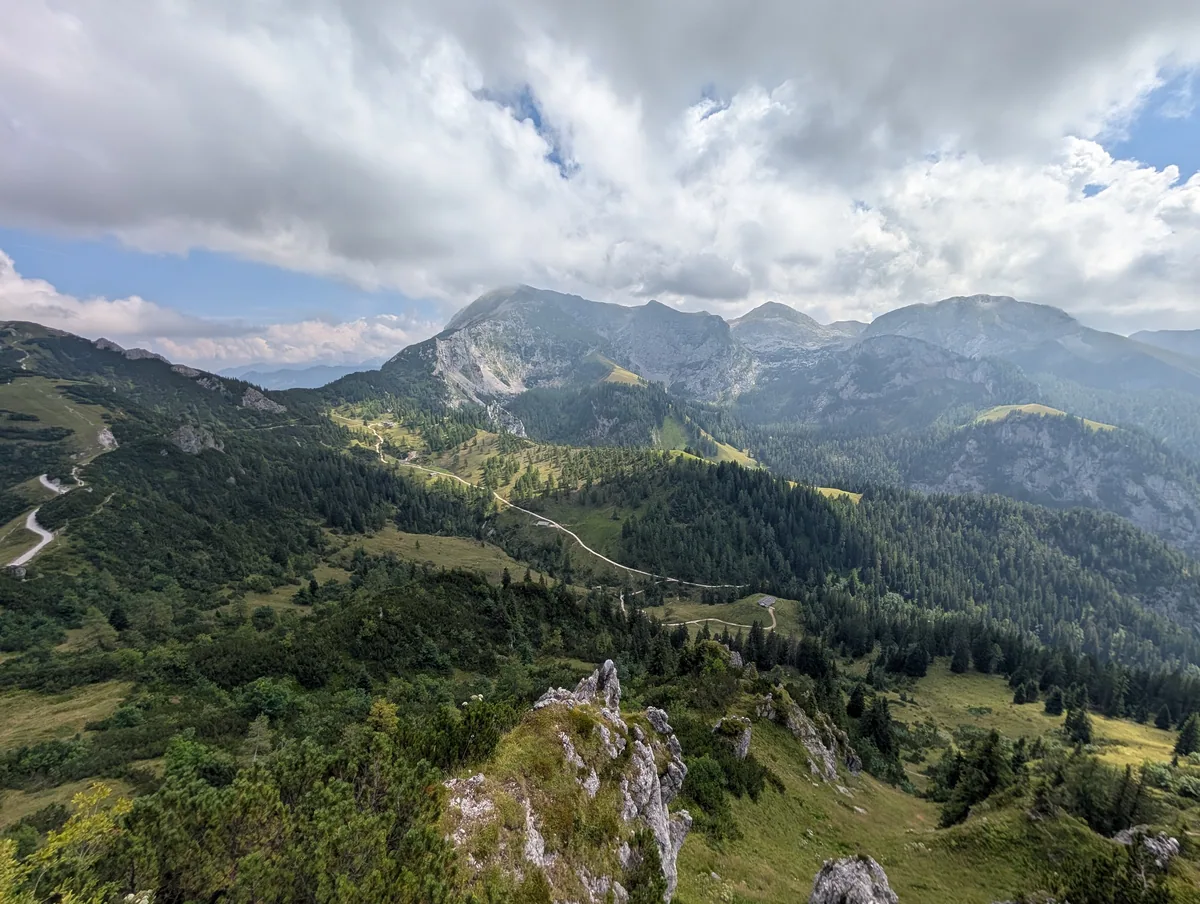
The combined See-Gipfel-Ticket
There is a combined boat-and-cable-car ticket, the See-Gipfel-Ticket, at 56.00 €. It covers the crossing to St. Bartholomä and the full return trip on the Jennerbahn.
The maths is quickly done: 23.40 € plus 47.00 € comes to 70.40 € separately. So you save 14.40 €, and the voucher stays valid for six months.
But be careful: it is only sold from 1 January to 30 June and from 15 September to 31 December. In high summer, from 1 July to 14 September, it is not available. So if you come in August, forget it.
What is forbidden in the Königssee national park
A short section, but it saves you fines.
Strictly forbidden: private boats, canoes, kayaks, stand-up paddleboards, inflatable mattresses and any personal floating craft. Only the official shuttle boats are allowed on the water.
I insist on the kayak because the question comes up a lot: there is no kayak hire on the Königssee, and putting your own on the water can cost you dearly: the rangers patrol all year round, early in the morning as well as late in the evening, and they hand out fines.
Also forbidden: drones, bivouacking and camping (including on the Salet, Kessel and St. Bartholomä headlands), fires, picking plants, and leaving the marked trails. Dogs are allowed but must stay on the lead.
Swimming, on the other hand, is permitted! The best spot is just below the bobsleigh track, a little meadow at the water’s edge that is easily reached from the car park. You can also swim over on the St. Bartholomä and Salet side, keeping an eye out for passing boats. The water sits between 16 and 20 °C in summer, exceptionally 22. I should warn you, it is bracing!
How to get to the Königssee
By car, and where to park
The main Königssee car park (P1) is a five-minute walk from the boat landing. 273 spaces, 62 electric charging points at 11 kW powered partly by solar, and free toilets.
| Car | Motorbike | Motorhome (P2) | |
|---|---|---|---|
| Up to 1 hr | 3.00 € | 2.00 € | — |
| Up to 3 hrs | 7.00 € | 4.00 € | — |
| 24 hrs | 9.00 € | 5.00 € | 25.00 € (10 € for 8 hrs) |
Payment by card, in coins or via the Parkster app. And worth knowing: the car park only charges from 7am to 7pm; after that, it is free.
The Hammerstiel and Hinterbrand hikers’ car parks are cheaper (3 €, 5 € or 6 €) and open 24 hours a day, but they are further from the lake.
One warning all the same: in July and August, the P1 is full by around 10am. So arrive before 9am, or take the bus.
By public transport
And here there is something rather good.
If you are staying in Berchtesgaden, Schönau, Bischofswiesen, Ramsau or Marktschellenberg, your host hands you a Gästekarte. It gives you completely free travel on the RVO buses, including the line that serves the Königssee.
Three points that make it far more useful than it looks:
- It is valid from your day of arrival right through to your day of departure inclusive. So you can use it to get there, not just once you are settled in.
- It covers the regional network of Upper Bavaria, almost as far as Munich.
- Since 2023, it also includes the train from Berchtesgaden to Salzburg via Bad Reichenhall.
In other words, if you are sleeping in the area, leave the car at the hotel! You save 9 € in parking and you spare yourself the hunt for a space.
Without accommodation in the area, from Munich allow 2 hours 30 by train to Berchtesgaden and then the bus, or 1 hour 50 by road. From Salzburg, 33 minutes by car, it is the closest base.
Where to stay near the Königssee
Three possible approaches.
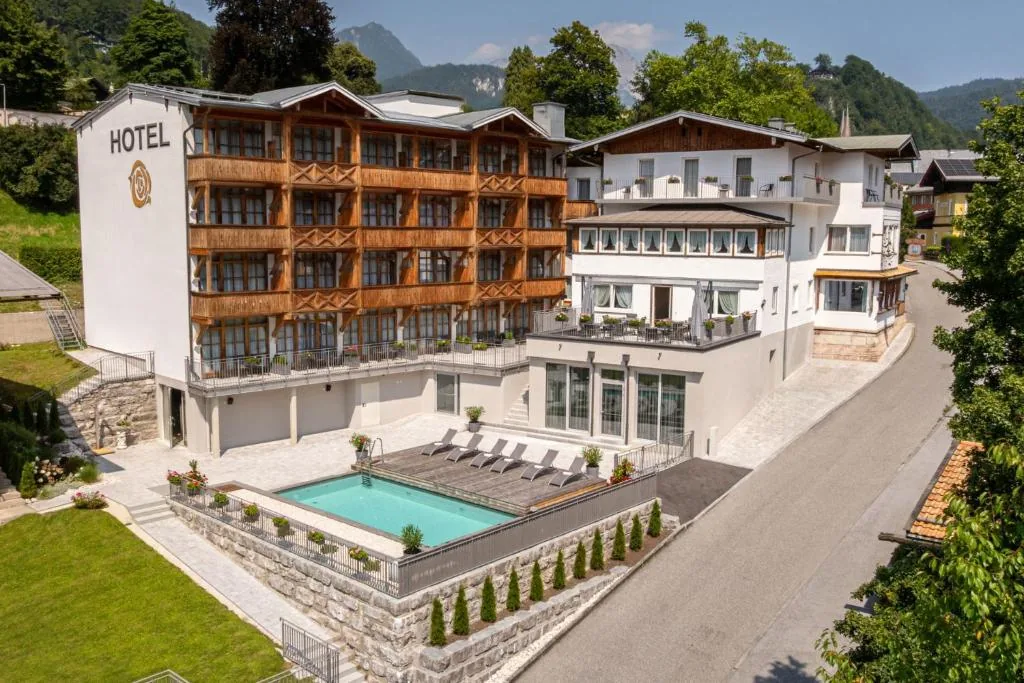
Schönau am Königssee is the village on the lakeshore. You are within walking distance of the boat landing, you catch the first boat with no effort, and you have the lake to yourself in the evening once everyone has left. It is my choice if you are only staying one night.
Berchtesgaden, ten minutes away, offers far more choice, more restaurants and more shops. It is the best base if you are staying three or four days and heading out across the region: Eagle’s Nest, Hintersee, Ramsau, Salzburg.
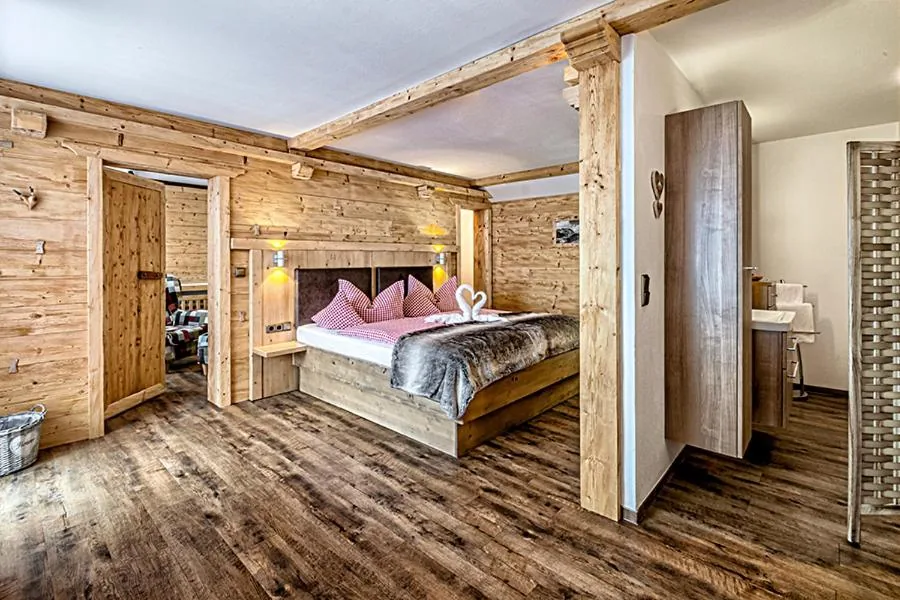
Finally, there are the two unusual options I mentioned: the rooms at the Gasthaus of St. Bartholomä on the headland, reachable only by boat, and the Kärlingerhaus refuge at 1,638 metres for those heading up to the Funtensee.
A typical day at the Königssee
Two versions, depending on the time you have.
The full day, with Salet and the Obersee, which is to say the right way to do it:
- 7.45am — arrive at the car park, Salet return ticket
- 8.00am — first boat, you are almost alone
- 8.50am — step off at Salet, walk to the Obersee
- 9.30am — the boathouse, with no one in front of you
- 10.15am — the Fischunkelalm, then the Röthbachfall
- 12.30pm — back to Salet, boat to St. Bartholomä
- 1.00pm — lunch facing the lake
- 3.00pm — a walk round the headland and the pebble beach
- 4.30pm — back to Schönau, with the afternoon light on the rock faces
And the half day, with St. Bartholomä on its own: first boat, two hours there, back around midday. Then the afternoon at the Malerwinkel or on the Jenner.
In every case, one single rule: the first boat. At 8am you have the lake, at 11am you have the crowds. It really is the difference between a lovely day and a day spent queuing.
Combining the Königssee with the rest of the region
The Königssee fits into a single day. But the rest of the region deserves three or four!
Twenty minutes away, the Hintersee and its enchanted forest, smaller, more intimate, superb at the end of the day. The Eagle’s Nest and the Dokumentation Obersalzberg, to be done in that order and not the other way round; I explain why elsewhere. Berchtesgaden and its salt mine. And Salzburg, half an hour’s drive away on the other side of the border.
It is all set out in my complete guide to the Bavarian Alps, with a one-week itinerary.

FAQ: your questions about the Königssee
Do you need to book the boat tickets?
You don’t have to, but you can: the official online shop sells tickets for departures from the Seelände, and with an online ticket you go straight to the pier. It doesn’t remove the wait to board in high season, so arrive early anyway.
How much time should you allow?
A whole day if you go up to Salet and the Obersee. Half a day for St. Bartholomä on its own.
St. Bartholomä or the Obersee if I only have three hours?
St. Bartholomä without hesitation, it is closer and the boat trip is shorter. But if you have the whole day, the Obersee is more beautiful.
Can you swim in the Königssee?
Yes, swimming is permitted. The best spot is below the bobsleigh track, and the water sits between 16 and 20 °C in summer. SUP, kayaks and private boats, on the other hand, are forbidden.
Do the boats run in winter?
Yes, from 12 October to 23 April, with a first departure at 9.45am. But Salet is only served part of the year, so there is no Obersee in winter: the boat stops at St. Bartholomä. There is no service on 24 December either. We went in February and it is a superb experience, there is no one about!
Does the lake freeze? Can you walk on it?
Very rarely, and no. The last complete freeze goes back to 2006, for 29 days. Don’t count on it.
When is the last boat?
It depends on the season. In high season, the last return from Salet is at 5.40pm and from St. Bartholomä at 6.00pm. Outside high season, 5.10pm and 5.30pm respectively. Be at the boat landing an hour beforehand.
Is it accessible by pushchair or wheelchair?
The boats and St. Bartholomä, yes. The path from Salet to the Obersee is flat and wide on the first stretch. The trail to the Fischunkelalm, however, is not. And travel is free for people with disabilities, as well as for their companion if the card carries the mark “B”.
Can you bring a dog?
Yes, 5 € on the boat, muzzle compulsory, and lead throughout the park.

How much does the day cost?
Around 110 to 125 € for a couple with lunch there, and 85 € for a family of four with a picnic.
Can you walk right round the lake?
No. The rock faces drop straight into the water along almost the entire shoreline, and the boat is the only way to reach St. Bartholomä and Salet.
Can you visit on a day trip from Salzburg or Munich?
From Salzburg very easily, it is 33 minutes away. From Munich it is doable but long: 1 hour 50 by road each way. And if you don’t want the hassle, go through an agency, it will be far simpler! And on top of that it is usually combined with a visit to the Eagle’s Nest. Two examples just below.


What is the best time to avoid the crowds?
The first boat of the morning. It is the only honest answer I can give you!
Conclusion
The Königssee is one of those places that genuinely lives up to its promise. The water really is that colour, the silence on the boat is real, and the Obersee in the morning mist remains one of our finest memories of Bavaria.
What it asks of you is just a little preparation. The right ticket, the Salet one. The first boat. And an eye on the time of the last return.
Do those three things and you will have a day you remember for a long time. Enjoy your visit!