Last updated on
I’ll be honest about this one: I wasn’t looking for this ferry. I was driving up from Paris to Tromsø, it was late in the evening, and I was convinced I was heading for a bridge further north than the Øresund Bridge. I ended up in front of a ferry terminal in Helsingør. Genius, me.
Because I hadn’t prepared at all, I didn’t know the timetables (are there ferries at night?), the prices, how to pay… in short, total improvisation.
I got on board anyway. And honestly, it was the best thing that could have happened to me that evening.
Because this boat does something the Øresund Bridge doesn’t: it drops you 60 km further north, at Helsingborg, exactly where the E4 begins, the road that runs all the way up Sweden. If you’re headed for Lapland, northern Norway or just Stockholm, you’ve just spared yourself the detour via Malmö.
The crossing takes 20 minutes. There’s a departure every 20 minutes during the day, and it runs 24 hours a day. There you go, you know almost everything. The rest is the prices, the night-time timetables and the two or three things I’d have liked to know before turning up at the ticket desk with nothing prepared.
⛴️ The Helsingør – Helsingborg ferry in brief
- Duration: 20 minutes, for 4 km of sea
- Frequency: up to one departure every 20 minutes during the day, around fifty a day in total — it also runs through the night, but more spaced out
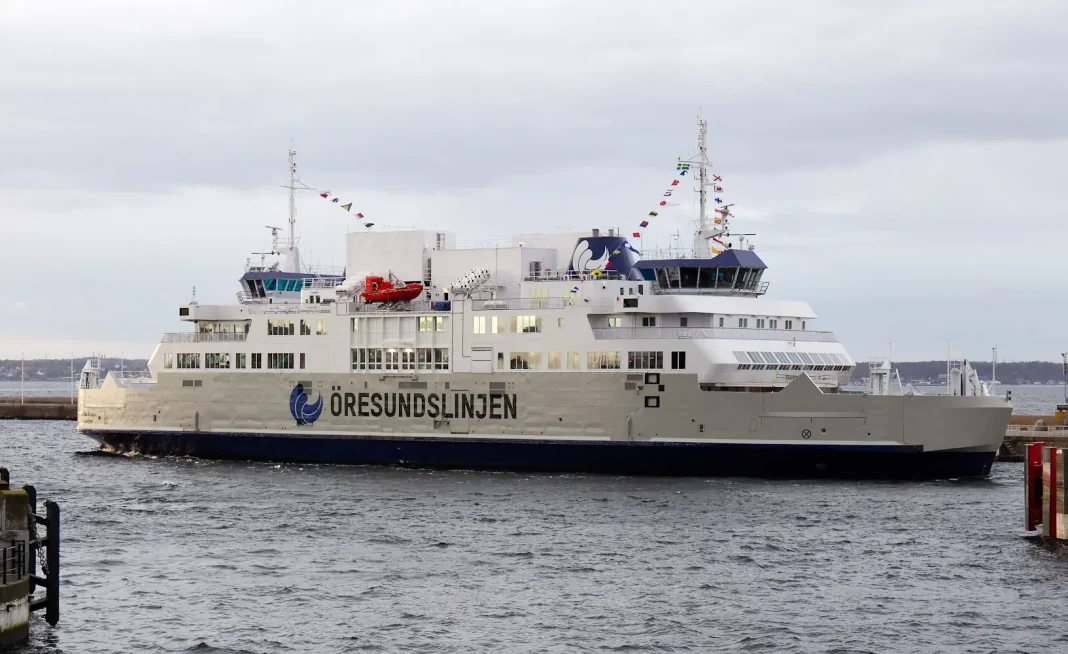
- Company: Öresundslinjen (formerly ForSea), the only car operator on the route
- Car fare: from 199 DKK (~€27) on the web fare, passengers included — but ~460 DKK (~€62) if you pay at the desk
- Booking: not compulsory, never full for a car… but booking halves the bill
- The real appeal: you land 60 km further north than with the bridge, right at the start of the E4
Why take the ferry rather than the Øresund Bridge
Both take you from Denmark to Sweden. They don’t drop you in the same place, and that’s the whole point.
The Øresund Bridge starts from Copenhagen and arrives at Malmö. Perfect if you’re coming from the airport, from central Copenhagen, or if you’re heading down to southern Sweden.
The ferry leaves from Helsingør, 45 km north of Copenhagen, and arrives at Helsingborg. And Helsingborg is kilometre zero of the E4, the motorway that runs all the way up Sweden to Haparanda, on the Finnish border. The E6 towards Gothenburg and Oslo also passes through here.
In other words: if you’re heading north, the bridge takes you down to Malmö only for you to then drive 60 km back up along the coast. The ferry drops you straight in the right place.
My verdict: north of Copenhagen and heading north, it’s the ferry, no hesitation. To the south, or if you’re leaving from Copenhagen airport, take the bridge — there’s no sense in driving 45 km the wrong way just to catch a boat.
The drawback you have to accept, and it’s a real one: the ferry forces a break in your journey. You slow down, you queue, you board, you switch off the engine, you drive back off. On paper it’s a 20-minute crossing; in real life reckon on 40 to 50 minutes between the moment you leave the road and the moment you rejoin it. On the bridge, you never lift your foot off the pedal.
That said, a 40-minute forced break after eight hours of driving isn’t exactly a punishment.
Seen on a scale map, the argument becomes obvious: the crossing is 4 km where the bridge is 16 km, and above all the two don’t drop you at anything like the same latitude.
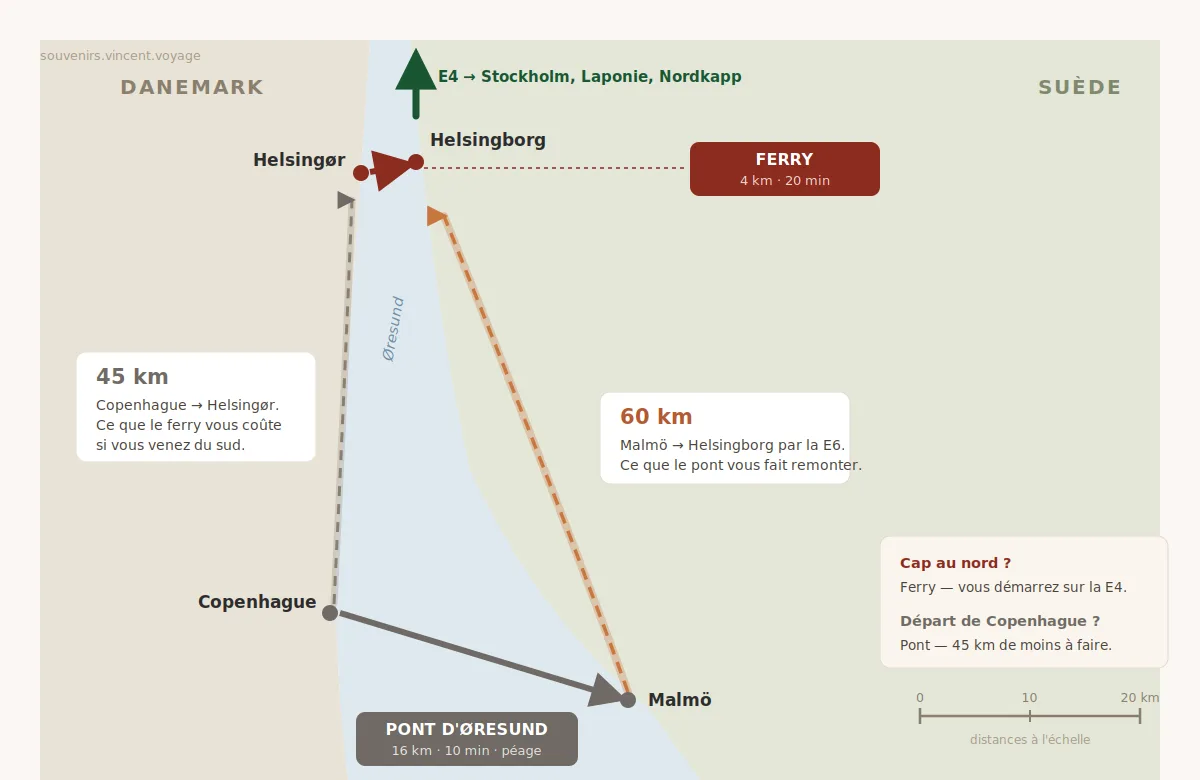
The two crossings to scale: 4 km for the ferry, 16 km for the bridge — and 60 km of road between the two arrival points.
On the way back, I did exactly the opposite — and it was deliberate. We were coming back down from Tromsø towards Paris via Oslo, then the whole Swedish coast along the E6. In other words, we arrived right at Helsingborg: the ferry was there, on our route, and it was clearly the fastest option.
We still carried on to the Øresund Bridge, just to see what it looked like. It cost us about thirty minutes and a toll. No regrets, the structure is worth the detour once in a lifetime — but if you don’t have that curiosity to satisfy, the map above tells you what to do.
What are the timetables for this ferry
This is the killer argument for this route. It’s also the only place where I had a real moment of doubt.
- During the day: up to one departure every 20 minutes in each direction
- Over 24 hours: around fifty crossings, which works out at a real average of roughly one every 27 minutes
- At night: it doesn’t stop, but it thins out — there are indeed departures at 1am, 2am, 3am and 4am, simply more spaced out
In practice, you don’t have a timetable to remember. You arrive at the terminal, and the next boat leaves in under 20 minutes. It’s one of the busiest sea crossings in the world: Öresundslinjen reports more than 6 million passengers and 1 million cars a year, plus 410,000 lorries.
The moment I started wondering. I arrive at Helsingør late in the evening, I pull into the boarding lane… and there’s not a single car. Not one. Hard not to wonder whether you’re waiting for a boat that won’t come until morning. Answer: it does come. The route never stops. But a deserted terminal in the evening isn’t reassuring at all, and nothing on site tells you the next one leaves in twenty minutes.
One important constraint: some night departures — 2.40am Tuesday to Saturday, 3am on Sunday and Monday — are dangerous-goods rotations, with restricted passenger capacity. They appear on the timetable, but they aren’t necessarily open to you. If your crossing falls in the middle of the night, check it on the day itself on the company’s website rather than trusting the “24 hours a day”.
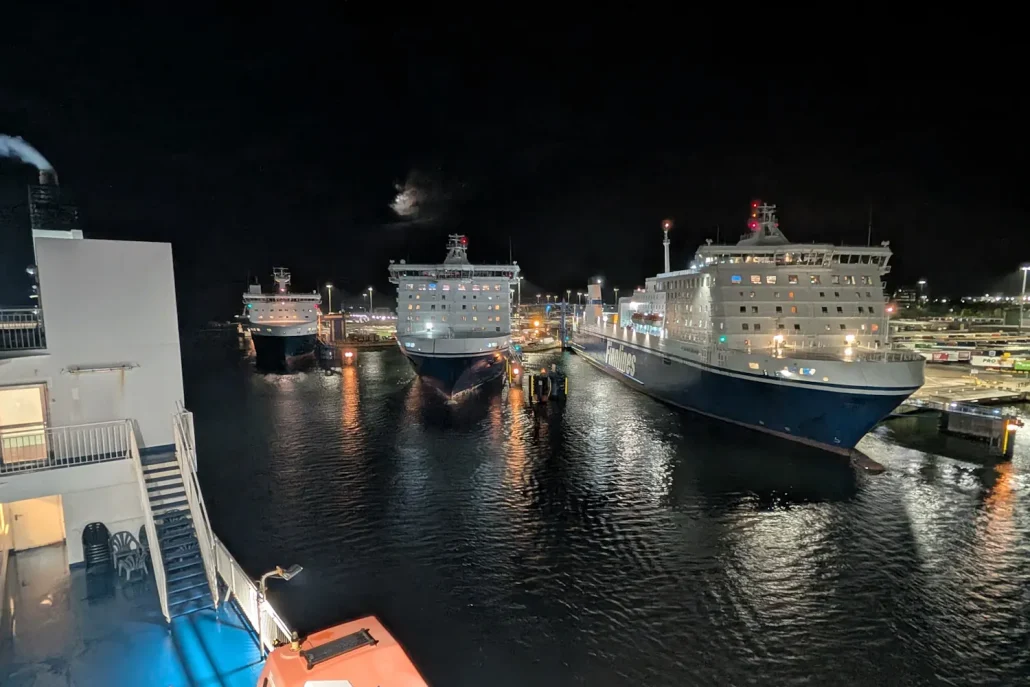
A word on the fleet, because it’s rare enough to be worth mentioning: the company operates five vessels, of which the three largest run on batteries. So there’s a good chance your crossing will be electric, with no diesel engine noise. Over 20 minutes, you notice it.


How much does the Helsingør – Helsingborg crossing cost?
Here are Öresundslinjen’s official fares, recorded in August 2026, for a one-way trip. Prices are shown in Danish kroner (DKK), with the conversion for guidance only.
| Web fare (Lavpris) | Standard fare / desk | |
|---|---|---|
| Car < 6 m (passengers included) | from 199 DKK (~€27) | ~460 DKK (~€62) |
| Motorhome up to 10 m | from ~420 DKK (~€56) | higher, charged by length |
| Motorbike | from ~119 DKK (~€16) | ~245 DKK (~€33) |
| Adult foot passenger | from ~45 DKK (~€6) | ~56 DKK (~€7.50) |
Three things to remember, and the first one is worth money.
1. The car fare includes all passengers. Unlike many ferries, you don’t pay for the vehicle and each person on board. A car with four people in it pays the price of a car. With four of you, the crossing works out at under €7 a head on the web fare.
2. The gap between booking ahead and paying on the spot is huge. 199 DKK against around 460 DKK — that’s more than double for exactly the same boat. That’s where your budget is decided, nowhere else.
3. The difference is flexibility. The Lavpris ticket is non-refundable and ties you to a departure, with a tolerance of about an hour either side of the time. The Standard ticket is flexible over roughly 8 hours and refundable. On a route that leaves every 20 minutes, the one-hour tolerance is more than enough.
Also worth knowing: the 2026 high season runs from 1 June to 31 August, with the rest of the year in low season. And if you make the trip often, Öresundslinjen sells multi-trip car cards that go as low as 159 DKK per crossing (~€21) from 35 trips, valid for a year. For a holiday return trip, it’s of no interest. For a cross-border commuter, it is.
Conversions given for guidance only (1 DKK ≈ €0.134): check the current rate. And fares move — the simplest thing is to compare the current timetables and prices on Direct Ferries.
Do you need to book in advance?
Technically, no. You can turn up at the terminal with no ticket, pay, and board the next departure. That’s exactly what I did, late at night, with nothing planned — I was expecting to take a bridge, let me remind you.
It worked, but I really do recommend booking.
Two reasons. The first is the price: paying at the counter costs more than double the online fare. On a 20-minute crossing, getting stung for €35 just because you didn’t plan ahead stings a little.
The second is the pointless stress. When you’re driving through a country you don’t know in the dead of night, the question “are there still any ferries running at this hour?” nags at you for miles. Having a ticket on your phone puts that to rest. The boat runs 24/7 anyway, but you only find that out afterwards.
My advice, and it’s clear-cut: book, even the day before, even an hour ahead. You get the online fare, you know exactly when you’re boarding, and all you have to do is drive.
The downside of booking: you commit to a time slot. If you’re the sort who runs three hours behind on their road-trip schedule, get the Standard flexible ticket or buy on the spot — it’s dearer, but that’s what it’s for.
Good news all the same: on this route, a car never gets left on the quay. With around fifty departures a day, finding space isn’t the issue it would be on a long-distance ferry.
The two terminals
On the Danish side: Helsingør
The terminal is right next to Helsingør station, on the seafront, just outside the town centre. Car access is signposted from the main road.
And if you have an hour to spare, Kronborg Castle is right there, a few minutes’ walk away. It’s Hamlet’s castle, a UNESCO World Heritage Site, planted on the headland facing Sweden. Honestly, it’s well worth the detour if you’re passing through in daylight.
On the Swedish side: Helsingborg
The terminal is Knutpunkten, and it’s a fairly rare case: the port, the railway station and the bus station are all in the same building, right in the town centre. You step off the boat and you’re in the town.
For cars, the terminal exit puts you straight onto the roads towards the E4 (north and Stockholm) and the E6 (Gothenburg and Oslo).
The downside: at Helsingborg, the terminal exit brings you out in the middle of town, with traffic lights and traffic. It’s not a motorway toll gate — allow a few minutes to reach the main roads.
What to do on each side of the strait?
A twenty-minute crossing means you can easily fit in a visit on one side and set off again from the other straight afterwards. And it just so happens there’s a castle on each shore.
I came through late in the evening, so needless to say I saw none of it. If you cross in daylight, don’t do the same.
Kronborg, Hamlet’s castle (Danish side)
This is the big one, and it’s a ten-minute walk from the Helsingør terminal. Kronborg is the 16th-century Renaissance fortress set on the headland, facing Sweden, listed as a UNESCO World Heritage Site. It’s also Shakespeare’s Elsinore: this is where he sets Hamlet.
You can visit the state rooms, the great banqueting hall, and above all the casemates beneath the castle, dark and vaulted, where the statue of Holger Danske sleeps. The ramparts look out over the strait, and from there you can watch the ferries go by every twenty minutes.
The entry ticket starts from €20, rated 4.5/5 from 279 reviews, with free cancellation up to 24 hours before. You can book it in advance here, which saves you the counter queue in summer.
The downside to accept: it’ll cost you at least two hours, and more like three if you do the casemates. On an already long day’s drive, that’s not nothing. And if you’re coming for Hamlet, be aware the connection is purely literary — Shakespeare never set foot there.

Kärnan and Sofiero (Swedish side)
On the Helsingborg side, it’s more modest but quicker to do.
Kärnan is the medieval brick tower overlooking the town centre, a few minutes from the terminal. It’s the last remnant of the Danish stronghold that held the strait before Scania became Swedish. You climb up and get the view over the Øresund and Kronborg opposite. It’s short, it’s good, and it slots neatly into a lunch break.
Sofiero is the other option, 5 km north of the town. A former royal summer residence from 1865, with a 15-hectare park and above all 10,000 rhododendrons in 300 varieties planted across two ravines. It’s open from 8 April to 24 September, from 10 am to 6 pm.
The downsides, and they’re real: Sofiero is closed for more than six months of the year, and outside the rhododendron bloom — the peak is May–June — you’re visiting a pretty park, nothing more. You also need a car; it’s not walkable from the port. As for Kärnan, don’t expect a castle: it’s a tower, and there are steps.
A word of honesty about bookings: on the Danish side, Kronborg can be booked online without any trouble. On the Swedish side, there’s no equivalent — tickets for Kärnan and Sofiero are bought on the spot or on the Helsingborg tourist office website. Don’t try to line it all up in advance; that option doesn’t exist.
You’ll find plenty to do either around Stockholm or towards Gothenburg.

Staying on one side of the strait or the other
There are two good reasons to break the drive here rather than press on: taking the time to sightsee, or catching the ferry first thing so you start the day with hours ahead of you.
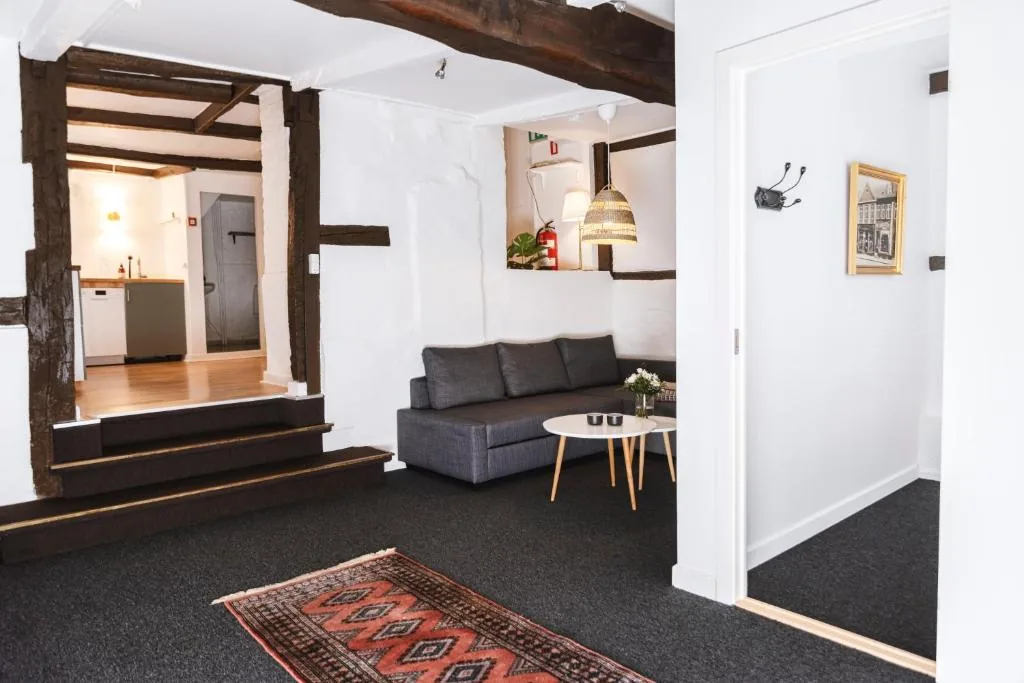
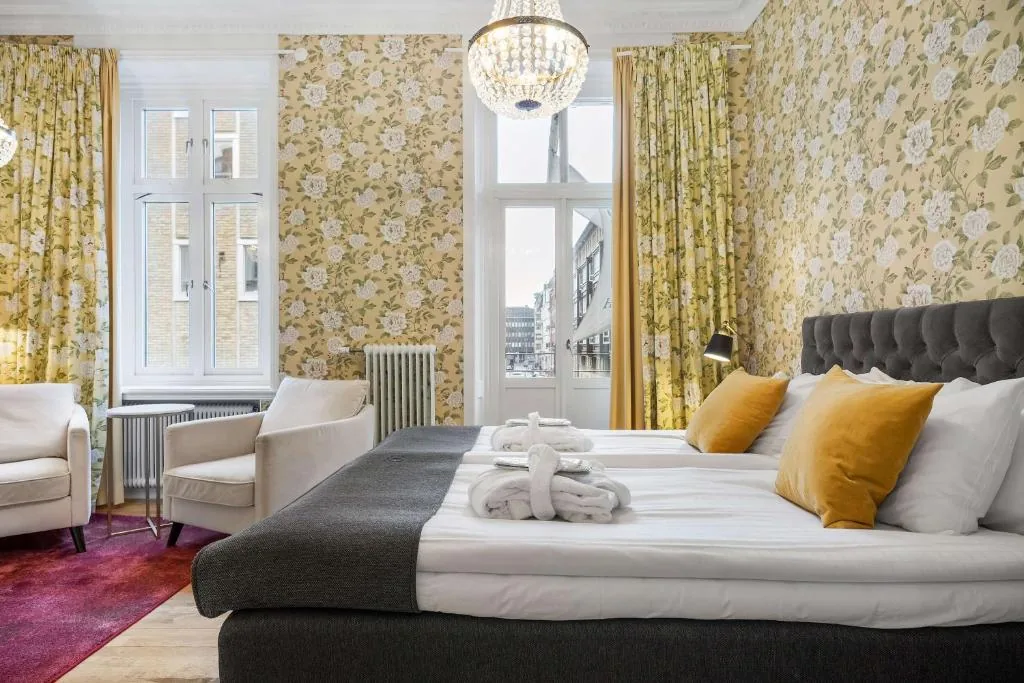
On the Danish side, if you want to do Kronborg at your leisure or board first thing: the Hotel Hamlet — yes, it has just the right name — is a stone’s throw from the Helsingør terminal and a few minutes’ walk from the castle. A 3-star in the old town, on Bramstræde, which is by far the nicest spot to stay here. In the morning you drive five minutes and you’re on board.
The downside: Helsingør is a small town. The evenings are quiet, so don’t count on it for a night out.
On the Swedish side, to visit Helsingborg or simply catch your breath after the drive: the Hotell Linnéa, lovely, close to both the terminal and the town centre, and at reasonable rates for Scandinavia — which is no small thing in these parts.
The downside: it’s the opposite of the previous one. You’re in town, so there’s life to it, and how quiet it is will depend on the room.
My advice, and it follows straight from the map above: if you’re heading north, cross in the evening and sleep on the Swedish side. You save yourself the morning crossing and set off straight onto the E4. If you’re heading back down towards Copenhagen, do exactly the opposite.
Frequently asked questions about the Helsingør – Helsingborg ferry
How long does the crossing take?
20 minutes port to port, for 4 km of sea. With boarding and disembarking, allow 40 to 50 minutes between leaving the road and getting back on it.
Does the ferry run at night?
Yes, all year round and with no overnight break: there are departures at 1 am, 2 am, 3 am and 4 am. The frequency simply eases off compared with the 20-minute intervals during the day. Two night slots (2.40 am and 3.00 am depending on the day) are reserved for freight with limited passenger capacity: check on the day itself if you’re relying on them.
Do you need to book?
It’s not compulsory — a car can always find space. But the online fare starts at 199 DKK when the counter fare is around 460 DKK: booking, even an hour ahead, halves the bill.
Are passengers included in the price of the car?
Yes. The vehicle fare covers all occupants, which makes the crossing very good value with three or four people.
Ferry or Øresund Bridge?
The bridge links Copenhagen to Malmö, the ferry links Helsingør to Helsingborg, 60 km further north. If you’re driving towards northern Sweden or Norway, the ferry saves you the loop via Malmö. If you’re coming from Copenhagen airport or heading south, take the bridge.
Can you cross on foot or by bike?
Yes, and it’s very cheap: from around 45 DKK (~€6) for a foot passenger. Both terminals sit right next to a station, so the crossing links up easily with a train on either side.
Which company operates the route?
Øresundslinjen, the former ForSea, the only operator for vehicles. It runs five ships, the three largest of which are battery-powered.
In conclusion
This ferry isn’t an attraction, it’s a shortcut. 20 minutes, a departure every quarter of an hour or so, and you disembark 60 km further north than the bridge, right at the start of the E4.
What I took away from my crossing: book online, even at the last minute, because the gap with the counter fare is outrageous. And go up onto the outer deck instead of staying in the car — 20 minutes goes by very fast, so you may as well watch them.
If you’re planning a long drive north, I’ve laid out the other stages of the route here:
- Crossing the Øresund Bridge — the full fare table, the electronic toll tags and the bridge / ferry / train comparison
- The Rødby – Puttgarden ferry — the other short crossing on the route, between Germany and Denmark
- Taking the ferry to Norway — all the crossings from Denmark, Germany and Sweden
- Taking the ferry in Norway — how it works once you’re there, payment and timetables
- What to do in Tromsø — the end of the road, and the reason for the whole trip
If you’re still torn between the bridge and the boat, just look at where you’re going next. That’s the only criterion that really matters. And if you have a question about the route, don’t hesitate to get in touch!